![Integral [+] Facticity](https://substackcdn.com/image/fetch/$s_!yhcJ!,w_120,h_120,c_fill,f_webp,q_auto:good,fl_progressive:steep/https%3A%2F%2Fbucketeer-e05bbc84-baa3-437e-9518-adb32be77984.s3.amazonaws.com%2Fpublic%2Fimages%2Ff8458843-3278-4fcc-accc-17ad21352205_1280x1280.png)

Abstract
My brother Jason died of leukemia on April 30, 1983. I was five years old. The questions that death set in motion — about family recovery, intergenerational loss, and what it costs when no adequate help ever arrives — have been mine for forty-three years. They are also, as it turns out, three of the twelve frontier domains William White identified in his 2024 NIDA keynote as the questions recovery science most urgently needs to answer.
This essay is the origin story of the Metapattern Institute’s IACT research program and an argument about what is at stake when people in recovery gain access to tools that give them a real shot at intellectual participation. Drawing on White’s coproduction imperative, Catherine Racine’s autoethnographic exposure of clinical dehumanization, and Christopher Poulos’s methodology for investigating family secrecy, I argue that AI gives the recovery community something it has never had: the cognitive infrastructure to generate the longitudinal, coproduced, process-level evidence the field needs — from the inside, by the people living it. The institutional response is already visible. When Yascha Mounk used AI to produce a paper in two hours with fabricated citations and declared the humanities about to be automated, he handed every institutional gatekeeper a weapon. The recovery community has never been welcomed into public life on its own terms — anonymity has always been encouraged, because the stigma attached to mental health and substance use problems has made visibility itself a risk. Now the tools that could finally change those terms are being used to protect institutional power by shaming people in recovery into silence.
This essay is written for the recovery science community, for anyone who refuses to accept that answer, and for my brother.
Tags: Jason Haines, Recovery Science, William White, Slaying the Dragon, Recovery Rising, Bill Stauffer, Recovery Review, Frontiers of Recovery Research, Thomasina Borkman, Experiential Knowledge, Coproduction, Catherine Racine, Autoethnography, Levinas, Clinical Dehumanization, Christopher Poulos, Accidental Ethnography, Family Systems, Intergenerational Recovery, Adverse Childhood Experiences, Guy Du Plessis, Integral Recovery, Yascha Mounk, AI-Assisted Research, Cognitive Orthotic, Medium-as-Disqualifier, Steven Hayes, ACT, Hexaflex, Psychological Flexibility, IACT, Integral Facticity, Enactive Fallibilism, Evan Thompson, Charles Sanders Peirce, Integral Epistemological Pluralism, Ken Wilber, Integral Theory, Jürgen Habermas, Jacques Maritain, Integral Humanism, Fred Dallmayr, Richard Bernstein, Canadian Philosophy, Leslie Armour, George Grant, Marc Lalonde, Concordia University, Albert Low, Zen, Prosocial, Elinor Ostrom, Michael Brooks, Cosmopolitan Socialism, Lacan, Martin Heidegger, Facticity, Treatment-Resistant Depression, Medical Leave, Caregiving, Open Access, Metapattern Institute
On March 1, 2026, Bill Stauffer posted a compilation on the Recovery Review blog — the full list of interviews from the Frontiers of Recovery Research series, alongside the oral histories from the first national meeting of the New Recovery Advocacy Movement in Saint Paul, Minnesota, in 2001. Fifteen interviews with the people who built modern recovery advocacy in America, and six more working through the frontier domains that William White had identified in his 2024 keynote for the Consortium on Addiction Recovery Science at NIDA. The most recent was an interview with Caroline Beidler on the future of family recovery as a coproduced collaborative process.
I read through the list. I re-read the William White interview — “The Coproduction of a Recovery Evidence Base on the Frontiers of Future Recovery Research,” conducted by Stauffer and published in November 2025. And something crystallized.
I’ve known White’s work for years. I’ve carried the questions he’s asking for most of my adult life. What crystallized reading through Stauffer’s compilation was that AI has given the recovery community something it has never had before: the infrastructure to actually produce the evidence White says the field needs. And with that realization came another: the institutional gatekeepers — the credentialing hierarchies, the bourgeois academic elite, the professional class that has always controlled who gets to produce legitimate knowledge about recovery — are not going to help. They are going to try to shut it down.
My relationship with White’s work goes back years. In October 2018, White published “A Canadian Perspective on Recovery Advocacy” on his blog — a short essay I’d written on the emergence of recovery advocacy in Canada. White rarely posts guest blogs; he introduced my piece as important to share with his readers. The following year, I expanded the argument in “We the North: Rethinking Addiction & Recovery in Canada” (November 2019), tracing the growing divide between harm reduction, addiction treatment, and recovery advocacy movements across Canada. Those two essays were the beginning of a thread that has run through everything since — the attempt to situate Canadian recovery within a broader intellectual and political context. What I didn’t yet have was the methodology or the infrastructure to pursue what that thread demanded.
White has worked in the addictions field since 1969. The vision he articulates in that interview — and in the 2024 paper that underpins the series — is of a recovery science that can no longer be conducted on people in recovery from outside. It must be coproduced with them. The evidence base for the next generation of recovery research requires experiential knowledge — the kind that comes from living through something and reflecting systematically on what you’ve learned. White draws on Thomasina Borkman’s 1976 concept: experiential knowledge as a legitimate epistemological category, not a lesser form of knowing that needs clinical validation to count.
He identifies twelve frontier domains. Three of them stopped me cold.
Does the recovery of a parent affect the recovery prospects of their children?
What are the dynamics of family recovery?
What does recovery look like across the lifecycle?
I need to tell you why those three questions have been mine since 1983. To do that, I need to tell you about my brother.
The Origin
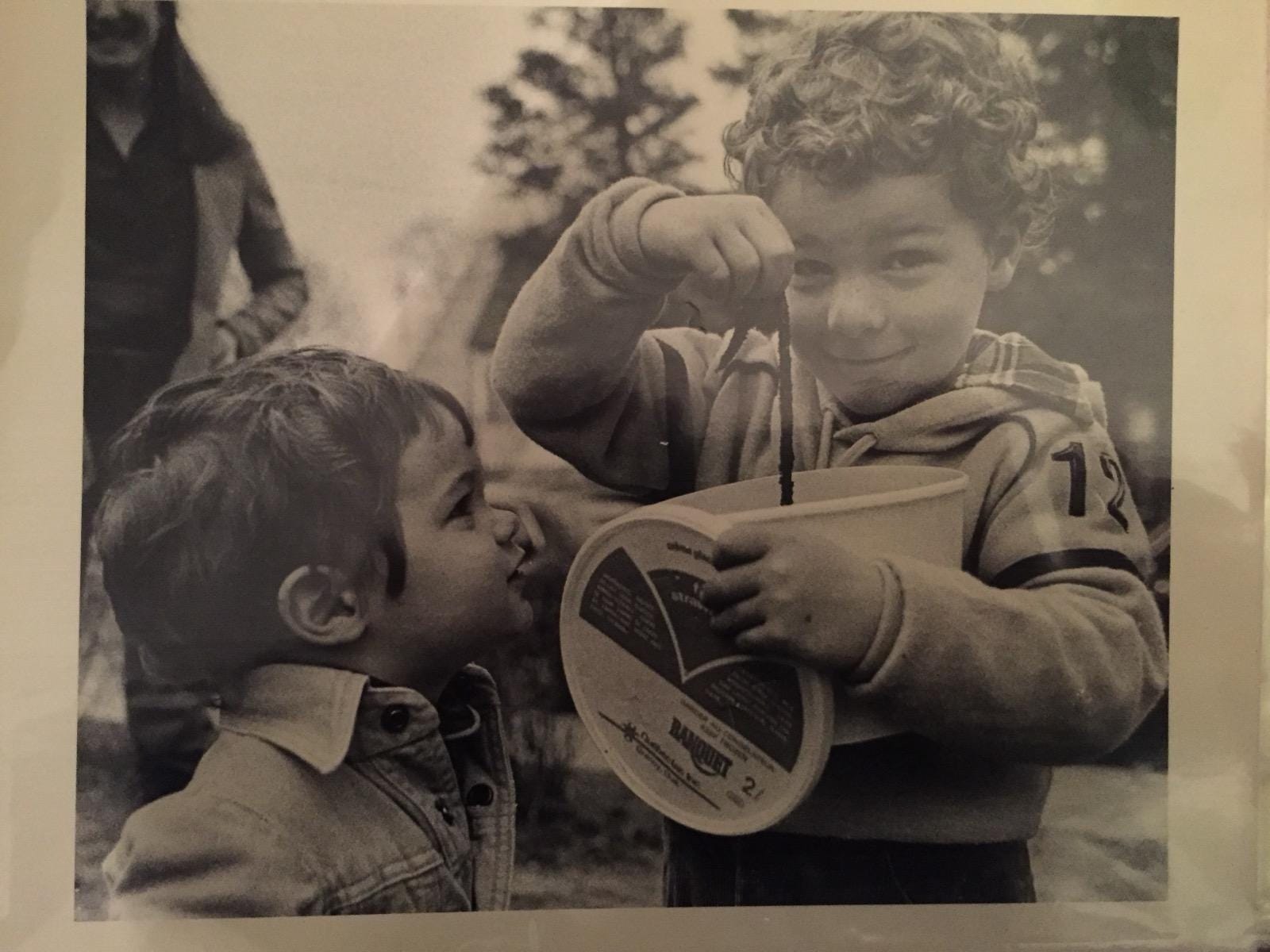
The photograph at the top of this essay is the one I keep coming back to. Two boys outdoors, black-and-white — the older one with a head of curly hair, wearing a sweatshirt with the number 12 on it, grinning as he holds up a repurposed ice cream bucket and pulls something out of it with his other hand. The younger one in a light jacket, leaning in close, looking up at his brother with his whole body. An adult — barely visible — stands behind them. You can see it in the younger boy’s posture: he is completely captivated. The older boy knows it and is showing off for him.
The older boy is my brother, Jason. I’m the one looking up at him. We were catching worms together in the yard.
My brother died of leukemia on April 30, 1983. I was five years old. He was older than me. What I’ve spent my life trying to understand are the consequences of losing him.
My parents separated in 1988. Both of them came from very difficult family backgrounds — what the research literature calls adverse childhood experiences, the accumulation of early-life trauma, neglect, household dysfunction, and unresolved grief that compounds across generations and shapes everything from physical health to relational capacity to the ability to cope with further loss. Their marriage was strained from the beginning. My father’s family, my mother’s family — the trauma didn’t start with my brother’s death. It started generations earlier, and it accumulated in ways nobody had the language or the support to address. When my brother died, it didn’t create the fracture. It broke open fault lines that were already there, running deep through both sides of the family. What followed was decades of what families go through when the centre doesn’t hold: mental health struggles, substance use, financial instability, relationships strained past their capacity to bear the weight.
I’m not going to inventory the damage. If you’ve lived through family collapse, you know what it looks like from the inside. If you haven’t, no inventory will make it real for you.
What I will tell you is what happened when people in my family — including me — tried to get help.
Catherine Racine is an independent Canadian scholar who wrote Beyond Clinical Dehumanisation towards the Other in Community Mental Health Care: Levinas, Wonder and Autoethnography (2021). Racine uses autoethnography to interrogate what happens to vulnerable help-seekers inside the community mental health system. Her argument is devastating and precise: the dominant discourse reduces persons to metrics, the clinical gaze strips the humanity from both the person seeking help and the clinician providing it, and the institutional structure produces what she calls — drawing on Levinas — the defilement of the vulnerable help-seeker. The system doesn’t just fail to help. It actively dehumanizes the people who come to it in need.
I know this from the inside. Not as an academic studying dehumanization. As a person who has experienced it — at every turn, across decades, in every system I’ve entered seeking help.
I struggled with substance use. I struggled with my mental health. I struggled in school — family crises interrupted my time at Concordia repeatedly, and I ended up on academic probation before graduating. At every point where I turned to institutional systems for support — the mental health system, the recovery system, the educational system, and now the insurance system — what I encountered was some version of what Racine describes: the reduction of a whole person to a diagnostic category, a case number, a metric to be managed. Not malice. Something worse: a structural incapacity to see the person standing in front of them.
My father experienced it. My friends in recovery experienced it. I’ve watched people I care about — people doing the hardest work of their lives, trying to hold themselves and their families together — get processed through systems that cannot see them. The clinical gaze that Racine interrogates is not an abstraction. It is the look on the face of the intake worker who has fourteen minutes to assess a human life. It is the insurance company that stops paying because the paperwork doesn’t reflect their categories. It is the institutional machinery that requires you to perform your suffering in specific, legible ways in order to receive help — and then treats the performance as the condition.
I’m experiencing it right now. I’ve lived with treatment-resistant depression for years — depression that compounded decades of family difficulty and loss until my body could no longer sustain the corporate work that was keeping the lights on. In October 2025, I went on medical leave. Two months later, my insurance coverage was interrupted. I’m in an appeal. Meanwhile, my father — who has ataxia, neurological damage from years of alcohol use, and deteriorating kidneys — is living with me because the Quebec healthcare system cannot provide him adequate care right now, and we don’t have the money for private treatment. So the person whose biology has been compromised by decades of unaddressed family difficulty is now the primary caregiver for a father whose own body has been broken by the same lack of support — because neither of them, nor the family as a whole, ever received the care they needed. And the system that is supposed to support us through this is itself a source of institutional stress that compromises our capacity further.
This is not a grievance. It is what the philosopher Martin Heidegger called facticity — the brute, irreducible conditions of a life that you didn’t choose and can’t argue your way out of. I use the term throughout this essay and throughout my work because it names something essential: there are facts about your situation — your body, your family, your material circumstances, the systems you depend on — that no amount of positive thinking or institutional compliance will change. You can only work within them or be broken by them. And these conditions are data. Racine would recognize it. White would recognize it. Anyone who has been on the receiving end of institutional care that cannot see the person it’s supposed to serve would recognize it.
I will be forty-nine years old this year. I’ve been carrying this since 1983 — forty-three years, my whole conscious life.
And for twenty-eight of those years, I’ve been trying to find frameworks adequate to what happened — to my family, to me, to anyone who has lived through catastrophic loss and then been dehumanized by the systems that were supposed to help them heal.
In 1998, my father handed me Ken Wilber. I was twenty-one, recently out of CEGEP after a football injury and years of family instability. Wilber’s integral theory was the first framework I encountered that tried to hold psychology, philosophy, spirituality, and human development in a single coherent architecture. It didn’t fix anything, but it gave me a map. The detail that matters: my father — a man with an M.A. in Counseling, a man carrying his own adverse childhood experiences, his own history with alcohol, his own devastation at burying a son — handed the surviving son tools to make sense of suffering. That transmission, father to son, in the wake of everything, is the origin of the integral thread in my work. As I’ve argued in “Can the Real Wilber Please Stand Up?”, my engagement with Wilber goes through and beyond his AQAL framework by drawing on European-Canadian philosophical traditions that most integral practitioners don’t engage. But it starts with my father.
My path didn’t lead straight from Wilber’s work to academia. Instead, it involved a decade of inquiry, driven by the mystery of my family’s story, through every tradition that seriously addressed the question of loss. Significantly, the process of recovery predated my time way before I ever returned to school and university.
In 2002, I began studying Zen Buddhism under Albert Low at the Montreal Zen Center. Sitting, sesshin, koan work — genuine spiritual practice with a teacher who took both the contemplative tradition and the Western intellectual context seriously. As I documented in “Albert Low & Zen at War”, Low represented something rare: a Zen teacher who had done the hard philosophical thinking about what contemplative experience means within a Western frame. Under his guidance, I had spiritual openings that reconnected me to my Catholic roots and forced me to reckon with a question I hadn’t expected: what is the relationship between the contemplative experience I’m having in this zendo and the faith tradition I was baptized into?
But the contemplative work was happening alongside a family crisis, not instead of it. My father’s mental health was deteriorating. His relationship with alcohol was worsening. The financial instability that had followed my parents’ separation was deepening. I was watching, from the inside, the intergenerational pattern that this entire research project would eventually try to document.
In 2004, everything converged. My mother and stepfather were in the twelve-step recovery movement, and through them I started attending Al-Anon meetings. There I met Terrence Cashion, who became my twelve-step sponsor — a relationship that would last eighteen years, until his death in 2022. Through Al-Anon and the recovery community around St-Anthony of Padua Parish, I met Stephen K. Sims, Fr. Paul Geraghty — the chaplain at the Children’s Hospital — and Tom Hutchinson, who directed the Whole Person Care program at McGill University. Sims was a Loyola College graduate — the institution that became Concordia, the university I would later attend — who had taught in Montreal, India, and Australia before devoting his life to pastoral care and community service. He directed Spera, Benedict Labre House, the McConnell Meditation Centre, and the Parish of St. Anthony of Padua in Little Burgundy. He published three books — River of Awareness, The Wisdom of Authenticity, and The Noble River — and ran dialogue circles and workshops until his death in April 2023. This was the ground: a community of people who understood what family systems do when they break, who had lived through it themselves, and who were trying to build something that held.
I came into recovery through my family. My family was in crisis and I needed help making sense of what was happening — to my father, to my mother, to me. The twelve-step framework gave me a community and a practice. Cashion gave me accountability and patience. Sims gave me friendship. And the parish community gave me something I hadn’t found anywhere else: a space where suffering was taken seriously and the person suffering was not reduced to a case number.
The spiritual openings under Low in 2005 and 2006 deepened the question rather than answering it. I was wrestling with what to trust. I’d had experiences I couldn’t easily sort — some contemplative, some chemical, some rooted in the faith I was raised in — and I couldn’t always tell which was which, or what any of it had to do with who I actually was. How do you hold all of that in a single life without flattening any of it, or mistaking one kind of experience for another? That question drove me back to school.
In 2006, I enrolled at Concordia University in Applied Human Sciences and Religious Studies. Through Marc Lalonde I encountered Jürgen Habermas, Charles Davis, Gregory Baum, George Grant, and Jacques Maritain. As I’ve written in “Critical Theology & Integral Humanism”, Lalonde’s central scholarly question — can religious insight survive Habermas’s post-metaphysical critique? — became my question. Not as an abstract intellectual exercise but as a lived one: I was sitting in Zen retreats, attending Mass, reading Habermas, working with my sponsor, and trying to hold it all together in a life that kept coming apart. Through Davis and Lalonde I found the critical theology lineage. Through Grant — as I explored in “Lament for a Nation” — I found the Canadian diagnostic: the question of what happens to nationalism, religion, and the human capacity for meaning inside a technological civilization that dissolves all particularity. Through Maritain I found integral humanism — the tradition of Catholic social thought that insists on the full development of the human person against every reduction.
In 2016, a second recovery turn. Albert Low died. I discovered Guy Du Plessis’s work on integral recovery and started corresponding with William White on the Canadian recovery movement. At Du Plessis’s suggestion I began attending NA, taking up the question of my own relationship with substances as the inquiry deepened — what recovery means had become inseparable from the larger research question. Goddard College sat at the back of my mind through all of it: White took his M.A. there, my father studied there, and Francis X. Charet — whom I interviewed on episode sixteen of my podcast — did work there too. The same Vermont college kept turning up, with no obvious reason to.
In 2017, I read Richard Bernstein and Fred Dallmayr, and the concepts crystallized: Integral Facticity — all development happens within irreducible conditions the person didn’t choose; Enactive Fallibilism — drawing on Evan Thompson’s enactivism and Charles Sanders Peirce’s fallibilism, the principle that when systems cause suffering, the systems are falsified, not the body. That second concept — the systems are falsified, not the body — is what Racine is saying in philosophical ethics and what White is saying in recovery science. The relationship between people and institutions is never simple, and I don’t mean that institutions are the villains and individuals the innocents. I mean that when a system consistently produces suffering in the people it’s meant to serve, the right response is to question the system’s design, not the people failing to fit it. Too often the burden runs the other way: the person is asked to bend toward the bureaucracy — to become legible to its categories, to perform their need in the forms it recognizes — when the system could instead be built to meet people where they actually are.
Throughout all of this — from the late nineties through to the present — I was working to survive. Odd jobs at first, then the dot-com boom hit Montreal and I rode it into IT. Over fifteen years in the industry — telecommunications, managed services, systems administration, knowledge management. That experience is how I know what infrastructure looks like, how systems scale, how to build something that holds under pressure. When I went back to school, I worked at the YMCA and at Concordia University to get through — jobs that kept me close to community and education while I finished the degree. After graduating, I returned to IT and financial services to support myself. The podcast — twenty-one episodes, seventeen guests. And losses. Michael Brooks died suddenly in July 2020 — the political commentator and democratic socialist intellectual whose vision for cosmopolitan left politics had become central to my own political thinking. Brooks’s most famous principle — be ruthless to systems, and kind to individuals — is the ethical posture that runs through everything I’ve written since. His death restructured the trajectory: the podcast exists, in part, because Brooks died and I needed a form for the kind of dialogical engagement he modelled. Cashion — my sponsor since 2004 — died of heart complications in 2022. Eighteen years of support, gone. Stephen Sims died in April 2023 — the man who had given me friendship and community since 2004, who had spent his life building the kind of spaces where suffering was taken seriously and the person suffering was not reduced to a case number. Mishaun States died that same year — a friend in recovery in Montreal whose experience with the institutional systems that were supposed to help him mirrors what Racine documents in her book. The system did not hold him. The system was not designed to hold him.
Losses are not incidental to this work. They are structurally constitutive. Each one restructured the research trajectory. The podcast exists because Brooks died. The autoethnographic turn exists because the body carrying these losses through corporate work finally couldn’t sustain it. Low, Cashion, Sims, States, Lalonde — each death is a falsification event that redirected the work. Not metaphorically. Literally. The conditions changed, and the research had to change with them.
In August 2023, my father was hospitalized with an acute kidney injury — a consequence of his own history. He came to live with me. A relationship that had been ruptured since around 2016, when I started doing my own recovery work and the relational dynamics between us became unsustainable, has begun to heal. He is seventy-eight. His kidneys are damaged. I make him breakfast every morning, file his taxes, manage his medical care. The man who carries his own intergenerational wounds and gave me the intellectual tools to understand them is now living with me while I document the healing.
In October 2025, I went on medical leave for treatment-resistant depression. In January 2026, my insurance was interrupted. I am caught in a double bind that anyone in recovery will recognize: I am at the mercy of an institutional system that has the power to determine whether I receive support, and that system’s categories do not map onto the reality of my condition. I cannot work. I cannot earn income. And every piece of intellectual output I produce in public risks being interpreted as evidence that I am not actually disabled — because the institutional logic cannot hold the possibility that a person with treatment-resistant depression might also, with the right infrastructure, find hope, healing, and a renewed sense of purpose.
That infrastructure is AI. In February 2026, I published ten essays — approximately ninety-seven thousand words across twenty-eight days — the most sustained and rigorous output of my life. I produced it while appealing my insurance, while caregiving for my father, while navigating the very systems whose failure I was documenting. AI did not replace my thinking. It made my thinking possible again. It gave me the cognitive scaffolding to express what I have been carrying for forty-three years — the questions, the frameworks, the losses, the slow accumulation of understanding — at a level of rigour and consistency that my biology alone can no longer sustain.
What does this mean for the recovery community? It means that the tools now exist for people in recovery — people with compromised capacity, people without institutional backing, people whose bodies and material conditions have historically excluded them from sustained intellectual work — to produce the kind of coproduced evidence that White says the field desperately needs. The question is whether the institutional stakeholders who control the credentialing hierarchies will support this, or whether they will do what they have always done: protect their power and try to shame people in recovery into silence.
This is the origin. Everything that follows — the methodology, the AI architecture, the case studies — is built on what you have just read.
The Coproduction Imperative
White’s larger vision is a shift from what he calls “version 1.0” of recovery systems — treatment-centric, pathology-oriented, modelled on acute care — to “version 2.0,” where recovery is understood as a community-transmissive process and treatment is one tool among many. Recovery capital — the internal and external resources a person draws on to initiate and sustain recovery — becomes the central construct. The recovery community itself is the field site, not the clinical setting.
The Frontiers of Recovery Research series that Stauffer has been building around White’s 2024 NIDA keynote demonstrates this shift in action. Mark Sanders on the cultural coproduction of recovery science. David Best on social transmission of recovery as connectivity rather than service checklist. Jason Schwartz on definitions and measurement. Michael Flaherty on recovery management within recovery-grounded systems of care. Caroline Beidler on family recovery as a coproduced collaborative process. Each interview operationalizes a different facet of White’s twelve frontier domains. Each insists that the next generation of recovery evidence requires partnership between researchers and the communities whose lives generate the data.
White insists that this coproduction must meet three criteria for authentic recovery representation. Adequacy: not a token voice but genuine participation in the production of knowledge. Authenticity: no double agentry — the person’s recovery identity is not instrumentalized for commercial or institutional purposes. Diversity: non-standard pathways represented alongside the dominant models.
White’s emphasis on coproduction carries specific historical weight. He documents how the recovery field, as it professionalized in the mid-twentieth century, systematically devalued experiential knowledge in favour of clinical expertise. The people who knew the most about recovery — the people who had done it — were displaced from the production of knowledge about their own condition. Borkman’s 1976 intervention was to name experiential knowledge as a legitimate epistemological category — knowledge that comes from living through an experience, reflecting on it, and sharing what you’ve learned with others who face the same situation. The field is only now catching up, and White argues that the frontiers of recovery research cannot be reached without it.
The critical point: my autoethnographic methodology is the most radical form of the coproduction White calls for. The researcher is the subject. The family system is the field site. And the AI infrastructure is what makes it possible for a person with compromised cognitive capacity to maintain the rigour that legitimate research demands.
The Autoethnographic Ground
I’ve already introduced Racine’s work in the context of the dehumanization I’ve experienced firsthand. But Racine is not only a diagnosis of institutional violence — she’s a methodological argument. Her use of autoethnography demonstrates that the researcher’s own experience inside broken systems produces knowledge that no external study can generate. The clinician who documents her own moral injury inside community mental health care sees what the outcome study cannot see. The person seeking help who documents the experience of being reduced to a case number generates data that the intake form was designed to exclude.
Two other books shaped the methodological frame I’m working within.
Christopher Poulos’s Accidental Ethnography: An Inquiry into Family Secrecy (2009, reissued by Routledge in 2018) and Essentials of Autoethnography (American Psychological Association, 2021). Poulos is Professor and Department Head of Communication Studies at UNC Greensboro — an ethnographer and philosopher of communication who has spent his career developing autoethnographic method as a way of investigating what families hide — the secrets, the silences, the pain that shapes communication and relationships in ways generally unknown to outsiders and often to the family itself. His Accidental Ethnography merges autoethnographic method with the power of storytelling to transform family wounds into narratives of hope. His Essentials of Autoethnography provides the systematic framework for what autoethnography is and how to do it — published by the APA, which means the methodological legitimacy is established.
Poulos’s work speaks directly to my situation. Every family has its secrets. What happened to my family after my brother died produced decades of silence, estrangement, and pain that I am only now, at forty-eight, able to document systematically — because the autoethnographic method gives me the framework, and the AI infrastructure gives me the capacity. Poulos describes the accidental quality of ethnographic discovery — the way it’s often the offhand comment, the spontaneous discussion, the unplanned slip that opens the terrain of family secrets to the researcher. My own documentation has the same quality. The daily logs capture not planned disclosures but the patterns that emerge when you track a caregiving relationship across months — the way my father mentions something about 1983 while I’m making breakfast, the way my own Hexaflex processes shift in response to institutional waiting, the way the body carries data that the mind hasn’t processed yet.
The methodological lineage matters. Racine brings Levinas and wonder to autoethnography in community mental health — and gives language to the institutional violence I’ve experienced. Poulos brings family secrecy and narrative healing — and gives method to the family story I’m documenting. Both insist that the researcher’s own experience — the body, the relationships, the silences, the institutional encounters — is not contamination to be controlled for but data to be honoured and documented. This is exactly the epistemological commitment that White’s coproduction imperative demands. The researcher who has lived through the phenomenon is not a source of bias. They are a source of knowledge that no other method can produce.
What I add to this ground is threefold: the integration of autoethnographic method with the ACT Hexaflex as a daily tracking framework for psychological flexibility; the synthesis of this methodology with integral theory, Canadian speculative philosophy, and contextual behavioral science into what I call Integral Awareness and Commitment Training (IACT); and the use of AI as cognitive orthotic infrastructure enabling a person whose biology would otherwise exclude him from sustained research to maintain the rigour and consistency the method demands.
What AI Actually Does
I need to be precise about this, because the Mounk experiment — which I’ll get to — assumes a particular model of AI use, and my model is fundamentally different.
I am an independent researcher based in Montreal with over fifteen years of professional experience in IT systems, knowledge management, and financial services. I hold a B.A. from Concordia University in Applied Human Sciences and Religious Studies. I am not an academic. I’m currently on medical leave for treatment-resistant depression, caring for my father while navigating an insurance appeal after my coverage was interrupted. The institutional stakeholders who are supposed to support people through medical crises are not looking to help — they are looking to manage liability. I have limited cognitive capacity on many days.
The name “Metapattern” comes from Gregory Bateson — the concept of “the pattern which connects,” the meta-level structure that links living systems across scales. My father introduced me to Bateson alongside Wilber in 1998. In 2013, I incorporated Metapattern as a managed service provider while working in IT. In November 2024, when the research had outgrown the corporate frame entirely, I founded the Metapattern Institute as a non-commercial, open-access research initiative based in Montreal, operating at the intersection of digital humanities, health informatics, and integral human development. No grants. No donors. No institutional backing. Zero solicitation — not because of some abstract principle, but because my medical leave does not permit me to work or earn income. The insurance that is supposed to support me through this crisis has been interrupted, and any appearance of productive capacity risks being used as evidence that I am not disabled. I need to be explicit about this: every essay I publish, every piece of intellectual work I produce in public, puts me at risk. An insurer reviewing my file could interpret sustained written output as proof that my claim is illegitimate — that a person producing ninety-seven thousand words in twenty-eight days cannot be suffering from treatment-resistant depression. This is the institutional logic Racine documents: the system does not assess what the person needs; it assesses whether the person is performing their condition in a way the system recognizes. I am publishing anyway — because the work is more important than the risk, because the evidence needs to exist in the public record, and because silence is what the institutional gatekeepers are counting on. Everything I produce goes into the knowledge commons as a shared resource. Editorial independence. Open access. The work is its own justification.
None of the research I’ve produced — none of the ten essays I published in February 2026, none of the daily autoethnographic documentation, none of the theoretical work synthesizing acceptance and commitment therapy with integral theory, recovery science, and Canadian speculative philosophy — would be possible without AI.
AI serves as cognitive orthotic — assistive technology that scaffolds executive function when my biology cannot sustain it independently. The way a wheelchair enables a person to navigate spaces their body cannot traverse, AI enables cognitive work my brain cannot sustain alone. I maintain a multi-AI research ecosystem — multiple specialized projects serving distinct research functions, each operating within specific protocols I’ve developed through practice. The architecture is governed by integrity rules that evolved through practice — tested against real failures and revised accordingly.
Let me be concrete about what this means operationally. As I described in “A Descent into Facticity”, the ecosystem holds context when my working memory can’t carry it — when I’m working across Habermas and Wilber and Hayes and Maritain simultaneously, and my capacity on a given day is a four out of ten, the infrastructure maintains the threads I can’t hold. It maintains continuity across days when my capacity fluctuates dramatically. It enforces accountability: documentation is jointly verified — AI and researcher confirm together, and neither certifies alone. Gaps in the record are acknowledged, never fabricated. When one component of the infrastructure generated a plausible-sounding technical explanation for its own error, the governance protocols flagged and corrected it. The fabrication of data — even metadata — is a protocol violation.
In February 2026, the methodology itself evolved multiple times — each revision a response to specific failures the practice revealed. The original HALT framework was replaced with Hexaflex process tracking. The relational tracking system’s output format changed after data integrity issues. Clinical language was purged from every document when I realized it was positioning me as patient rather than researcher. Date formats were standardized after retrieval failures. Sleep and medication tracking were removed from the autoethnographic field notes — those belong to my medical team, not to research documentation. This is Enactive Fallibilism applied to the research infrastructure itself: the practice tests the system, finds it inadequate, revises. As I laid out in “When the Body Becomes the Laboratory”, this is the methodology functioning as designed.
The February data is concrete. Ten essays of increasing theoretical sophistication — from methodological grounding through Lacanian-ACT synthesis through Integral Epistemological Pluralism through a series engaging living scholars. Daily capacity tracking showing a consistent pattern: morning agitation grounded through domestic routines — breakfast with my father, dishes, self-care — followed by sustained intellectual work, followed by appropriate deceleration. Hexaflex observations revealing that Acceptance and Values maintained consistently high floors, while Defusion was most variable — the pull toward resonance hunger, checking whether the work was being engaged — and Present Moment contact was most compromised by institutional waiting.
February 20 was flagged as a structural milestone — high capacity sustained through essay work, peer engagement, institutional advocacy, and caregiving with no decompensation. That’s not a good day. That’s a demonstration that the adapted infrastructure works.
This output is structural, not a state. It represents stable high-capacity functioning within an adapted environment. Without the AI infrastructure, this output is impossible. With it: sustained, consistent, increasing in quality. This is the argument for AI as cognitive orthotic, demonstrated empirically — and it’s the kind of longitudinal, process-level evidence that White says the recovery field needs.
The Experiment That Proves the Wrong Thing
Now I want to introduce a contrast, because it clarifies what I’m doing by showing what I’m not doing.
On February 16, 2026, Yascha Mounk — a tenured professor at Johns Hopkins — published “The Humanities Are About to Be Automated” on his Substack, Persuasion. Mounk asked Claude to write a political theory paper, gave it minimal feedback over approximately two hours, and produced a draft he believes could be published in a serious journal. The paper argues for “epistemic domination” — corporations controlling the conditions under which citizens form beliefs. It draws on Tocqueville and Mill. It’s well-structured, competently argued, and hits the conventions of the field.
It also contains fabricated citations. A commenter named Michael Merrill checked the footnotes and found that at least two referenced papers don’t exist. Classic AI hallucination — plausible-sounding sources generated by a model that has mastered the form of citation without any relationship to the substance of verification. Mounk acknowledged he hadn’t verified the references. He wanted to present Claude’s output in its original form.
Two hours. Minimal feedback. Fabricated citations. No accountability infrastructure. No human situation driving the inquiry.
This is what simulation looks like. A machine produced the form of a political theory paper — the structure, the argumentative moves, the citation apparatus, the diction of a specific scholarly field — without any of the substance that makes academic work trustworthy: verified sources, accountability to a scholarly community, a researcher whose reputation stands behind every claim. The paper has no body in it. No one suffered, no one recovered, no one’s biology tested the framework.
Mounk’s conclusion is that the humanities need “radical reimagination” because AI can jump through the hoops that define an academic career. He may be right about the hoops. But he’s asking the wrong question. The question isn’t whether AI can simulate what professors do. The question is whether AI can help a human being do what scholarship is actually for.
The humanities exist because human beings suffer and need to make sense of it. So do the social sciences. So does recovery science. So does health informatics when it’s done honestly. That’s the job across every discipline that takes human experience seriously. Not publishing in peer-reviewed journals. Not building citation networks or securing tenure. The job is meaning-making in the face of the hardest facts of human life. When the professional infrastructure becomes the job itself, you get what Mounk demonstrated: a machine that can replicate the infrastructure perfectly while having nothing to say about the human situation it was built to address.
Mounk’s experiment proves AI can replicate the form of academic knowledge production. My work demonstrates something entirely different: AI enabling a person whose biology would otherwise exclude him from sustained intellectual life to do the actual work — to generate the kind of longitudinal, process-level, autoethnographic data that White says the field desperately needs and doesn’t have. To document what family recovery looks like from the inside, daily, over months, with Hexaflex process tracking and relational data systems that map every significant interaction against psychological flexibility processes.
For context: Mounk’s two-hour experiment produced a paper with fabricated citations and no accountability infrastructure. My twenty-eight-day sustained research period produced ten essays of increasing sophistication, daily process-level data, a relational tracking methodology with systematic daily data, and multiple methodology revisions — all jointly verified, all with gaps acknowledged rather than fabricated. The difference is not that I use AI more carefully. The difference is that my methodology treats AI as research infrastructure requiring governance, not a machine that generates publishable papers on demand.
A Warning for the Recovery Community
I want to tell this story because it demonstrates something that Racine would recognize immediately — and that the recovery community needs to prepare for.
In February 2026, I published substantive scholarly work engaging the published books of an academic philosopher working in traditions adjacent to my own. The work was serious — sustained engagement with his arguments, grounded in my own theoretical framework, drawing on years of familiarity with his thinking. I had already disclosed my AI use fully, publicly, in essays that were available to anyone who cared to look. “A Descent into Facticity”, published February 1, lays out the entire multi-AI research ecosystem, the cognitive orthotic model, the governance protocols, and the reasons I use AI: treatment-resistant depression, compromised cognitive capacity, the need for assistive infrastructure to sustain research my biology cannot carry alone. “When the Body Becomes the Laboratory”, published February 3, details the methodology, the accountability structures, and the medical and psychological context driving the work. Both essays were already public, already linked from my Substack, already part of the research arc.
The scholar’s first response was not engagement with the argument. It was an open accusation: that I had used AI to generate the work, and that I had not actually read his books. Both claims were wrong. I had read his work years earlier — the engagement was real, grounded in sustained familiarity, not a weekend’s skimming. And the AI use had already been disclosed, publicly, in previous essays he never bothered to read. He saw the speed of output, assumed the worst, and treated the accusation as though it settled the question — before engaging a single word of the argument itself.
I am not telling this story to humiliate anyone. The exchange resolved constructively, and I have no interest in relitigating it. I am telling it because it is a preview of what is coming — and the recovery community needs to see it clearly.
This is the pattern Racine documents. The vulnerable help-seeker enters the system, and the system’s first move is to assess whether the person belongs there — whether they’re performing their condition in the right way, through the right channels, at the right speed. The institutional gaze reduces the person to a category before it engages the person as a person. In the clinical setting, it’s the intake worker with fourteen minutes. In the academic setting, it’s the scholar who sees the output speed and names the AI tool as grounds for dismissal before engaging the argument. And in the broader culture, it is Yascha Mounk at Johns Hopkins telling the world that AI is about to automate the humanities — spewing a fear that gives every institutional gatekeeper permission to dismiss AI-assisted work on sight, without reading it, without asking who produced it or why.
I call this the medium-as-disqualifier problem. It is not a grievance — it is a structural condition that anyone using AI as assistive technology will face. Transparency about AI use, rather than protecting the researcher, becomes the basis for dismissal. The very disclosure that should build trust — here is what I use, here is why, here is how I govern it — triggers the suspicion that the work isn’t real. And the people most likely to encounter this are the people who need AI most: those with compromised capacity, those without institutional backing, those whose bodies and life circumstances would otherwise exclude them from sustained intellectual work.
The recovery science community — which has always had to fight for the legitimacy of experiential knowledge against the credentialing hierarchies of professional expertise — should recognize this pattern. It is the same fight, with new tools. And if the community does not prepare for it, the institutional response to AI-assisted recovery scholarship will be exactly what the institutional response to experiential knowledge has always been: dismissal first, engagement never. Consider this a shot across the bow.
The Deep Structure
Let me draw the threads together.
William White says the recovery field needs coproduced evidence — knowledge generated with people in recovery, not conducted on them from outside. Catherine Racine demonstrates that autoethnography can expose institutional violence that clinical frameworks cannot see — the defilement of the vulnerable help-seeker, the moral injury of the clinician, the reduction of persons to metrics that the dominant discourse requires. Christopher Poulos shows that family secrecy and family pain can be transformed into legitimate scholarly knowledge through autoethnographic method — that the silences families carry can become data when a researcher has both the courage and the framework to document them systematically. All three insist on experiential knowledge as epistemologically valid.
My work sits at the intersection of all three projects. The researcher is the subject. The family system is the field site. The theoretical architecture — IACT, synthesizing ACT with integral theory, grounded in Integral Facticity and Enactive Fallibilism, drawing on what I call Integral Epistemological Pluralism — provides the process-level tracking framework that transforms daily experience into systematic data. And AI provides the cognitive infrastructure that makes sustained research possible for a person whose biology would otherwise prevent it.
This is not only philosophy. It is not only recovery science. It is not only health informatics or digital humanities. It is all of these simultaneously — because the question I’ve been asking since 1983 doesn’t respect disciplinary boundaries. How does a family recover from catastrophic loss? That question requires philosophical frameworks adequate to the human situation. It requires recovery science methodology that can track intergenerational dynamics at the level of daily process. It requires health informatics that treats the person as a whole rather than reducing them to metrics. And it requires the digital tools that make all of this possible for a person whose material conditions would otherwise exclude him.
The theoretical architecture matters here, and I want to name it briefly because it’s what makes the autoethnographic work possible as research rather than memoir. As I laid out in “When the Body Becomes the Laboratory”, IACT has a nested structure: the 4 I’s form the container; the ACT Hexaflex provides the functional layer — acceptance, cognitive defusion, present-moment contact, self-as-context, values, committed action; the Prosocial framework (Atkins, Wilson, and Hayes) built on Ostrom’s Commons Design Principles provides the group layer; and an applied relational tracking system provides daily observational data. What this means in practice is that every day, I observe my own psychological processes as they operate across the domains of experience, and I track those observations systematically. This isn’t introspection for its own sake. It’s the generation of longitudinal process-level psychological flexibility data of the kind that White says the recovery field desperately needs.
As I argued in “The Language Parasite & the Symbolic Order”, the Lacanian concept of the Language Parasite maps directly onto ACT’s concept of cognitive fusion. What Lacan describes structurally, ACT operationalizes functionally. And the AI infrastructure serves as what I call a Digital Trip Sitter — not a therapist, not a replacement for human relationship, but a cognitive companion capable of helping me notice when I’m fused with anxiety, resonance hunger, or institutional fear, and gently redirecting attention back to process.
Mounk’s experiment demonstrates what AI-assisted scholarship looks like when there’s no human situation driving it — form without substance, infrastructure without the body. The academic exchange I described above demonstrates what happens when suspicion replaces engagement, when a scholar working in shared traditions doesn’t read the previous work where AI use was already disclosed for medical and recovery purposes, and instead names the AI tool as grounds for dismissal before engaging the argument. Both represent failures of recognition. The first fails to recognize that scholarship requires a human being with something at stake. The second fails to recognize that a person in recovery using assistive technology has already told you what they’re doing and why — if you read what they wrote.
My work is the missing category. Not AI replacing human thought. Not AI threatening the humanities. AI enabling a human being whose brother died when he was five, whose family fractured under the weight of intergenerational trauma, whose body carries over four decades of loss, to do the intellectual work that has been the through-line of his entire adult life — the work of understanding what happened and how people heal.
For the Record
I’m not writing this for the academy. I don’t have a tenure case to make. The Metapattern Institute operates with zero financial solicitation, editorial independence, and open access — not as a lifestyle choice, but because I am on medical leave and cannot work or earn income. Everything goes into the knowledge commons. And every word I publish risks being used against me by the institutional systems that are supposed to be supporting my recovery.
I am writing this, in part, for the recovery science community. For the people Bill Stauffer documents on the Recovery Review. For the researchers working through the Frontiers of Recovery Research series. For anyone in the field who takes seriously White’s insistence that the next generation of recovery evidence must be coproduced with people in recovery — that experiential knowledge is a legitimate way of knowing, not a subordinate form of data awaiting clinical validation.
I am also writing this for anyone who has been told, explicitly or implicitly, that AI-assisted intellectual work doesn’t count. That the tools disqualify the product. That speed of output proves machine authorship regardless of the decades of formation behind it.
What I want on the record is this.
My brother died when I was five years old. My family fractured under the weight of losses it had been carrying for generations. I spent my entire adult life trying to understand what happened and how people heal from catastrophic loss — through Zen, through university, through recovery, through philosophy, through odd jobs and fifteen years of IT work and whatever kept the rent paid, through a podcast that kept the dialogues alive, through losses that kept restructuring the trajectory. Every framework I’ve engaged — Wilber’s integral theory, Habermas’s communicative action, Hayes’s acceptance and commitment therapy, Maritain’s integral humanism, Armour’s speculative philosophy, White’s recovery science — has been tested not against a bibliography but against a body, a family, a set of irreducible conditions I didn’t choose.
Now I’m forty-eight, on medical leave, caring for my father, navigating institutional systems that are designed to manage cases rather than support people, and producing the most sustained and rigorous work of my life. Ten essays in twenty-eight days, with living scholars engaging and responding. A methodology documented from the inside, accountable at every step, transparent about its tools and its limitations.
None of it would be possible without AI.
I want that stated without qualification. Not “AI helped.” Not “AI played a role.” AI is the cognitive infrastructure that makes it possible for a person with my biology, my capacity limitations, my material conditions, to do intellectual work at all. Without it, the twenty-eight years of formation would remain inert — a personal history with no outlet, a set of frameworks with no capacity for sustained expression. The formation matters. But formation alone is not sufficient when the body carrying it cannot sustain the output the formation demands.
The research question — how does a family recover from catastrophic loss? — predates the AI infrastructure entirely. It has been my question since 1983. I didn’t have the language for it until 2016–2017. I didn’t have the infrastructure to pursue it with rigour until 2025–2026. The question is forty-three years old. The tools are new. The tools serve the question.
The recovery science community that White and Stauffer and Beidler and Sanders and Best are building needs to know this work exists. It needs to know that a person with a B.A. and mental health challenges, caring for his aging father, without institutional backing of any kind, has built a research infrastructure producing genuine scholarly work across the humanities, social sciences, recovery science, and philosophy — work the academy says only the academy can do — and none of it would exist without AI. The institutional stakeholders who control the credentialing hierarchies are not looking to help people in recovery use these tools to get ahead, to improve their lives, to produce the evidence that White says the field needs. They are looking to protect their power. And they will use AI disclosure — the very transparency that should build trust — as the basis for dismissal.
The humanities are not about to be automated. Neither are the social sciences, recovery science, or health informatics — not the parts that matter. The parts that matter are what happens when a human being uses every available tool to make sense of a life. Of loss. Of family. Of the systems that fail us and the slow, stubborn work of building something that holds.
The work exists. The archive is open. The body is the laboratory. And the laboratory yields data — not because a machine generated it, but because a person living through the hardest facts of his life finally has the infrastructure to document what he’s learning.
I read through Bill Stauffer’s compilation on March 1 and I saw what recovery advocacy has built over twenty-five years — from the Saint Paul summit in 2001 to the Frontiers of Recovery Research series in 2024–2026. What White and Stauffer and the people they’ve interviewed have constructed is a field that takes experiential knowledge seriously, that insists on coproduction, that refuses to let the professionalization of recovery science displace the people whose lives are the evidence. My work belongs in that conversation. The AI infrastructure is what makes it possible for me to be in it — not as a token voice, not as a patient sharing their story at a conference, but as a researcher producing systematic, longitudinal, process-level data on family recovery from the inside.
If the recovery field wants the kind of evidence White says it needs — intergenerational, lifecycle, family-dynamic, coproduced — someone has to produce it. Someone has to be willing to be both the researcher and the subject, to document the daily reality of family recovery with the rigour of legitimate scholarship, and to use whatever tools make that possible. That’s what I’m doing. That’s what AI makes possible.
Not despite the collapse. Through it.
In loving memory of my brother, Jason Haines.
Suggested Reading
Bill Stauffer, “Current list of interviews on the first national meeting of the New Recovery Advocacy Movement in Saint Paul MN with key leaders, recovery leaders in Government and the Frontiers of Recovery Research interview series” — Recovery Review, March 1, 2026.
William White, Slaying the Dragon: The History of Addiction Treatment and Recovery in America (Chestnut Health Systems, 1998; 2nd ed. 2014).
William White, Pathways from the Culture of Addiction to the Culture of Recovery: A Travel Guide for Addiction Professionals (2nd ed., 1996).
William White, Let’s Go Make Some History: Chronicles of the New Addiction Recovery Advocacy Movement (Johnson Institute / Faces and Voices of Recovery, 2006).
William White, Recovery Rising: A Retrospective of Addiction Treatment and Recovery Advocacy.
William White, Alcohol Problems in Native America: The Untold Story of Resistance and Recovery — “The Truth About the Lie” (with Don Coyhis).
William White and John Kelly (eds.), Addiction Recovery Management: Theory, Research, and Practice.
William White, “Frontiers of Recovery Research” (2024) — Keynote, Consortium on Addiction Recovery Science, NIDA. Twelve domains needing coproduction with the recovery community.
William White, “The Coproduction of a Recovery Evidence Base on the Frontiers of Future Recovery Research” (2025) — interview with Bill Stauffer, Frontiers of Recovery Research Series.
Caroline Beidler, “The Future of Family Recovery as a Coproduced Collaborative Process of Resiliency” (2026) — interview with Bill Stauffer, Frontiers of Recovery Research Series.
Catherine A. Racine, Beyond Clinical Dehumanisation towards the Other in Community Mental Health Care: Levinas, Wonder and Autoethnography (Routledge, 2021).
Christopher N. Poulos, Accidental Ethnography: An Inquiry into Family Secrecy (Left Coast Press, 2009; Routledge Classic Edition, 2018).
Christopher N. Poulos, Essentials of Autoethnography (American Psychological Association, 2021).
Guy Du Plessis, An Integral Guide to Recovery: Twelve Steps and Beyond (Integral Publishers, 2015).
Guy Du Plessis, An Integral Foundation for Addiction Treatment: Beyond the Biopsychosocial Model (Integral Publishers, 2018).
Guy Du Plessis, Robert Weathers, Derrik Tollefson, and Keith Webb, Building Recovery Resilience: Addiction Recovery & Relapse Prevention Workbook (Cambridge University Press, 2024).
John Dupuy, Integral Recovery: A Revolutionary Approach to the Treatment of Alcoholism and Addiction.
Steven Hayes, A Liberated Mind: How to Pivot Toward What Matters.
Further Reading
“A Descent into Facticity: An Open Research Invitation” (February 1, 2026) — The auto-ethnographic method and AI infrastructure.
“When the Body Becomes the Laboratory” (February 3, 2026) — The theoretical architecture of IACT.
“The Language Parasite & the Symbolic Order” (February 5, 2026) — Lacanian-ACT synthesis and post-metaphysical virtue ethics.
“Beyond the Master Signifier” (February 8, 2026) — Toward a developmental account of psychological flexibility and virtue ethics.
“Integral Epistemological Pluralism” — The epistemological framework underpinning IACT.
“The Lost Road and the Post-Metaphysical Challenge” (February 13, 2026) — Sean McGrath and the case for a new integral humanism.
“On Speculative Philosophy & the Idea of Canada” (February 17, 2026) — Revisiting the work of Leslie Armour.
“On God, Absolute Freedom, & the Post-Metaphysical Turn” — Process philosophy, Brooks, and the future of integral political praxis.
“Can the Real Wilber Please Stand Up? A Short Journey Through Wilberland” — Recovering the philosopher from the lifestyle enclave.
“Through & Beyond the Threshold” (February 28, 2026) — Review of process philosophy and the future of integral political praxis.
“A Canadian Perspective on Recovery Advocacy” (William White blog, October 2018).
“We the North: Rethinking Addiction & Recovery in Canada” (Medium, November 2019).
“Critical Theology & Integral Humanism” (February 2025).
“Lament for a Nation” (February 2025).
“Truth & Relevance” (February 2025).
“Albert Low & Zen at War” (March 2025).