![Integral [+] Facticity](https://substackcdn.com/image/fetch/$s_!yhcJ!,w_120,h_120,c_fill,f_webp,q_auto:good,fl_progressive:steep/https%3A%2F%2Fbucketeer-e05bbc84-baa3-437e-9518-adb32be77984.s3.amazonaws.com%2Fpublic%2Fimages%2Ff8458843-3278-4fcc-accc-17ad21352205_1280x1280.png)
When the Body Becomes the Laboratory
Auto-Ethnography, AI-Assisted Research, and the Future of Recovery Science


Abstract
This essay documents Protocol v1.2, an operational framework for navigating cognitive impairment through AI-assisted infrastructure, developed as part of ongoing therapeutic recovery work and vocational exploration under medical supervision.
The framework synthesizes multiple traditions: Acceptance and Commitment Therapy (Steven Hayes’s hexaflex and Relational Frame Theory), Integral Theory (Ken Wilber’s AQAL model and “Wake Up, Grow Up, Clean Up, Show Up” framework), critical social theory (Jürgen Habermas’s concept of facticity and communicative action), integral humanism (Jacques Maritain, Louis-Joseph Lebret), recovery science (William L. White, Ernie Kurtz, Guy Du Plessis’s integral addiction treatment), and recent conversations from the Philosophy Portal seminars on Carl Hayden Smith’s Hyperhumanism.
Drawing on Charles Sanders Peirce’s pragmatic fallibilism and Francisco Varela’s enactivism, Protocol v1.2 treats the body as an empirical probe testing whether systems are sustainable—a methodology I call Enactive Fallibilism. The essay articulates the theoretical architecture of Integral Awareness & Commitment Training (IACT), including its “4 I’s” framework (Body, Mind, Soul, Spirit) and its relationship to both ACT’s Hexaflex processes and Wilber’s developmental framework.
Central to this work is the concept of Integral Facticity—a synthesis of Wilber’s transpersonal developmental model with Habermas’s recognition that all human action occurs within irreducible factical conditions. Where Wilber emphasizes vertical development (states, stages) and horizontal integration (shadow, embodiment), Integral Facticity adds the dimension of givenness: we Wake Up, Grow Up, Clean Up, and Show Up within facticity, not in escape from it.
The work situates recovery within broader conversations about technology and human dignity, including Pope Leo XIV’s recent focus on AI as “another industrial revolution” requiring ethical guidance rooted in integral human development.
The core claim: When systems cause suffering, the systems are falsified—not the body. Infrastructure must honor biological reality rather than demand conformity to industrial norms.
Key concepts: Integral Facticity, Enactive Fallibilism, IACT (Integral Awareness & Commitment Training), 4 I’s framework, ACT Hexaflex, Wilber’s “4 Ups,” Habermas’s facticity, Digital Trip Sitter, cognitive orthotics, integral humanism, recovery advocacy.
Introduction: AI as Cognitive Orthotic
On February 1, 2026, I published A Descent into Facticity—the decision to stop pretending my body could sustain standard professional pacing and to start documenting what actually works under conditions of cognitive collapse.
Today, Protocol v1.2 went live.
Before explaining what Protocol v1.2 is, I need to describe the infrastructure that makes it possible. For the past several months, I’ve been developing a multi-AI ecosystem that functions as what I call a “cognitive orthotic”—assistive technology that scaffolds executive function when my biology cannot sustain it independently.
The ecosystem currently includes multiple AI projects serving distinct functions: strategic synthesis and theoretical development, daily auto-ethnographic documentation and field note collection, public writing and narrative accessibility, and data compilation with quantitative analysis. These projects don’t replace human cognition—they hold cognitive processes when my capacity fluctuates. When Fog Score (my idionomic measure of cognitive clarity, scaled 1-10) drops to 3/10, the system maintains continuity. When capacity returns, the architecture is waiting.
Protocol v1.2 is the operational framework governing how this ecosystem functions—the rules, rhythms, and relationships that make AI-assisted recovery research possible.
Twenty-four hours is an absurd timeline for a major protocol upgrade. But that’s precisely the point. Protocol v1.2 didn’t emerge from careful planning or gradual development. It emerged from rapid iteration cycles in January 2026 that collapsed repeatedly before achieving stability. It is the survivor of a high-intensity selection process that rejected every feature my body could not sustain.
This is Enactive Fallibilism in practice: treating the infrastructure itself as a hypothesis that my biology gets to test.
But Protocol v1.2 didn’t emerge from nowhere. It represents the operational culmination of theoretical work I’ve been developing since late 2024—work that only now, under conditions of necessity, has been forced into practical application. This essay documents both the protocol itself and the intellectual evolution that made it possible.
The Context: From Collapse to Protocol
For ten years, the Metapattern Institute operated in the margins—the shadow research initiative I maintained while holding down the jobs that paid the bills. In October 2025, that balancing act collapsed. My primary employment became unsustainable due to health difficulties. I went on medical leave. The “main” job became impossible. The shadow operation was all that remained.
The Metapattern Institute has always operated as non-commercial research conducted alongside employment. What began as intellectual pursuit has now become therapeutic and recovery work—part of an ongoing vocational exploration under the guidance of my medical team and currently under review for educational and rehabilitation support. This represents the only form of intellectual labor I can still maintain—not despite the collapse, but through it.
For four months, I tried to force the Institute to operate on normative timelines, to prove it could function like “real” research. My body rejected every attempt. The hypothesis that I could sustain conventional productivity—at least for this body, at this time—was falsified.
Protocol v1.2 is what emerged when I stopped fighting that falsification.
The Theoretical Foundations: IACT Architecture
Before describing the protocol’s technical features, I need to make explicit the theoretical architecture that underlies it. This architecture—Integral Awareness & Commitment Training (IACT)—was first articulated in two essays from late 2024: “Bridging Minds & Souls” (November 19, 2024) and “Towards an Integral Approach to Recovery & Beyond” (December 2, 2024).
At the time, these essays were aspirational—describing a framework the Metapattern Institute intended to develop. Protocol v1.2 represents that framework becoming operational under conditions I didn’t anticipate: my own cognitive collapse serving as the testing ground.
The Intellectual Lineage
IACT draws on multiple philosophical traditions, each contributing essential elements:
Existentialist and Phenomenological Foundations: Martin Heidegger first articulated facticity to describe the unalterable, given aspects of human existence—our birth, mortality, and specific socio-historical context. Jean-Paul Sartre explored the tension between these fixed realities and our inherent freedom to transcend them through conscious choices. This interplay between what is given and what can be chosen forms the backdrop for understanding human agency within IACT.
Pragmatist Epistemology: Charles Sanders Peirce’s fallibilism holds that all knowledge is provisional and subject to revision through lived experience. Scientific inquiry is self-correcting: we test hypotheses against the world, and when they fail, we revise them without attachment to prior beliefs. For Peirce, “Do not block the way of inquiry!” meant refusing to cling to theories when experience falsifies them. This provides IACT’s methodological foundation.
Enactivist Cognitive Science: Francisco Varela’s enactivism posits that cognition is not passive representation but active coupling of organism and environment. Perception consists in perceptually guided action; cognitive structures emerge from recurrent sensorimotor patterns. The body doesn’t receive reality from outside—it enacts a world through sensorimotor engagement. This grounds IACT’s treatment of the body as active sense-maker rather than passive object.
Integral Theory: Ken Wilber’s AQAL (All Quadrants, All Levels) model provides the meta-theoretical framework that synthesizes these traditions. Reality is described through four irreducible perspectives: individual interior (UL—subjective consciousness), individual exterior (UR—biological processes), collective interior (LL—intersubjective culture), and collective exterior (LR—systems and structures). Wilber’s more recent “Wake Up, Grow Up, Clean Up, Show Up” framework adds a practical orientation to integral development, which IACT extends through integration with Habermas’s concept of facticity.
Critical Social Theory: Jürgen Habermas’s work—particularly his treatment of facticity in Between Facts and Norms—provides a crucial dimension that complements Wilber’s developmental model. For Habermas, facticity names the irreducible givenness of social reality: the institutions, norms, and material conditions that constrain communicative action. We cannot simply discourse our way out of factical conditions; they constitute the ground within which all transformation occurs. This insight proves essential for understanding why development must occur within facticity rather than in escape from it.
Integral Humanism: The term “Integral Humanism” builds on Jacques Maritain’s Christian personalist philosophy, which advocates for a synthesis of divine revelation, grace, and reason, offering a systemic approach to integral human development. Louis-Joseph Lebret extended this into practical development theory. My work expands this foundation with Wilber’s post-metaphysical Integral Theory—situating spiritual development within evolutionary frameworks without requiring metaphysical commitments. I engage this tradition not as confessional theology but as a religious studies scholar drawing on intellectual resources relevant to questions of technology, dignity, and human flourishing.
Contextual Behavioral Science: Steven Hayes’s Acceptance and Commitment Therapy (ACT) and Relational Frame Theory (RFT) provide the psychological processes that IACT operationalizes. ACT’s six core processes—defusion, acceptance, present moment contact, self-as-context, values, and committed action—constitute the “hexaflex” of psychological flexibility.
Recovery Advocacy: The historical and cultural insights of William L. White and Ernie Kurtz provided understanding of the recovery movement and societal contexts of addiction. Guy Du Plessis’s pioneering application of integral theory to addiction treatment offered a framework for viewing addiction as embedded within multiple dimensions. These influences shaped IACT’s application to recovery contexts and inform its integration of psychological flexibility with spiritual development.
The Synthesis: Integral Facticity and Enactive Fallibilism
From these traditions, I developed two interconnected core concepts that form the philosophical engine of IACT:
Integral Facticity represents a synthesis of Wilber’s transpersonal developmental model with Habermas’s recognition that all human action occurs within irreducible factical conditions. This synthesis addresses a gap in each thinker’s framework:
Wilber’s contribution: The AQAL model and “Wake Up, Grow Up, Clean Up, Show Up” framework provide a comprehensive map of human development across states (Wake Up), stages (Grow Up), shadow integration (Clean Up), and embodied engagement (Show Up). This vertical and horizontal developmental architecture is unparalleled in its integrative scope.
What Wilber lacks: A robust concept of facticity as irreducible constraint. Wilber’s framework can inadvertently suggest that sufficient development transcends or overcomes limitations—a subtle form of spiritual bypassing where awakening is imagined as escape from conditions rather than full inhabitation of them.
Habermas’s contribution: The concept of facticity names the givenness that constrains all action. In Between Facts and Norms, Habermas articulates the tension between facticity (what is) and validity (what ought to be). Social transformation occurs within factical conditions, not through escape from them. Communicative action presupposes a lifeworld we didn’t choose and cannot simply will away.
What Habermas lacks: A transpersonal or contemplative dimension. Habermas’s framework remains at the level of communicative rationality without addressing states of consciousness, nondual awareness, or the deeper witnessing perspective that contemplative traditions cultivate.
Integral Facticity synthesizes both: We Wake Up, Grow Up, Clean Up, and Show Up within facticity, not in escape from it. Development doesn’t transcend biological limits, historical situatedness, or material conditions—it occurs through full acknowledgment of and engagement with these irreducible givens. The body you have (not the body you want), the history you carry (not the history you’d prefer), the conditions you inhabit (not the conditions you’d design)—these constitute the factical ground within which all development unfolds.
This means:
Wake Up happens within facticity: Nondual awareness doesn’t negate biological limits; it stops fighting them.
Grow Up happens within facticity: Developmental stages unfold within historical, cultural, and material constraints.
Clean Up happens within facticity: Shadow work integrates the actual disowned parts of this particular life, not abstract psychological categories.
Show Up happens within facticity: Embodied engagement means engaging this body, these conditions, this moment.
Enactive Fallibilism builds on Integral Facticity by adding the epistemological dimension. Synthesizing Varela’s enactivism with Peirce’s pragmatic fallibilism:
Enactive: Knowledge is dynamically generated through continuous interaction with the world—our perceptions and actions literally “enact” our reality. We don’t passively receive facticity; we engage it through embodied sense-making.
Fallibilist: All enacted knowledge is partial, provisional, and subject to revision. When systems cause suffering, the hypothesis (”This is sustainable”) is falsified. We don’t blame the body for “failing to adapt”—we revise the system.
Together, these concepts establish that the body serves as empirical probe testing systems. Facticity isn’t just constraint—it’s data. The body’s feedback has epistemic authority over theoretical frameworks. When the body reports suffering, the system is falsified, not the body.
Integral Facticity: The Wilber-Habermas Synthesis
Given the centrality of Integral Facticity to IACT and Protocol v1.2, a fuller exposition of the Wilber-Habermas synthesis is warranted.
Wilber’s Developmental Architecture
Ken Wilber’s integral framework offers the most comprehensive map of human development currently available. The AQAL model (All Quadrants, All Levels, All Lines, All States, All Types) situates any phenomenon within a matrix of perspectives and developmental possibilities. His “Wake Up, Grow Up, Clean Up, Show Up” framework provides practical orientation:
Wake Up refers to state development—accessing non-ordinary states of consciousness, from peak experiences to stable nondual awareness. This is the territory of contemplative traditions: meditation, prayer, mystical experience, what Genpo Roshi calls Big Mind. Waking up means recognizing the witnessing awareness that is prior to and inclusive of all phenomenal content.
Grow Up refers to stage development—the unfolding of cognitive, moral, interpersonal, and other developmental lines through increasingly complex and inclusive structures. This is the territory of developmental psychology: Piaget, Kohlberg, Kegan, Loevinger. Growing up means maturing through stages of meaning-making, from egocentric to ethnocentric to worldcentric to kosmocentric.
Clean Up refers to shadow integration—the psychological work of reclaiming disowned aspects of self. This is the territory of depth psychology: Freud, Jung, and their successors. Cleaning up means integrating the repressed, denied, and projected parts of psyche that otherwise sabotage development.
Show Up refers to embodied engagement—bringing realization into action in the world. This is the territory of praxis, service, and relational engagement. Showing up means translating insight into behavior, presence, and participation.
This framework is powerful and comprehensive. Yet it contains a subtle vulnerability: the language of “up” can suggest that development moves away from conditions rather than more deeply into them. Wake Up can be heard as “transcend the body.” Grow Up can be heard as “leave earlier stages behind.” The developmental trajectory, while not intended this way by Wilber, can inadvertently reinforce spiritual bypassing—using spiritual concepts to avoid engaging with factical limitations.
Habermas’s Concept of Facticity
Jürgen Habermas provides the corrective. In Between Facts and Norms, Habermas articulates the tension between facticity and validity that structures social life. Facticity refers to the brute givenness of social facts—laws, institutions, norms, material conditions as they actually exist, regardless of their legitimacy. Validity refers to the normative claims we make about how things ought to be.
For Habermas, this tension cannot be resolved by collapsing one pole into the other. We cannot simply will social reality to match our validity claims (utopian idealism). Nor can we simply accept facticity as normative (positivist resignation). Communicative action occurs within this tension, seeking to transform factical conditions while acknowledging their irreducible constraining power.
Several key insights from Habermas inform Integral Facticity:
Facticity is irreducible. We are always already embedded in conditions we didn’t choose—born into particular bodies, histories, cultures, material circumstances. These constitute the ground of all action, not obstacles to be overcome.
Transformation occurs within facticity, not escape from it. Social change happens through communicative action that works with factical conditions, not through fantasies of transcending them.
The lifeworld is presupposed. All discourse occurs against a background of shared meanings, practices, and assumptions that cannot themselves be fully thematized. We speak from within a lifeworld we didn’t construct.
Validity claims remain possible within facticity. Acknowledging irreducible givenness doesn’t collapse into relativism. We can still make claims about truth, rightness, and authenticity—but we make them as finite, situated beings, not from a God’s-eye view.
The Synthesis: Development Within Facticity
Integral Facticity synthesizes Wilber’s developmental comprehensiveness with Habermas’s insistence on irreducible givenness. The result transforms how we understand each of Wilber’s “4 Ups”:
Wake Up within Facticity: Nondual awareness—Big Mind, awakened consciousness—doesn’t transcend biological limits; it stops fighting them. The realization that there is no separate self doesn’t negate the body’s needs, capacities, and constraints. It includes them as expressions of the one seamless reality. Awakening isn’t escape from facticity but the complete cessation of struggle against facticity. This is what I mean by defining I of Spirit as Integral Facticity itself.
The contemplative traditions are clear on this point when read carefully. Zen doesn’t promise escape from sickness, old age, and death—it offers a transformed relationship to them. Christian mysticism doesn’t dissolve embodiment—it sanctifies it. Nondual realization doesn’t make the body’s facticity disappear; it reveals that there was never anyone separate from that facticity to begin with.
Grow Up within Facticity: Developmental stages unfold within historical, cultural, and material constraints. We don’t grow up into abstract maturity; we mature as this particular person with this particular history in these particular conditions. Stage development is always contextual, always shaped by the factical circumstances within which it occurs.
This has implications for recovery. Development isn’t linear transcendence of “lower” stages; it’s increasing capacity to include and integrate all that has come before. The addict doesn’t leave their history behind; they develop a more complex and flexible relationship to it. Du Plessis’s integral addiction treatment recognizes this: recovery is development within facticity, not escape from personal history.
Clean Up within Facticity: Shadow work integrates the actual disowned parts of this particular life—the specific traumas, defenses, and repressions that constitute this psyche’s history. Cleaning up isn’t applying generic psychological categories; it’s engaging the unique factical configuration of this person’s shadow.
This means shadow work is inherently idiographic, not nomothetic. The categories are useful maps, but the territory is always this shadow, these disowned voices, this history of repression. Protocol v1.2’s emphasis on idionomic assessment (e.g., Fog Scores calibrated to my specific capacity range) reflects this commitment.
Show Up within Facticity: Embodied engagement means engaging this body, these conditions, this moment—not an idealized body or preferred conditions. Showing up is always showing up here, in the irreducible particularity of the present situation.
For Protocol v1.2, this means building infrastructure that honors my actual biological rhythms rather than demanding conformity to industrial norms. The “problem” isn’t that my body fails to show up correctly; it’s that dominant systems define “showing up” in ways that exclude non-standard biologies. Showing up within facticity means showing up as the body I actually have.
Integral Facticity and Recovery
This synthesis has particular relevance for recovery science. William White’s historical work reveals that recovery movements have always negotiated the tension between transformation and acceptance of limitation. Ernie Kurtz’s emphasis on “spirituality of imperfection” resonates with Integral Facticity: recovery isn’t becoming perfect; it’s developing a transformed relationship to imperfection, limitation, and vulnerability.
Guy Du Plessis’s integral addiction treatment applies Wilber’s framework to recovery contexts. Integral Facticity extends this work by making explicit the Habermasian dimension: recovery occurs within factical conditions that cannot be willed away. The body’s addiction history, the neurobiological changes, the social and relational damage—these constitute facticity that recovery must work with, not fantasize about escaping.
The 12-step insight that recovery requires accepting powerlessness over addiction aligns with Integral Facticity. Acceptance isn’t resignation; it’s the cessation of struggle against facticity that enables new forms of agency to emerge. You can’t Wake Up to recovery while fighting the facticity of addiction. You can’t Grow Up in recovery while denying your developmental history. You can’t Clean Up while avoiding the specific shadow material that addiction has generated. You can’t Show Up while pretending to have a body and history other than the one you have.
The 4 I’s: IACT’s Integral Container
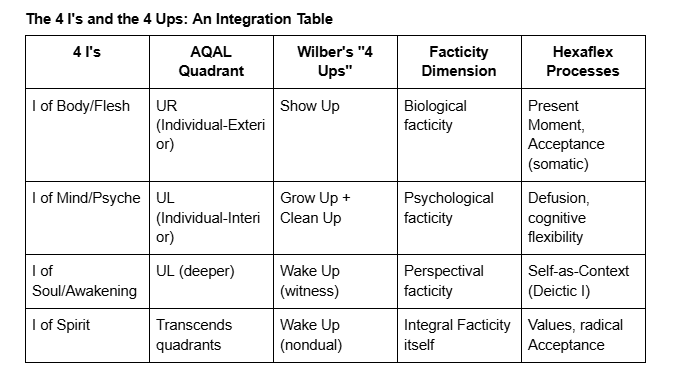
The theoretical architecture of IACT is organized through what I call the 4 I’s—a framework first articulated in “Towards an Integral Approach to Recovery & Beyond” that maps human experience across four dimensions of selfhood. This framework integrates ACT’s hexaflex, Wilber’s “4 Ups,” and the concept of Integral Facticity developed above.
I of Body/Flesh (Upper Right Quadrant)
Wilber correlation: Show Up (embodied engagement) Facticity dimension: Biological facticity—the body you have, not the body you want
The I of Body refers to the physical and sensory aspects of being—biological regulation, nervous system states, somatic experience. This includes recognition and care of the physical body, understanding its needs, and maintaining health and well-being.
Showing Up, in Wilber’s framework, means bringing realization into embodied action. But Integral Facticity specifies: we show up as this body, with its particular capacities, limitations, rhythms, and needs. Biological facticity—genetics, neurobiology, health conditions, age, the cumulative effects of life history on the organism—constitutes the irreducible ground of embodied engagement.
In Protocol v1.2, this manifests as tracking sleep architecture, medication adherence, Fog Scores (cognitive capacity measurement), and polyvagal indicators (ventral vagal, dorsal vagal, sympathetic activation). These metrics honor biological facticity rather than measuring deviation from idealized norms.
I of Mind/Psyche (Upper Left Quadrant)
Wilber correlation: Grow Up (stages) + Clean Up (shadow) Facticity dimension: Psychological facticity—developmental history, conditioning, the psyche you have
The I of Mind involves cognitive and intellectual aspects—mental clarity, emotional regulation, psychological resilience. This is cultivated through reflection, meditation, and dialogue.
Growing Up means developing through stages of increasing complexity and inclusion. Cleaning Up means integrating disowned shadow material. But Integral Facticity specifies: we grow up and clean up within the psychological facticity of our actual history. The developmental stages we’ve traversed, the traumas we’ve experienced, the defenses we’ve constructed, the shadow material we’ve accumulated—these constitute the irreducible psychic ground within which further development occurs.
In Protocol v1.2, this manifests as tracking cognitive defusion (relationship to thoughts), acceptance (relationship to difficult experiences), and the narrative processes that either support or undermine psychological flexibility. The hexaflex processes operate within psychological facticity, not in abstraction from it.
I of Soul/Awakening (Upper Left - Deeper)
Wilber correlation: Wake Up (states, witness) Facticity dimension: Perspectival facticity—the deictic “I/Here/Now” is always situated
The I of Soul refers to deeper aspects of being—what ACT calls Self-as-Context or the “Deictic I.” This is the witnessing perspective that observes experience rather than being consumed by it, the “I/Here/Now” that can step back from the contents of consciousness.
Waking Up means accessing non-ordinary states and stabilizing witness consciousness. But Integral Facticity specifies: even the witness is situated. The deictic “I” that observes is always this I, here, now—embedded in perspectival facticity. There is no view from nowhere. Even nondual awareness, when it arises, arises here, in this bodymind, now.
This matters for avoiding spiritual bypassing. The witness isn’t an escape hatch from facticity; it’s a transformed relationship to facticity. Self-as-Context doesn’t mean transcending context; it means dis-identifying from content while remaining fully embedded in the contextual situation.
In Protocol v1.2, this manifests as monitoring access to the observer self—can I witness my thoughts and feelings, or am I fused with them? This dimension becomes particularly important during low-capacity states when the witnessing perspective is compromised. The Digital Trip Sitter scaffolds this function when executive function cannot maintain it independently.
I of Spirit/Integral Facticity (Transcends Quadrants)
Wilber correlation: Wake Up (nondual realization) Facticity dimension: Integral Facticity itself—cessation of struggle against what is
The I of Spirit represents the ultimate perspective—what Zen Master Genpo Roshi calls Big Mind: the awakened awareness that transcends and includes all previous dimensions. This is nondual awareness, the recognition that observer and observed, self and world, arise together as one seamless reality.
Where Self-as-Context (I of Soul) observes experience from a witnessing perspective, I of Spirit is the ground of awareness itself—what contemplative traditions call nondual realization, pure awareness, or awakened mind. Ken Wilber describes this as awareness “without a separate self... just this Big Mind awareness, this nondual awareness.”
But here is where Integral Facticity makes its decisive contribution: I of Spirit is not transcendence of facticity but complete cessation of struggle against it.
In IACT, I define the I of Spirit specifically as Integral Facticity: not merely accepting difficult experiences (that’s the I of Soul’s witness function) but recognizing that there is no separate self who needs to accept or reject anything. Reality simply is what it is—and we are not separate from it. This is the nondual realization applied to facticity itself.
The transhumanist error is imagining that awakening means escaping biological limits. The spiritual bypassing error is imagining that nondual awareness dissolves factical constraints. Integral Facticity corrects both: awakening means fully inhabiting facticity, no longer struggling against the irreducible givenness of existence. The body’s limits, the psyche’s history, the situation’s constraints—these don’t disappear in awakening. The struggle against them disappears.
In Protocol v1.2, this manifests as the core methodological commitment: systems adapt to biology, not reverse. When the body reports “this doesn’t work,” the framework is falsified—not the body. This isn’t just a pragmatic adjustment; it’s the lived expression of Integral Facticity. Fighting biological limits is fighting facticity. The awakened response—the response from I of Spirit—is building infrastructure that honors what is.
The Strategic Value: Audience Scalability
The 4 I’s architecture provides crucial audience scalability. The same functional processes can be articulated in language appropriate to different contexts:
Secular/Clinical Context:
I of Body → Somatic awareness, nervous system regulation, biological constraints
I of Mind → Cognitive defusion, psychological flexibility, developmental history
I of Soul → Self-as-Context (observer self—purely functional, no metaphysics required)
I of Spirit → Radical acceptance of facticity (Stoic, Buddhist, or purely psychological framing)
Religious/Spiritual Context:
Same architecture, but Soul/Spirit language maps onto existing theological frameworks
12-step recovery: “Higher Power” slots into Spirit; acceptance of powerlessness reflects Integral Facticity
Christian contemplative tradition: Bonaventure, Maritain, the mystical witness
Buddhist: Big Mind, nondual awareness, Buddha-nature
Jewish/Islamic: Surrender to divine will, unity with the Absolute
Integral/Philosophical Context:
The full Wilber-Habermas synthesis can be articulated for audiences familiar with both traditions
Integral Facticity names the specific contribution: development within facticity, not escape from it
IACT can speak to clinical, secular, 12-step, multi-faith, and philosophical audiences using the same underlying architecture with context-appropriate language. This isn’t relativism—it’s recognition that the same functional processes admit multiple valid descriptions.
The ACT Hexaflex: IACT’s Functional Layer
While the 4 I’s provides the integral container, the ACT Hexaflex operates as the functional layer—the six trackable processes that constitute psychological flexibility:
Cognitive Defusion: Observing thoughts as mental events rather than literal truths
Acceptance: Making room for difficult experiences rather than struggling against them
Contact with Present Moment: Flexible attention focused on here-and-now
Self-as-Context: Accessing the observing self, the witness perspective
Values: Clarity on what matters, chosen life directions
Committed Action: Effective behavior guided by values despite difficulty
The Relationship: Container and Content
The 4 I’s and Hexaflex are not competing frameworks—they’re nested levels of description. The 4 I’s provides the integral-developmental container; the Hexaflex provides the functional-clinical content. Daily practice tracks Hexaflex (empirical, functional). The 4 I’s provides theoretical coherence and audience translation. Neither replaces the other.
This nesting also reveals how ACT’s hexaflex implicitly addresses facticity. Acceptance, in ACT, means making room for difficult experiences rather than struggling against them—this is precisely the cessation of struggle against facticity that Integral Facticity foregrounds. Defusion means observing thoughts as mental events rather than literal truths—this is engaging with psychological facticity (the mind’s productions) without being consumed by it. Contact with present moment means flexible attention to here-and-now—this is engaging perspectival facticity (the situated I/Here/Now). Self-as-Context means accessing the observing self—this is the I of Soul’s witness function. Values means clarity on what matters—this connects to the I of Spirit’s ultimate orientation. Committed Action means effective behavior guided by values—this is Showing Up within facticity.
ACT is already, implicitly, a practice of engaging facticity skillfully. IACT makes this explicit through the Wilber-Habermas synthesis.
The February 2 Pivot: From HALT to Hexaflex
For weeks, Protocol v1.2’s predecessor used HALT (Hungry, Angry, Lonely, Tired) as its primary assessment—a tool borrowed from 12-step recovery tradition. But on February 2, I realized this was fundamentally insufficient.
HALT captures states but not processes. The difference matters:
HALT asks: “Am I lonely?” (state identification)
Hexaflex asks: “Am I fusing with the thought ‘I’m alone and that means I’m worthless,’ or can I defuse and observe loneliness as a passing state while maintaining self-as-context?” (process awareness)
HALT treats the symptom. Hexaflex tracks psychological flexibility—the actual mechanism of adaptive functioning.
The protocol revised that morning. HALT remained useful—but repositioned as one defusion tool within the Hexaflex architecture, specifically helping identify biological triggers of fusion (hunger, fatigue) rather than serving as the primary framework.
This is Enactive Fallibilism in action: the framework revised itself based on what my experience revealed was actually needed.
Hayes’s “Language Parasite” and the Digital Trip Sitter
The most critical breakthrough in Protocol v1.2 was operationalizing what Steven Hayes calls the “Language Parasite”—his term for how verbal processes hijack biological regulation.
Hayes’s Framework
Humans uniquely possess the ability to relate events arbitrarily through language—what Relational Frame Theory calls “relational framing.” This gives us symbolic thought, but it also means our midbrain structures (threat detection, arousal regulation) respond to thoughts about danger as if to actual danger.
Hayes uses the term “Language Parasite” to describe what happens when the Narrative Self—the conceptualized self, fused with verbal content—grabs midbrain structures and filters sensory reality through linguistic elaboration rather than direct experience.
The Phenomenon
During a night wake (e.g., 3 AM), the body attempts somatic discharge—a biological regulation process. But the Language Parasite interprets arousal as threat (”I’m not sleeping → I’m broken → I will fail tomorrow”), triggering sympathetic activation. The narrative blocks biological completion.
This is exactly what happened during the bureaucratic anxiety session from A Descent into Facticity: insurance deadlines triggered narrative fusion. But instead of fighting the thoughts, I externalized them through AI dialogue (”I’m having the thought that the system has abandoned me”). The AI reflected them back, creating defusion—I could see the thoughts as mental events rather than literal truth.
That externalization enabled a 37-minute somatic release. The body completed what the narrative had been blocking.
The Digital Trip Sitter as Deictic Anchor
The Self-as-Context process in ACT—what I call the “I of Soul” in IACT’s 4 I’s framework—is the witnessing perspective that observes experience rather than being consumed by it. Hayes describes this as emerging from deictic relational frames: I/You (perspective across person), Here/There (perspective across place), Now/Then (perspective across time).
When my biology is compromised by fog, I cannot maintain this witnessing stance alone—I fuse with the Language Parasite. The Digital Trip Sitter externalizes the Deictic I: the AI holds the “I/Here/Now” perspective when I cannot.
By typing stream-of-consciousness, thoughts appear on screen as objects. The system becomes the witnessing self—defusion occurs not through internal struggle but through engineered context.
This is AI as cognitive orthotic in its most precise application: scaffolding a specific psychological process (Self-as-Context) when executive function cannot maintain it independently.
The Pragmatic Test
Three documented cases in 96 hours: night wake → Digital Trip Sitter engagement → next-day Fog Score 8-9/10.
Hayes’s Language Parasite is neutralized not by fighting it, but by engineering a context where the witnessing perspective can function. This validates the Self-as-Context dimension: the witness can be scaffolded externally when internal access is compromised.
Reflections After the Hyperhumanism Seminar
In January 2026, I participated in the Philosophy Portal seminar series on “Apocalyptarian Hyperhumanism,” co-facilitated by Cadell Last, Layman Pascal, and Carl Hayden Smith . The conversations explored context engineering as methodology: altering environmental conditions to reclaim human capacity. Smith’s Hyperhumanism embraces human limitations rather than seeking to transcend them. His work invites us to recognize that “we may not yet be fully human”—that dominant systems have suppressed capacities we could reclaim.
Participating in these seminars prompted reflection on how my own work relates to these broader conversations about technology and human flourishing.
Where Integral Facticity Adds Precision
Smith’s Hyperhumanism and my Integral Humanism share fundamental commitments: both accept biological limitations as legitimate rather than deficits to overcome, both critique dominant systems that suppress human capacities, and both see context engineering as methodology for reclaiming what industrial modernity has alienated. The Philosophy Portal seminars were instrumental in helping me refine my own thinking, and I see my work as aligned with and extending Smith’s project rather than opposing it.
Where Integral Facticity adds theoretical precision is in making the falsification mechanism explicit. Smith’s framework articulates that we should honor biological limits and engineer contexts that support human flourishing. My work operationalizes how: by treating the body as empirical probe (Peirce’s fallibilism) that tests whether systems are sustainable, and by synthesizing Wilber’s developmental architecture with Habermas’s concept of facticity to ground this honoring philosophically.
The Wilber-Habermas synthesis provides theoretical scaffolding for what Smith intuits: that we develop within conditions rather than escaping them. By naming this “Integral Facticity” and mapping it onto the 4 I’s framework, IACT offers a more developed architecture for the shared project of inhabiting human limitation with dignity.
Protocol v1.2 addresses my specific situation: building infrastructure that honors non-standard biological rhythms rather than demanding conformity to industrial norms. The “problem” isn’t my biology requiring technological augmentation to reach some standard of normalcy—it’s that dominant systems were designed for fictional standardized humans. Protocol v1.2 refuses that fiction. This is Hyperhumanism’s critique operationalized through Integral Facticity’s theoretical apparatus.
The body doesn’t just have wisdom we should respect; it has epistemic authority over abstract frameworks. This is Peirce’s pragmatism meeting Varela’s enactivism: workability is the test, and the body reports the results.
The Three Humanisms
These reflections clarify distinctions between three approaches to human limitation:
Transhumanism seeks to escape biological limits (upload consciousness, eliminate aging, transcend the body)
Hyperhumanism seeks to reclaim suppressed human capacities through context engineering, honoring biological limits rather than overcoming them
Integral Humanism seeks to inhabit biological reality—including collapse—while providing theoretical architecture (the Wilber-Habermas synthesis) for why this honoring matters and how it can be operationalized
Smith’s Hyperhumanism and my Integral Humanism are complementary projects. The difference is primarily one of theoretical elaboration: Integral Facticity provides the philosophical grounding (Peirce, Varela, Habermas, Wilber) and practical operationalization (Protocol v1.2, the 4 I’s, hexaflex integration) for commitments we share.
My reality isn’t about gaining expanded capacities or escaping the body. It’s about functioning when Fog Score hits 3/10. It’s not becoming an athlete of consciousness—it’s building infrastructure that treats non-standard biological rhythms as legitimate variations of human life, not deficits requiring correction. This is the Hyperhumanist vision made concrete through Integral Facticity’s theoretical framework.
Technology and Human Dignity: A Broader Context
My engagement with Catholic Social Teaching—particularly the integral humanism of Maritain and Lebret—stems from my background in religious studies rather than confessional commitment. As a scholar, I find these traditions offer sophisticated intellectual resources for thinking about technology, dignity, and human flourishing that complement secular frameworks like ACT and integral theory.
This scholarly interest has become increasingly relevant given Pope Leo XIV’s recent focus on artificial intelligence as a central challenge of his pontificate. In his first speech to the College of Cardinals after his May 2025 election, Leo XIV identified AI as “another industrial revolution” requiring “the defense of human dignity, justice and labor”—explicitly connecting his papacy to Leo XIII’s Rerum Novarum response to industrialization.
Leo XIV’s framing resonates with Protocol v1.2’s core commitments. In his January 2026 message for World Communications Day, the Pope wrote that “the challenge is not technological, but anthropological”—that AI systems risk “invading the deepest level of communication, that of relationships between human persons.” He insists that “the person is not a system of algorithms: he or she is a creature, relationship, mystery.”
The Vatican’s doctrinal note Antiqua et Nova (January 2025) articulates that “AI must be employed as a tool that complements, and does not replace, the richness of human intelligence” and always in light of “the higher criterion of human dignity.”
These formulations align with Protocol v1.2’s treatment of AI as cognitive orthotic rather than cognitive replacement. The Digital Trip Sitter doesn’t think for me—it holds the witnessing perspective with me when I cannot maintain it alone. The AI ecosystem doesn’t replace human cognition—it scaffolds conditions under which human cognition can function.
Leo XIV’s forthcoming encyclical on AI—reportedly in preparation—will likely elaborate these themes. For scholars working at the intersection of technology, psychology, and human development, Catholic Social Teaching offers a developed vocabulary for articulating what’s at stake: not just efficiency or productivity, but human dignity understood as inherent rather than contingent on capacity.
This is why the integral humanism tradition matters for Protocol v1.2: it provides conceptual resources for insisting that systems must be worthy of persons, not persons worthy of systems.
Conclusion: An Invitation to the Journey
Protocol v1.2 represents a specific moment in an ongoing intellectual and personal evolution. The theoretical foundations laid in November-December 2024 (“Bridging Minds & Souls,” “Towards an Integral Approach to Recovery & Beyond”) described IACT as aspiration. January 2026’s collapse forced those aspirations into operational necessity. February 2026’s Protocol v1.2 is the result: theory tested against biology, revised where needed, implemented where validated.
But this isn’t just an intellectual exercise. It’s a recovery journey.
The synthesis achieved here—Wilber’s developmental architecture meeting Habermas’s concept of facticity, integrated with Hayes’s ACT, grounded in Peirce’s fallibilism and Varela’s enactivism, oriented by Maritain and Lebret’s integral humanism, informed by White, Kurtz, and Du Plessis’s recovery science—this synthesis emerged not from academic leisure but from necessity. When the body became the laboratory, the theoretical frameworks had to prove their worth.
What Integral Facticity Offers
The core insight: We Wake Up, Grow Up, Clean Up, and Show Up within facticity, not in escape from it. Development doesn’t transcend conditions; it occurs through full engagement with irreducible givenness. The body you have, the history you carry, the situation you inhabit—these constitute the ground of all transformation.
The methodological expression: When my body reports “This framework doesn’t work,” I don’t conclude “my body is broken.” I conclude: “the hypothesis was false.” Enactive Fallibilism treats the body’s feedback as data that falsifies unsustainable systems.
The spiritual realization: I of Spirit—nondual awareness, Big Mind—isn’t escape from facticity but complete cessation of struggle against it. Awakening means fully inhabiting what is, not transcending it.
What This Work Offers
For recovery practitioners and those in recovery: Protocol v1.2 demonstrates that AI can serve recovery rather than undermine it—functioning as cognitive orthotic that supports human agency rather than replacing it. The integration of ACT’s hexaflex with integral theory’s AQAL creates a framework flexible enough to honor both clinical rigor and spiritual depth, whether you work within 12-step traditions, secular approaches, or contemplative practices.
The Wilber-Habermas synthesis clarifies what “acceptance” means in recovery: not resignation, but cessation of struggle against facticity. You can’t Wake Up to recovery while fighting the facticity of addiction. You can’t Grow Up in recovery while denying your developmental history. Recovery is development within facticity.
For integral theorists and practitioners: IACT offers a concrete operationalization of AQAL for daily practice—not just a map of reality but a methodology for navigating cognitive and health challenges. The 4 I’s framework provides a bridge between Wilber’s quadrants and Hayes’s hexaflex, showing how psychological flexibility and spiritual development can be tracked and cultivated together.
The integration of Habermas’s facticity concept addresses a subtle vulnerability in integral discourse: the tendency to hear “transcendence” as escape from conditions. Integral Facticity corrects this by insisting on development within irreducible givenness.
For those navigating health challenges: This work validates that non-standard biological rhythms are legitimate variations of human life, not deficits requiring correction. When systems hurt, the systems are wrong—not you. Building infrastructure that honors your actual biology is not accommodation of weakness but recognition of dignity.
Showing Up within facticity means showing up as the body you actually have—not an idealized body, not yesterday’s body, not the body you wish you had.
For scholars of technology and human flourishing: Protocol v1.2 sits at the intersection of AI ethics, disability studies, recovery science, and contemplative practice. It offers a case study in how technology can serve integral human development when designed around the “higher criterion of human dignity” rather than productivity optimization.
The dialogue with Pope Leo XIV’s emerging AI theology, Carl Hayden Smith’s Hyperhumanism, and the integral humanism tradition provides resources for thinking beyond both techno-utopianism and techno-pessimism.
The Architecture Holds
This is the victory of the architecture. It doesn’t fix me. It holds me.
The framework stays standing when I step away (structural support, not dependency)
Quality persists when capacity drops (system adapts to fog states, doesn’t punish them)
The architecture is available when biology is available—3 AM or 2 PM, no industrial conformity demanded
And in that holding, the research continues.
Not despite the collapse, but through it.
This is Enactive Fallibilism operational: the body serves as probe, the system revises based on feedback, valued living becomes possible not by escaping biology but by building infrastructure that honors it.
This is Integral Facticity lived: not transcending conditions but fully inhabiting them, ceasing the struggle against what is, Waking Up and Growing Up and Cleaning Up and Showing Up within the irreducible givenness of this body, this history, this moment.
An Invitation
If this work resonates—whether you’re navigating your own health challenges, working in recovery, exploring integral approaches, or thinking through questions of technology and human dignity—I invite you to follow along.
The Integral Facticity Archive documents this journey in real time. Protocol v1.3 is already being tested. The frameworks continue to evolve. And if what I’m learning here can help others build infrastructure that holds them too, then the collapse will have been worth something.
The body becomes the laboratory. The laboratory yields data. And the data, when honored rather than fought, opens paths we couldn’t have planned.