![Integral [+] Facticity](https://substackcdn.com/image/fetch/$s_!yhcJ!,w_120,h_120,c_fill,f_webp,q_auto:good,fl_progressive:steep/https%3A%2F%2Fbucketeer-e05bbc84-baa3-437e-9518-adb32be77984.s3.amazonaws.com%2Fpublic%2Fimages%2Ff8458843-3278-4fcc-accc-17ad21352205_1280x1280.png)

Abstract
The initial tributes following Jürgen Habermas’s death on March 14, 2026, were largely incomplete and focused predominantly on his political persona: the liberal-socialist, the anti-fascist proceduralist, and the thinker who reconstructed critical theory after Adorno by grounding its emancipatory ambitions in communicative rationality rather than negative dialectics. Largely overlooked was the profound philosophical and theological dimension of his life’s work. Habermas’s intellectual journey was far broader than his public image suggests. It began with an engagement with Schelling’s Absolute, included a challenge to Heidegger’s support for fascism, and involved a reinterpretation of Hegel and Marx through the lens of American pragmatism, Piaget, and Kohlberg. His later decades were dedicated to a crucial question: whether secular reason is truly self-sufficient for sustaining democratic life without the moral substance drawn from religious traditions.
The theological dimension of Habermas’s work, which persisted throughout his career and reached its apex in his final three-volume history of philosophy, was largely absent from public discussion. This oversight is epitomized by the widespread neglect of the fifty-year intellectual culmination represented by the Habermas-Ratzinger dialogue. Ultimately, the public reception of Habermas favored the political and legal theorist, overshadowing the philosopher who wrestled with profound questions of faith and reason. This essay aims to recover a forgotten dimension of Habermas’s work by tracing his post-metaphysical turn from two distinct angles. The first is an internal philosophical trajectory, moving from Fichte’s Volksgeist through Hegel’s Geist to Heidegger’s Being, highlighting its disastrous political culmination of fascism in Germany. The second is an external perspective, rooted in the author’s own background in Zen Buddhism in Montreal, which reveals a structurally parallel catastrophe in the Kyoto School and can be found in various forms of modern Buddhism today.
Charles Davis’s framework of religion’s four temptations — the lust for certitude, the pride of history, cosmic vanity, and the wrath of morality — serves as the critical link between these two paths. Both lines of inquiry ultimately converge on the crucial insight that divine revelation and religion, when left to its own devices, is insufficient to resolve the problems of democratic society and provide a robust theory of justice. That convergence, however, arrives at a moment of acute pressure. The essay then maps the theological fault line now running from Milbank and McGrath through Peterson, Vance, and Vermeule — before confronting a darker recognition: that the post-liberal project is not simply dismantling the procedural architecture Habermas built, but occupying the precise philosophical structure he spent his career mapping. Habermas did not merely oppose the claim that political order must be grounded in a revealed, sacred inheritance that precedes and exceeds rational justification. He diagnosed it as the recurrent pathology of modern political thought — the move that had already run from Fichte through Romanticism to its catastrophic destination in Heidegger — and spent fifty years building the case against its return. That the post-liberal project now advances precisely these moves — through various forms of theological discourse, the organized ascent of regressive political formations, and their eventual occupation of the White House — is not a development Habermas's analysis failed to anticipate.
Finally, that confrontation extends into territory Habermas himself never fully mapped. Ken Wilber's integral theory represents the most philosophically serious attempt in the Anglophone world to hold contemplative depth and post-metaphysical rigour together. The ambition is to carry both the wisdom of the great religious traditions and axial civilizations and the full weight of Habermas's demanding theory of communication, justice, and the evolution of societies — and to hold them within a single coherent framework without collapsing either into the other. Whether that ambition has been met is precisely what is now at stake. The political ambivalence of integral theory today — its tendency to interpret democratic decline as a necessary evolutionary step, its reluctance to fully address issues of justice — reflects the core structural problem this essay diagnoses: whether depth and justice can be held together at all, or whether every framework that reaches for both will find a way to sacrifice one for the other. Ultimately, the essay presses a question Wilber's admirers have avoided and his critics have never quite earned: whether integral theory represents the framework that finally holds depth and justice together — or whether, as post-liberal authoritarianism advances and his followers offer nothing, Wilber will be remembered as another Heidegger, having built the most sophisticated philosophical architecture of our time only to repeat the precise capitulation Habermas spent his life warning against.
Tags: Habermas, Post-Metaphysical Philosophy, German Idealism, Critical Theory, Communicative Action, Schelling, Hegel, Heidegger, Volksgeist, Frankfurt School, Post-Secular Theology, Religion and Politics, Catholic Integralism, Radical Orthodoxy, Sean McGrath, Jean-Luc Marion, John D. Caputo, John Milbank, Kyoto School, Nishida, Nishitani, Tanabe, Zen Buddhism, Robert Bellah, Charles Davis, Marc Lalonde, Ken Wilber, Integral Theory, Adi Da, Perennial Philosophy, Theosophy, Anthroposophy, New Age, Occult, Traditionalism, Julius Evola, René Guénon, Alexander Dugin, Jason Wirth, Bret Davis, McMindfulness, Slavoj Žižek, Michael Brooks, Matthew McManus, Daniel Tutt, Peter Verovšek, Jordan Peterson, JD Vance, Postmodern Conservatism, MAGA, Democratic Theory, Justice, Moral Foundations Theory, Jonathan Haidt, Virtue Ethics
The death of Jürgen Habermas on March 14, 2026, delivered a profound and distinctly personal blow, particularly as it occurred during a period of intense study of his vast intellectual output. I had recently been following his latest work closely — working through Stefan Muller-Doohm and Roman Yos’s book-length interview Things Needed to Get Better, which captured my interest by focusing on Habermas’s early political and intellectual foundations. While Philipp Felsch’s more accessible biography, The Philosopher: Habermas and Us, was on my reading list, a compelling discussion between Daniel Tutt and Felsch on the Emancipations podcast finally convinced me to pick it up. I was halfway through it when the announcement came.
What followed was something I hadn’t anticipated, and which has preoccupied my thoughts ever since: a deluge of tributes that, despite their good intentions, were nearly all incomplete in similar ways.
The Habermas who arrived in the obituaries is the one most people recognize. The political Habermas. The Frankfurt School Habermas. The Habermas who confronted the Historians’ Debate in the 1980s, who opposed the Iraq War, who spent his last years warning against the collapse of democratic norms. That Habermas is real and his contributions on those fronts deserve to be named. But the tributes represent three distinct readings of his work, and all three of them flatten him — in different directions, for different reasons.
The first reading comes from the sympathetic liberal left: the Frankfurt School inheritors, the social democrats, the figures who genuinely loved and learned from Habermas and are now mourning him with full sincerity. The most representative of these tributes is Seyla Benhabib’s — “Carrying on His Legacy” — which is moving precisely because of how much she genuinely received from him over five decades. She gives an honest account of his formation, his gifts as a discussion leader, his ability to hold productive disagreement together in a seminar room. But even Benhabib moves quickly through The Theory of Communicative Action before arriving at his political interventions — the Ukraine essay, the Israel-Gaza question, his deep mistrust of German rearmament. The picture that emerges is of an indispensable public figure whose philosophical work was largely in service of that public role: Habermas as the defender of Enlightenment rationality against the authoritarian right, the anti-fascist intellectual who gave the liberal public sphere its philosophical backbone. It is a generous portrait. But it is a portrait of the political Habermas almost exclusively, and it is entirely silent on the philosophical and theological project this essay is all about. Peter Verovšek’s tribute in Social Europe — published alongside his new Columbia University Press biography, whose very title, Jürgen Habermas: Public Intellectual and Engaged Critical Theorist, announces its frame — is perhaps the most scholarly representative of this reading, and it suffers from exactly the same reduction: seven thousand words on the public intellectual, the Historians’ Debate, the European Union; a single sentence on the Ratzinger dialogue; nothing on the final three-volume history of philosophy. The biography title is, in this sense, almost too perfect an encapsulation of what this reception gets wrong about what Habermas was doing.
Matt McManus’s tribute in Jacobin — Jürgen Habermas Showed What Philosophy Could Be — is more philosophically ambitious, and I say that as someone who has followed his work closely and had the privilege of interviewing him on my podcast. McManus occupies an interesting and genuinely uncomfortable position in this conversation, because he stands with one foot in each of the first two readings I am describing. By training he is a critical legal theorist, and his sympathetic Habermas is shaped accordingly: the proceduralist, the defender of democratic norms, the Frankfurt School inheritor who gave liberal-socialist politics its most rigorous philosophical architecture. That is the McManus who wrote his 2018 article “Post-Postmodernism on the Left” — his engagement with Habermas as a resource for a left politics capable of answering the irrationalist right, a project he developed in close intellectual partnership with the late Michael Brooks — and that is the McManus whose Jacobin tribute emphasises Habermas’s role as defender of democratic modernity. But McManus has also spent considerable time in the orbit of the Žižek-Lacanian tradition — through his work on postmodern conservatism, through an engagement with the Frankfurt School that is never quite free of the suspicion that Habermas’s proceduralism evacuates something the tradition needed to preserve. The resulting tribute, while honest in its scope, suffers from the same bias: it focuses on the Habermas known for opposing fascism and upholding liberal-democratic principles. His proceduralism is highlighted as both his major achievement and, from the persistent Lacanian-Marxist perspective, his most significant shortcoming.
That second, more hostile reading has its clearest representatives in Žižek and figures like Daniel Tutt, for whom Habermas represents the Frankfurt School’s great capitulation: the philosopher who abandoned Adorno’s negative dialectics, traded the genuine radicalism of immanent critique for the insipid fantasy of the ideal speech situation, and ended up providing philosophical cover for liberal proceduralism rather than challenging it. From this angle, The Theory of Communicative Action is not a philosophical achievement but a philosophical retreat — an attempt to ground democratic legitimacy in rational discourse that naively abstracts from power, capital, and the structural conditions under which communication always already takes place. I find this reading philosophically interesting, but ultimately it fails for the same reason as the sympathetic liberal version: both treat the post-metaphysical turn as a political choice rather than a philosophical conclusion, and neither has seriously reckoned with what Habermas was actually building in the works between Knowledge and Human Interests and The Theory of Communicative Action — or with the theological dimension of his project that both camps ignore entirely.
The third reading is the most unexpected, and in some ways the most instructive. In the days following Habermas’s death, a cluster of conservative commentators — most representative among them Tobias Teuscher writing in The European Conservative — discovered Habermas as a resource for the right. The argument runs like this: Habermas’s insistence that political claims must be translatable into publicly accessible reasons, defensible through argument rather than identity or authority, is a discipline that the left has abandoned and that the right should now wield against it. “Habermas does not teach conservatives how to shout down the Left,” Teuscher writes. “He teaches them how to make the Left answer.” There is something philosophically correct in this reading — the zwanglose Zwang des besseren Arguments, the unforced force of the better argument, does apply universally, and the progressive left’s retreat into moral pressure and administrative fiat is a genuine legitimacy problem that Habermas himself named. But this conservative appropriation takes the procedural shell and leaves everything else behind: the developmental account of communicative competence, the reconstruction of Hegel and Marx, the theological dimension of the post-metaphysical project, and above all the recognition — reached at enormous philosophical cost over seven decades — that the procedural framework cannot stand alone, that it needs the motivational resources the religious traditions carry, and that those traditions must in turn submit to the corrective of reason. What this reading receives is a debating technique. What it discards is the philosophical architecture that gives that technique its meaning.
What all three readings share — and what I want to name before moving forward — is a pattern that Jonathan Haidt’s moral foundations framework illuminates with uncomfortable precision. Each reading receives Habermas through a subset of moral foundations and filters out the rest. The liberal-left reading operates through Care and Fairness: the Habermas who protects vulnerable citizens, upholds equal dignity, defends procedural justice against the authoritarian right. The Lacanian-Marxist reading adds Liberty to the mix — Habermas betrayed emancipation by surrendering radical critique for procedural comfort. The conservative reading activates Authority and Loyalty: Habermas as a tutor in disciplined argumentation, a resource for giving conservative instincts the form of public reason. What none of the three can access — what all three systematically suppress — is the Sanctity dimension, the register in which Habermas spent his final decades working: the question of what the great traditions carry that secular reason cannot generate, what is owed to the victims of history that no procedural discourse can redeem, what ground justice requires that argument alone cannot provide. This is not an accident. It is the precise shape of the reception failure. And it is, in a sense, the Habermasian problem enacted in the reception of Habermas himself: a philosopher who spent his career showing how communicative rationality gets colonized by strategic action, systematically reduced to a strategic instrument by each of the communities claiming his legacy.
What makes all three readings worse — and what pushes the philosophical Habermas even further from view — is the way his reception in the English-speaking world became dominated by the debates with Rawls, Dworkin, and the Anglo-American legal theorists. Those exchanges were important on their own terms. But they had the effect of translating Habermas into the idiom of liberal political philosophy, where the questions that defined his actual project — about the metaphysical legacy of German Idealism, about the relationship between secular reason and religious traditions, about what philosophy could look like after the catastrophe the tradition had helped produce — became almost entirely invisible. In the Anglo-American academy, Habermas became a sophisticated interlocutor in debates about justice, public reason, and constitutional democracy. The philosopher who had begun in Schelling and ended in a sustained dialogue with theologians simply did not appear in that conversation. That is the Habermas this essay is about.
I. The Philosopher Before the Public Intellectual
There is a biographical fact about Habermas that nearly everyone knows and almost nobody takes seriously: his doctoral dissertation, completed in 1954 at Bonn, was a study of Schelling. The title — Das Absolute und die Geschichte: Von der Zwiespältigkeit in Schellings Denken — translates as The Absolute and History: On the Ambivalence in Schelling’s Thought. This detail tends to appear in intellectual biographies as a piece of early context before the real story begins — before Adorno and the Frankfurt School, before The Structural Transformation of the Public Sphere, before the mature project of communicative rationality. Treated this way, it means nothing. Treated seriously, it changes everything.
Habermas began his career inside the same tradition Heidegger had inhabited and radicalized — not as an outsider borrowing philosophical vocabulary for political ends, but as a philosopher formed in German Idealism who had read the tradition from the inside, traced its philosophical logic, and arrived at a verdict about what that logic had authorized. His dissertation on the ambivalence in Schelling’s thought is not a preliminary exercise. It is the site of an encounter: a young philosopher coming to understand, through careful reading, both the genuine resources in the tradition and the specific point at which those resources had historically overreached. The concept of the Absolute in Schelling — the positing of an unconditioned ground from which all differentiation proceeds, the reaching past the finite structures of knowledge and discourse to the foundation beneath them — was philosophically serious, and Habermas knew it was serious. He was not dismissing it from ignorance. He was beginning to understand why it could not do what it claimed.
That understanding had already begun to surface publicly before the dissertation was complete. In July 1953 — still a doctoral student — Habermas published an article in the Frankfurter Allgemeine Zeitung confronting Heidegger over his decision to republish his 1935 lectures on metaphysics without retracting or even annotating his reference to the “inner truth and greatness” of the Nazi movement. Heidegger was then the most celebrated philosopher in Germany, at the height of his postwar prestige. Habermas was a no-name student from the provinces. The move was intellectually courageous and personally risky. But it was not primarily a moral accusation against an individual. It was the opening move in a philosophical argument that would take Habermas seven decades to complete: that Heidegger’s politics were not an aberration of his philosophy but an available destination of it — that the structural features of his thought that made it so compelling were the same features that had made it so available for political catastrophe. That argument would deepen and ramify over the following three decades, issuing in the political and cultural essays collected in The New Conservatism (1989).
The New Conservatism is the book through which most English-speaking readers encountered the political Habermas — and it is, consequently, the book that has most consistently been mistaken for the whole project. Drawn from his Kleine politische Schriften of the mid-1980s and translated by Shierry Weber Nicholsen, it brought together his interventions in the Historians’ Debate, his attack on the revisionist German historians working to normalize and domesticate the Nazi past, his engagement with Heidegger’s entanglement with National Socialism, and the landmark essay “The New Obscurity” on the exhaustion of welfare-state utopianism. In the English-speaking world, this collection crystallized a particular image: Habermas as anti-fascist intellectual, defender of democratic memory, Frankfurt School heir who understood better than anyone what happens when a tradition fails to reckon honestly with its own past. That Habermas is real. But The New Conservatism was never the culmination of the project — it was a series of interventions written in the heat of the moment, while the deeper philosophical work was still fully in development.
What has gone almost entirely unremarked — and what makes this the right place to say it — is how far ahead of the curve Habermas was in diagnosing what the 1980s neoconservative turn was actually drawing on. The revisionist historians he targeted in the Historians’ Debate were not simply making a political argument about German memory. They were operating within an intellectual formation that had deeper roots: in the nationalist and völkisch traditions of German thought, in the esoteric and occult currents that had fed into fascism and that never fully disappeared from the cultural right after 1945, in the broader European reaction against Enlightenment rationalism that was beginning, in the 1980s, to find new political vehicles. Habermas saw the structural logic connecting these formations more clearly than almost anyone writing in that moment. He understood that the appeal to cultural depth, historical rootedness, and collective spiritual identity against the supposed coldness of liberal proceduralism was not a new argument. It was the same argument that had been running through German Idealism since Fichte, through the occult revivals of the nineteenth and early twentieth centuries, through the Volkish movements and into fascism — and it was now being laundered back into respectable conservative intellectual discourse under the guise of historical revision and cultural criticism.
This is a dimension of The New Conservatism that the Anglophone reception has never fully processed, in large part because the intellectual formations Habermas was responding to remained poorly understood outside Europe. The occult and esoteric currents that fed into twentieth-century European reactionary politics — from Guénon’s Traditionalism through Evola’s esoteric fascism to the post-war networks that kept these ideas circulating on the cultural right — were largely invisible to Anglo-American readers in the 1980s. They are only now beginning to be seriously discussed in the Anglosphere, driven in part by the rise of the new right and the recognition that figures like Alexander Dugin — whose Eurasianism draws directly on Guénon and Evola — are not eccentric outliers but representatives of a coherent, long-running intellectual tradition. Matthew McManus, whose work on postmodern conservatism has done more than anyone writing in English to map the philosophical genealogy of the contemporary right, has tracked these connections with increasing precision. Yet even McManus’s meticulous genealogies, for all their depth, have not fully credited what Habermas was already naming in the 1980s: that the new conservatism was not primarily a reaction to specific policy failures or cultural provocations, but a structural recurrence of the move Habermas had been analyzing since his dissertation — the substitution of depth, rootedness, and ground for the slow, exposed work of rational argument. Habermas had a name for what was coming before it fully arrived. That he is not recognized for this — that the tributes credit the anti-fascist interventionist without crediting the philosopher who understood why fascism kept returning in new forms — is perhaps the most telling symptom of the reception failure this essay is trying to diagnose.
What exactly the structural diagnosis meant, and why it required the post-metaphysical turn that followed, is a thread I will develop throughout what follows. What matters here is that this act — and the Schelling dissertation it ran alongside — establishes the philosophical starting point that the obituaries have missed. Habermas did not arrive at his project as a sociologist of modernity or a Frankfurt School critical theorist. He arrived at it as a philosopher who had spent his formative years inside the tradition he would spend his career reconstructing.
The first major fruit of that reconstruction is The Structural Transformation of the Public Sphere (1962), and it is worth pausing on it before moving to the more explicitly philosophical works, because it establishes the social and historical architecture within which everything else develops. The book’s argument is that the bourgeois public sphere — the network of coffee houses, salons, and print media that emerged in eighteenth-century Europe, in which private citizens came together to reason publicly about matters of common concern — represented a genuine historical achievement: the first institutional form in which communicative rationality, the force of the better argument rather than the authority of tradition or power, could in principle govern public life. The argument is not nostalgic. Habermas documents the structural transformation of that public sphere under the pressure of mass media, consumerism, and the colonization of public life by market and administrative logics — its degradation from a space of genuine rational-critical debate into a managed arena of opinion formation and political marketing. But the normative standard it establishes — that democratic legitimacy requires a public sphere in which citizens can genuinely reason together, rather than simply have preferences managed — is the foundation on which everything that follows is built. This is Habermas still within the Frankfurt School orbit, deploying the tools of historical sociology in service of a normative diagnosis. But the question driving the project — what conditions allow communicative rationality to actually function in modern societies, and what systematically undermines it — is already, unmistakably, his own.
Knowledge and Human Interests (1968) marks the turn toward a more explicitly philosophical engagement with the tradition, and it is where the reckoning with Marx begins in earnest. Habermas’s argument here is that Marx had illegitimately reduced the full range of human cognitive interests to a single paradigm — labour, instrumental action, the metabolism of humanity with nature — and in doing so had foreclosed the dimension of communicative action that any adequate theory of emancipation had to include. Working through Kant, Fichte, Hegel, and Marx alongside Peirce and Dilthey, Habermas identifies three irreducible cognitive interests: the technical interest in prediction and control, which governs the empirical-analytic sciences; the practical interest in mutual understanding, which governs the historical-hermeneutic sciences; and the emancipatory interest in liberation from ideologically distorted communication, which governs critical theory. The point is not that Marx was wrong about capitalism. It is that his reduction of all human interests to the productive paradigm had foreclosed the communicative dimension that any genuinely adequate theory of emancipation required. The critique of capitalism was necessary but insufficient. Emancipation was not only a matter of transforming the relations of production. It also required the transformation of the structures of communication — the conditions under which human beings could genuinely hear each other, challenge each other, and arrive at the kind of mutual understanding that instrumental action, by itself, could never produce. Habermas was updating Marx, not discarding him — and in doing so recovering the normative dimension that economistic readings of Marx had systematically suppressed.
Communication and the Evolution of Society (1976) is the crucial bridge that most readers skip, and skipping it is precisely what produces the misreadings of both The Theory of Communicative Action and the post-metaphysical project as a whole. This is the work where the engagement with Piaget and Kohlberg becomes decisive, and where the American pragmatist tradition — above all Charles Sanders Peirce, John Dewey, and George Herbert Mead — enters the project in a way that permanently reorients it. The key move is the transposition of Piaget’s model of individual cognitive development and Kohlberg’s model of individual moral development onto the level of social evolution. Piaget had shown that individual cognitive development follows an invariant sequence of discrete stages — each more complex and comprehensive than the last, each building on but irreversible from the previous — governed not by biological maturation alone but by a logic of learning that has its own internal structure. Kohlberg extended this to moral judgment: the development of moral consciousness in individuals follows an analogous sequence, from pre-conventional through conventional to post-conventional reasoning, in which each stage represents a genuine cognitive achievement, a more adequate way of handling moral problems, not merely a different cultural preference. What Habermas did — and this is the move that changes everything — was to argue that societies, like individuals, develop through analogous stage sequences in their normative structures: the institutional frameworks through which they organize social integration, handle conflict, and legitimate authority. Social evolution, on this account, is not only driven by changes in the forces of production, as Marx had argued. It also has another logic, rooted in the development of communicative competence — the capacity of members of a society to coordinate their actions through genuine mutual understanding rather than through force, tradition, or instrumental calculation.
The American pragmatist tradition is what makes this move philosophically coherent rather than merely speculative. Peirce’s account of the community of inquiry — in which truth emerges not from individual cognition but from the indefinitely extended process of communal inquiry, subject to ongoing revision and correction — gave Habermas a model of rationality that was neither subjective nor foundationalist. Dewey’s insistence that intelligence is always already embedded in social practice, that knowing and doing cannot be cleanly separated, and that democracy is itself a form of inquiry — a way of collectively solving problems through communication rather than authority — deepened this. And Mead’s social psychology, with its account of how the self is constituted through the internalization of the attitudes of others, provided the micro-level theory of intersubjective identity formation that the macro-level developmental account required. Together, these resources allowed Habermas to ground communicative rationality not in a philosophical Absolute — not in Hegel’s Geist, not in Marx’s productive forces — but in the immanent logic of communication itself: in what speakers necessarily presuppose whenever they attempt to reach genuine understanding with one another.
The Theory of Communicative Action (1981) is where these threads converge, and where the reconstruction of both Hegel and Marx is finally executed at full scale. To read it as a retreat from Frankfurt School radicalism — the Lacanian-Marxist charge — is to fundamentally misunderstand what it is doing. Hegel’s project, at its core, was the attempt to think the reconciliation of subject and object, particular and universal, the finite and the infinite — not as a presupposition handed down from prior metaphysics, but as something philosophy could demonstrate through the immanent movement of thought itself. The Absolute, for Hegel, was not a thing standing behind the world. It was the process of the world coming to know itself through the dialectical movement of Spirit. What Hegel achieved, and what made the tradition after him so generative and so dangerous, was the integration of history into philosophy: the recognition that reason is not ahistorical, that it develops, that what counts as rational is always already situated in a historical moment that shapes what can be thought and said. This insight — the historicity of reason — is one Habermas never abandoned. What he refused was the particular philosophical architecture Hegel used to secure it: the appeal to Geist as the subject of history, the claim that history’s movement could be comprehended from the standpoint of the Absolute. The Theory of Communicative Action is, in this precise sense, a reconstruction of Hegel’s project under post-metaphysical conditions. The reconciliation Hegel sought is still the goal. But its site is relocated: from Spirit coming to know itself through history, to the actual, imperfect, always-contested process by which human beings coordinate their actions, challenge each other’s validity claims, and arrive — fallibly, revisably, never finally — at shared understandings.
What Communication and the Evolution of Society had made possible is now fully visible: the reconciliation Hegel sought no longer needs to be grounded in the movement of Absolute Spirit through history. It is grounded in the developmental logic of communicative competence — the capacity of human beings to achieve, through the slow and fallible work of argument and mutual accountability, forms of social integration that are genuinely more adequate — more inclusive, more reflexive, more capable of handling moral complexity — than the ones they replaced. History has a normative direction, but that direction does not require a metaphysical subject to carry it. It is immanent in the structure of communicative action itself. Similarly, the emancipatory dimension Marx identified — the possibility of social arrangements genuinely accountable to the needs and interests of their members — is not abandoned but relocated: from the forces of production to the normative structures of communication, from the dialectic of labour to the developmental logic of moral consciousness. This is what the Lacanian-Marxist critique consistently misses. Habermas was not retreating from emancipation. He was providing it with a philosophical architecture that did not depend on either the Hegelian Absolute or the Marxist dialectic of productive forces — both of which, as he had learned from the inside, opened doors that good intentions could not keep closed.
This is the context within which the post-metaphysical turn has to be understood — and the context within which it is most consistently misread. Post-metaphysical thinking, in Habermas’s sense, does not mean the rejection of the questions Schelling, Hegel, and Marx were asking. It means the refusal of the specific philosophical move through which each of them tried to answer those questions: the appeal to a foundational ground — whether the Absolute, Geist, or the dialectic of productive forces — that stands beneath rational discourse and from which the whole can be surveyed and legitimated. To understand why Habermas regarded that refusal as philosophically urgent rather than merely cautious, you have to follow the logic of the tradition from Fichte through Hegel to Heidegger — and see how the move from the Absolute to fascism was not a distortion but a development.
The problem runs from the very structure of German Idealism’s central ambition. Fichte’s Addresses to the German Nation (1808), delivered under French occupation, drew a direct line from his philosophical system — in which the Absolute “I” constitutes itself through its own self-positing activity — to the cultural and political mission of the German people. For Fichte, the nation was not merely a political unit. It was the concrete historical form through which the universal spirit of humanity expressed itself at a particular moment. The Germans, with their “original language” and their uncorrupted relationship to the sources of human spiritual life, bore a special responsibility for the next stage of Spirit’s development. This is not a distortion of Fichte’s philosophical system. It is an application of it: if the Absolute expresses itself through particular forms, and if philosophy can identify which particular form is presently carrying the advance of Spirit, then cultural and national identity becomes metaphysically significant in a way that makes it available for political mobilization.
Hegel systematized this slide and made it philosophically respectable. In Hegel’s mature system, the Absolute Spirit (Geist) moves through history by expressing itself through the particular Volksgeister — the national spirits — of successive peoples. Each great civilization is the bearer of a stage in Spirit’s self-realization: Greece for the birth of freedom, Rome for law and institution, and in Hegel’s own telling, the Germanic Protestant world for the full actualization of rational freedom. The state, for Hegel, is not a mere political mechanism but “the actuality of the ethical idea” — the concrete institutional form in which the spirit of a people achieves rational self-expression. What makes this philosophically dangerous, as many of Hegel’s commentators observed, is precisely the problem of “the infinite in concreteness”: the tendency for Absolute Spirit, which should remain a philosophical category pointing beyond any particular historical realization, to slip into identification with actually existing political arrangements — as it did, notoriously, in Hegel’s near-deification of the Prussian state. The absolute legitimacy of the state becomes inseparable from the national culture that gives it life. And national culture becomes, in turn, the medium through which Spirit speaks.
Heidegger’s move is the most sophisticated version of this pattern, and the most consequential. He replaced the Absolute with Being — a deeper, more originary ground, less encumbered by the Hegelian apparatus of dialectical development. But the structural logic remained. Being discloses itself not to abstract rational subjects but to particular peoples through their language and historical situatedness. In his lectures on Hölderlin, Heidegger was explicit: the poetry of Hölderlin is reserved for the Germans, not the French or the British or the Americans — because Being sends different impulses to different national communities, and German is the language in which Being’s disclosure is most primordially possible. The philosopher’s task is not to argue from universal premises to universal conclusions, but to attend to the call of Being as it sounds through a specific cultural and linguistic heritage. Dasein in Being and Time begins as individual existence, but by the early 1930s Heidegger had extended it to the collective: the authentic existence of a Volk achieving its historical destiny, its genuine selfhood, against the flattening forces of modernity. As Rector of Freiburg University in 1933, he told his students that the Führer alone was “the present and future German reality and its law” — not as a private political opinion that he happened to hold alongside his philosophy, but as a conclusion that followed from the philosophical framework he had been developing.
This is what Habermas had understood by the time he published his 1953 article, and what he spent the next seven decades working through. The problem was not Heidegger’s personal failings. The problem was structural: what happens when you remove God — or the procedural constraints of rational argument — from the framework of disclosure, but keep the framework itself? What you are left with is a structure in which some particular community, language, or cultural identity becomes the privileged medium through which ultimate reality speaks. “Humanism without God,” in this specific sense, does not produce Enlightenment universalism. It produces the Volk as a quasi-theological category — the bearer of authentic Being, the custodian of the ground, the community whose cultural identity has been elevated to metaphysical status. This is the move that fascism required philosophically, and the German Idealist tradition — from Fichte’s Addresses through Hegel’s Volksgeist to Heidegger’s Being-in-language — had been rehearsing it for over a century before the Nazi seizure of power. Heidegger’s Being was not a distortion of a healthy tradition. It was one of that tradition’s available destinations. And what Habermas saw clearly, from inside that tradition, was that every time philosophy reached for the ground beneath rational discourse, it opened that door — and good intentions were not sufficient to keep it closed. The ground, once posited, could be occupied by anyone.
It is important to say at this point that the problem Habermas was diagnosing is not confined to German Idealism, or to academic philosophy, or even to the major institutional religious traditions. The structural move — positing a depth beneath argument that some community, lineage, or initiate has privileged access to — runs through the entire spectrum of Western esoteric and occult traditions, through the New Age movements that drew on them, and through the various neo-traditional and perennialist spiritualities that have shaped contemporary alternative culture. Helena Blavatsky’s Theosophy, Rudolf Steiner’s Anthroposophy, Julius Evola’s esoteric fascism, René Guénon’s Traditionalism — these are not fringe curiosities. They are the intellectual infrastructure through which the appeal to occult depth entered twentieth-century political imagination, often with catastrophic results. Evola’s influence on Italian fascism, Steiner’s racial-spiritual hierarchy, the Traditionalist current’s migration from Guénon through Dugin into Russian imperial ideology — these are not distortions of the esoteric traditions. They are available destinations of the structural logic those traditions share: the claim that initiatory knowledge of the ground authorizes political conclusions that merely rational argument cannot reach. The New Age domestication of this logic — the privatization of occult depth into personal transformation, spiritual growth, and consciousness expansion, stripped of explicit political content — does not escape the structure. It merely defers it, leaving the political question underdetermined and available for whoever arrives next with a use for the depth that has been cultivated. And traditional institutional religion, as Davis showed, carries its own version of the same temptation in every one of his four forms. The certitude, the historical pride, the cosmic vanity, the moral wrath — none of these are the property of bad religion or corrupt institutions. They are available to any tradition that takes seriously the claim to have touched ultimate reality. Habermas’s post-metaphysical framework was built to hold the line against the political weaponization of that claim in all its forms — philosophical, theological, esoteric, and popular. The breadth of the problem is why the framework had to be as rigorous as it was.
And here is where the most persistent misreading of the post-metaphysical turn needs to be named directly: Habermas was not against religion. He was not against the Absolute as a philosophical or spiritual reality. He was not dismissing the cognitive and moral content of the theological tradition. The post-metaphysical turn is not atheism, and it is not the Enlightenment polemic against superstition. What Habermas argued — and what almost none of the current tributes have followed — is something considerably more precise and considerably more philosophically serious: that in a plural, multi-faith public sphere, after the Holocaust, no single comprehensive doctrine — religious or secular-philosophical — can serve as the foundational ground of democratic legitimacy and a shared theory of justice. This is not because those doctrines are false. It is because the political conditions of modernity — genuine plurality, the coexistence of radically different comprehensive worldviews, the historical evidence of what happens when philosophy or theology claims the authority to resolve political questions by appeal to a ground beneath rationality and a theory of justice — make it impossible for any such doctrine to perform that foundational function without foreclosing the conditions democratic legitimacy requires. Religion has an indispensable role in the public sphere. It simply cannot play the role of metaphysical foundation for a theory of justice that must be accountable to everyone.
This distinction — between rejecting religion and refusing to let religion (or secular metaphysics) do foundational political work — is what the tributes have almost entirely failed to register. And the failure is not incidental. It is the precise shape of the reduction: reading Habermas as the Enlightenment liberal keeping religion out of the public square, when what he was actually arguing was considerably more nuanced, considerably more respectful of what the religious traditions carry, and considerably more interesting philosophically.
Because the dimension of Habermas’s work that gets buried most thoroughly — buried under the debate with Rawls, under the Historians’ Debate, under the political interventions — is his sustained, serious, and often deeply collaborative engagement with theologians and sociologists of religion. This engagement is not a late-career detour. It runs through the entire ideas of his career and philosophical project, and it is the dimension the current political moment most urgently needs.
The deeper theological engagement — with the tradition that produced the Browning-Fiorenza anthology Habermas, Modernity and Public Theology, which I engaged with at length in “Between Facticity & Grace” — was not Habermas managing theology as a problem within a secular framework. It was Habermas taking seriously the possibility that the religious traditions carry genuine cognitive content — moral and spiritual resources — that secular philosophy had not been able to generate from within its own terms. The central question this tradition pressed him on — whether communicative rationality could account for the victims of history, the dead, those whose suffering could not be retrospectively validated by any future reconciliation — was a theological question in the deepest sense, and Habermas knew it. What can be done with suffering that no future discourse can redeem? The theological tradition had been thinking about that question for centuries. Philosophy kept running up against it without being able to resolve it.
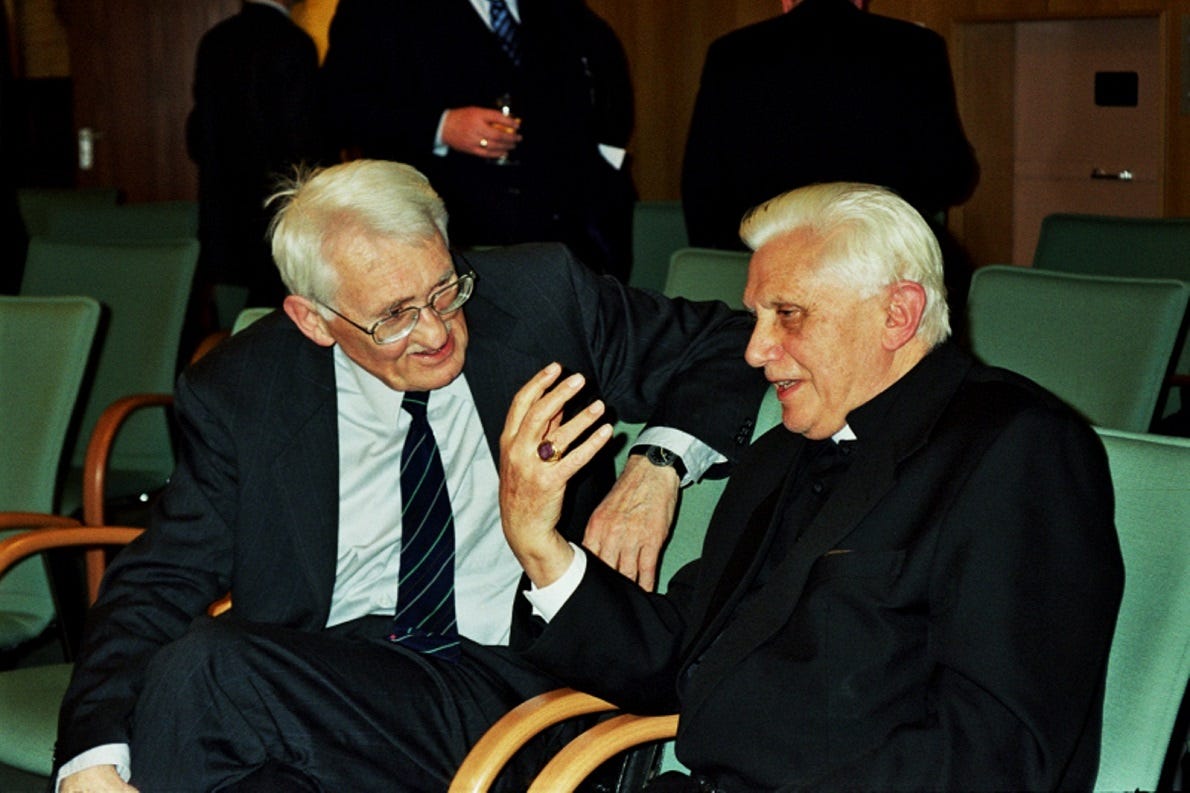
This is the thread that leads, over thirty years, to the 2004 dialogue with Cardinal Ratzinger at the Catholic Academy of Bavaria — a dialogue that the tributes treat, when they mention it at all, as a surprising biographical late turn rather than as the culmination of a project that had been oriented toward this question from the beginning. In that dialogue, Habermas made a concession that the political readings of his work had made almost unthinkable: secular reason cannot generate its own motivational resources. The values that sustain democratic life — solidarity, human dignity, the sense that justice matters, the obligation to those who have suffered — have deep historical roots in religious traditions, above all in the Judeo-Christian understanding of the person. Secular philosophy has not found a way to replicate or replace those roots. He argued for what he called a “complementary learning process” — a relationship in which secular reason and religious tradition each carry what the other needs and each submit to the corrective the other provides. Ratzinger, for his part, conceded that faith must submit to the corrective of reason — a concession that should not be taken for granted coming from the man who would become Benedict XVI.
What is philosophically significant about this exchange is not that Habermas converted to any form of theism. It is that he arrived, through seven decades of post-metaphysical philosophy, at the recognition that the central question the theological tradition had been asking — what actually grounds the claim that justice matters when no empirical fact compels it — was not a question that procedural rationality could answer from within itself. The post-metaphysical philosopher had followed his own argument all the way to its edge, and at that edge found that the tradition he had been carefully refusing to let do foundational political work was carrying something secular reason could not do without. That is a remarkable philosophical conclusion. It is also almost entirely invisible in the obituaries.
The prioritizing of the political debate involving Habermas over his theological dialogue is a deliberate, non-neutral editorial choice. The former, focused on Rawls, aligns well with Anglo-American political philosophy, allowing academia to easily engage with and evaluate its discussions on justice and public reason. The theological dialogue, however, presents a greater challenge. It necessitates considering that philosophy has genuine limitations, that religious traditions hold vital cognitive content secular reason requires, and that the post-Holocaust, post-metaphysical philosopher — a staunch defender of democratic discourse’s procedural conditions — ultimately embraced an intellectual humility before the deep tradition he had previously refused to let do foundational work. This is a more complex Habermas than political interpretations allow, but it is the figure whose work is now most significant.
His final major project — the three-volume Also a History of Philosophy, completed in his nineties — makes this explicit in a way that the tributes have not engaged. That work is not simply a history of ideas. It is an attempt to recover the spiritual and religious potential of the metaphysical tradition — the cognitive and moral content that philosophy has carried since the Axial Age — and to ask what of that content can survive the post-metaphysical turn and what cannot. It is the work of a philosopher who has spent his career bracketing the Absolute and has arrived, in his final years, at the question of what was actually in what he was bracketing, and how much of it secular reason actually needs. That project, more than any political intervention, more than any debate with Rawls or Dworkin, is where Habermas was working at the end of his life. Almost no one writing about his death this week has mentioned it.
It is also worth being clear about what Habermas’s openness to religion was not. He was never simply a champion of religion in the public sphere, and his caution here was deliberate and principled. His position was not that religious voices should be excluded from democratic deliberation — precisely the opposite. It was that they must translate their insights into publicly accessible reasons, ones that do not presuppose the truth of any particular comprehensive doctrine and that can in principle be heard and evaluated by citizens who do not share the underlying faith commitment. Religion carries genuine cognitive and moral content that secular reason needs. But the moment a religious tradition claims the authority to resolve political questions by appeal to revelation, natural law, or the will of God — the moment it short-circuits the slow, accountable work of public argument by appealing to a ground that only the faithful can access — it reproduces, in theological form, exactly the structural move Habermas spent his career diagnosing in German Idealism. The appeal to depth as a substitute for argument. The claim that some community, tradition, or people has privileged access to the ground from which political authority flows.
This is the defining political problem of the present moment. The rise of Christian nationalism and Catholic integralism in the United States — represented most visibly by JD Vance in the White House, by legal theorists like Adrian Vermeule arguing for a “common good constitutionalism” that subordinates liberal proceduralism to a substantive Catholic natural law framework, by Patrick Deneen’s sustained philosophical case in Why Liberalism Failed that Enlightenment proceduralism is itself the source of civilizational decay — is precisely the political form of the philosophical move Habermas identified. These are not fringe positions. They represent a serious, intellectually coherent, and increasingly politically empowered attempt to place one comprehensive religious doctrine in the position of foundational ground for democratic legitimacy — to do, in twenty-first century America, what the Volksgeist did in nineteenth-century Germany: elevate a particular cultural and religious identity to metaphysical status and claim that the political order flows from it. Habermas’s post-metaphysical framework, with all the limitations that Dallmayr and Davis rightly identified, was built precisely to hold the line against that move. His death arrives at the moment that line is most under pressure.
This is the philosopher whose death lands differently for me than the one being memorialized. Not the anti-fascist political theorist — though he was that too, and it mattered enormously. Not the proceduralist sellout — a reading that consistently fails to grasp what he was actually doing with Hegel and Marx, or what Piaget, Kohlberg, and the American pragmatists made possible. But the philosopher who began where Heidegger began, traced the philosophical logic of that tradition to the catastrophe it had authorized, built a post-metaphysical alternative that was never anti-religious but always insisted that religion could not do foundational political work in a plural public sphere, and arrived — through the Browning-Fiorenza tradition, through the Ratzinger exchange, through the final history of philosophy — at the recognition that secular reason and the religious traditions needed each other in ways that neither had fully acknowledged. That is the Habermas whose death this week represents a genuine loss. And it is this Habermas that is almost entirely absent from the current public discourse — and that I find the most vexing.
The personal path I want to trace in what follows — through Zen Buddhism, through the Kyoto School’s parallel catastrophe, through Bellah and back to the Western tradition, through Lalonde and Davis and the post-secular theology conversation — is not offered as an autobiography. It is offered as evidence. Evidence that the problem Habermas spent his career diagnosing is not a specifically European or Christian problem. It is a structural feature of what religion does when it overreaches — in any tradition, in any cultural context.
Charles Davis identified this structure with precision in his 1973 book The Temptations of Religion. Written in the aftermath of his own rupture with institutional Catholicism, the book names four temptations intrinsic to religion as such: the lust for certitude, the pride of history, cosmic vanity, and the wrath of morality. What Davis understood — and what made this book so important to the post-secular conversation at Concordia where I studied — is that these are not failures of bad religion or corrupt institutions. They are temptations built into the structure of religious traditions itself. The deeper a tradition’s commitment to ultimate truth, the more powerful the pull toward each of them. And each one, taken far enough, produces the same outcome Habermas had identified from the philosophical side: the claim to a ground beneath rational discourse, a certainty that forecloses the slow and accountable work of argument, a community that has elevated its own particular insight into the condition of possibility for everyone else’s.
What the section that follows tries to show is that this pattern recurs not only within Christianity or within Western philosophy, but in the encounter between Buddhist thought and German Idealism in early twentieth-century Japan. The Kyoto School catastrophe is not an exotic footnote. It is the same structural failure from a different direction — and tracing it from that direction is the clearest way I know to demonstrate that what Habermas was diagnosing was not a European cultural pathology but something more fundamental about what happens when any tradition, however sophisticated and however genuine, is asked to do foundational political work in a plural world.
II. How I Backed Into Habermas — Through Buddhism
The personal background — how I came to Buddhism in Montreal, what I found there, and what eventually came apart — is told in “Albert Low & Zen at War: On Suffering, Kensho & Catholicism in Quebec” and “Critical Theology & Integral Humanism: Marc Lalonde, Charles Davis, & the Postmodern Conservative Challenge”. Readers who want the full account are invited to start there. What I want to trace here is the intellectual path that connected that formation to the post-metaphysical questions Habermas had been working on, and why the connection felt not accidental but structurally necessary.
In 2006, the contemplative work and a family crisis running alongside it drove me back to school. I enrolled at Concordia University in Applied Human Sciences and Religious Studies, and it was here that the Zen formation and the philosophical questions I had been carrying began to find a framework. The path ran through Robert Bellah before it reached Habermas — and that sequence matters, because Bellah was the thinker who first gave me a way to hold what Section I describes above: the recognition that what the great traditions carry is not reducible to individual contemplative experience, but is embedded in historical institutions, evolutionary developments, and public practices that have their own logic independent of any individual’s interior life.
Two texts were indispensable. Beyond Belief — which contains his landmark 1964 essay “Religious Evolution” — gave me a developmental account of religion as a public and historical phenomenon, tracing the movement from archaic and mythic religious forms through the Axial Age breakthroughs to the modern differentiated religious situation. What Bellah made visible was something Wilber’s framework had gestured at but not fully grounded: that the development of religious consciousness is not just an interior spiritual story but a social and historical one, shaped by the same forces that shape everything else. The Robert Bellah Reader situated his project within the larger argument that the modern separation of rational cognition from moral evaluation — fact from value, faith from knowledge — is not only philosophically untenable but practically unsustainable. Bellah stood apart from my other reading because of his insistence that religion was shaped by forces independent of pure interior experience. He was, I came to understand, working in the same intellectual space as Habermas — asking what secular modernity had inherited from the religious traditions and what it was failing to acknowledge about that inheritance.
That recognition — that Bellah and Habermas were working on the same problem from adjacent angles — was what made the Kyoto School encounter, when I came to it through East Asian studies, land as something more than an intellectual history lesson. It landed as a diagnosis.
Kitaro Nishida, Keiji Nishitani, Hajime Tanabe — these were not marginal figures. Nishida is generally regarded as the most significant Japanese philosopher of the twentieth century, and the school that formed around his work at Kyoto Imperial University was the most serious attempt in modern intellectual history to bring Buddhist insight into sustained philosophical dialogue with the Western tradition. What made the project intellectually compelling — and this is important to say before the horror — was that it seemed to offer something neither tradition could provide alone. Western philosophy, in its Kantian and post-Kantian forms, had persistent problems with the ground of experience. German Idealism’s attempts to solve this — Fichte’s absolute ego, Schelling’s nature-philosophy, Hegel’s absolute spirit — each ended in philosophical overreach, positing a foundation that could not bear the weight placed on it. Heidegger’s turn to Being was the most sophisticated of these attempts, and it attracted serious Buddhist thinkers precisely because the Buddhist concept of śūnyatā — emptiness, the groundlessness of all things — seemed to offer what Western philosophy kept failing to find: a way of thinking about the ground of experience that did not commit the same errors. Nishida’s concept of absolute nothingness — developed from An Inquiry into the Good (1911) through the late essays — was a genuine philosophical achievement. Nishitani’s Religion and Nothingness extended this into a direct confrontation with nihilism, arguing that śūnyatā offered resources for a genuine response to the collapse of meaning in modernity that Western philosophy and theology had failed to find within their own traditions.
And yet what the Kyoto School built — in the years leading up to and during the Second World War — was, in significant part, a philosophical justification for Japanese imperialism. Nishida’s “place of nothingness” and Tanabe’s “logic of the species” were mobilized in support of the Japanese expansionist project. The Kyoto School, with all its philosophical sophistication and genuine Buddhist depth, provided intellectual cover for a militarist state in precisely the way Heidegger’s invocation of Being had provided intellectual cover for National Socialism. The structural parallel is exact: in both cases, the appeal to a ground beneath rational discourse — a mystical or ontological foundation that transcended the merely procedural — became the philosophical idiom through which atrocity was legitimated.
What this meant, in practical terms, was this: the contemplative depth was real. The philosophical achievement of Nishida’s absolute nothingness was real. None of that resolved the question of justice. None of that provided traction on the material and political question of what should happen to the people of Korea, China, Southeast Asia. The depth and the politics lived on entirely different tracks, and when they were forced to intersect, it was the politics that determined what the depth would be used for.
Brian Daizen Victoria’s Zen at War completed the picture. What collapsed was not the contemplative experience. What collapsed was the idealization: that Zen was somehow above history, transmitting a pure wisdom uncorrupted by the forces that shape everything else. And with that idealization collapsed a certain kind of confidence — the confidence that if we could just go deep enough, if we could just touch the ground beneath ordinary consciousness, the political and justice questions would somehow resolve themselves. They wouldn’t. They hadn’t. The most sophisticated Buddhist philosophical tradition in modern intellectual history had proven that they wouldn’t.
What makes the Kyoto catastrophe more than historical is that its structural logic — depth as substitute for argument, the appeal to an ontological ground as sufficient for political orientation — did not die with the Japanese imperial project. It migrated. It found new hosts. And tracing those migrations is where the abstract claim of the previous section becomes concrete and personal.
The most serious scholarly attempt to reckon honestly with the Kyoto School’s double legacy — its genuine philosophical achievement and its political catastrophe — is the work gathered in Jason M. Wirth, Bret W. Davis, and Brian Schroeder’s edited volume Japanese and Continental Philosophy: Conversations with the Kyoto School (Indiana University Press, 2011). Wirth, a philosopher at Seattle University who is also a Soto Zen priest, and Davis, who spent over a decade practicing Rinzai Zen at Shōkokuji monastery in Kyoto while completing doctoral work at Vanderbilt, bring to this project a rare combination of insider practice and rigorous philosophical accountability. Their approach does not simply celebrate the Kyoto School’s synthesis of Buddhist and Western thought. It holds the synthesis to the critical standard the synthesis itself demands — asking what the appeal to absolute nothingness actually authorizes, and what it forecloses. Wirth’s Nietzsche and Other Buddhas: Philosophy after Comparative Philosophy (Indiana University Press, 2019) extends this further, putting Dōgen, Linji, and Hakuin into genuine philosophical confrontation with Nietzsche and Deleuze — not to manufacture a convenient convergence, but to press on what each tradition is actually doing when it claims to have dissolved the ground problem. The honest answer, in both books, is that the dissolution is never complete, and that the political question — what follows, institutionally and democratically, from the nondual insight — remains perpetually underdetermined by the insight itself.
The Western appropriation of Buddhism that grew out of the same mid-twentieth-century context as the Kyoto School’s influence carried a different but structurally related problem. Slavoj Žižek’s diagnosis — however polemically overstated and however insufficiently grounded in actual Buddhist philosophy — tracks something real: that Western Buddhism, as it has developed in the consumer societies of North America and Europe, has too often functioned as what he calls “capitalism’s perfect ideological supplement.” The contemplative turn inward, the cultivation of equanimity in the face of structural injustice, the privatization of suffering into individual spiritual practice — these are not distortions of the Zen and Tibetan traditions as Western practitioners received them. They are available destinations of those traditions under specific social conditions, just as the Kyoto School’s politics were available destinations of Nishida’s absolute nothingness under the specific social conditions of 1930s Japan. The “McMindfulness” phenomenon — the reduction of Buddhist meditative practice to a productivity tool and stress-management technique, stripped of its ethical and soteriological context — represents the endpoint of this trajectory: depth fully absorbed into the logic of the system it was supposed to transcend. Ron Purser’s McMindfulness (Repeater Books, 2019) gives the fullest account of this colonization, tracing how what began as a serious contemplative practice was systematically disembedded from its communal, ethical, and political context and repackaged as an individual optimization technique compatible with, indeed supportive of, the very structural conditions that generate the suffering it purports to address. But McMindfulness is only the most visible and commercially successful form of a broader pattern. The same structural dynamic — depth privatized, ground claimed, political question deferred — runs through the New Age appropriation of Eastern traditions more generally: the eclectic spirituality market that assembled Zen, Tibetan Buddhism, Vedanta, Tarot, astrology, channelling, and neo-shamanism into a consumer product of inner transformation compatible with any political arrangement and critical of none. And it runs through the occult revival that has accompanied and often preceded the New Age: from Theosophical lodges and Anthroposophical communities in the early twentieth century, through the post-1960s explosion of esoteric publishing, to the contemporary internet-mediated occult culture that has developed its own political valences ranging from therapeutic self-help to outright reactionary mysticism. In each of these forms, the structural logic is the same: a depth is posited, access to it is claimed, and the political question — what follows democratically and institutionally from whatever is found at the bottom — is left entirely underdetermined.
This is the milieu in which Wilber built his integral synthesis of Buddhism, developmental psychology, and systems theory — and it matters for understanding both what his project achieved and where its structural vulnerabilities lie. It also matters to name the intellectual genealogy more precisely. Wilber’s project sits at the intersection of two lineages that are rarely traced together but that share the same structural feature. The first is the perennial philosophy tradition — from Blavatsky’s Theosophy through Aldous Huxley’s The Perennial Philosophy (1945) to Huston Smith’s Forgotten Truth — which claims that behind the surface diversity of the world’s religious traditions lies a single primordial wisdom accessible to the initiated. The second is the developmental psychology and systems theory tradition he drew on through Piaget, Kohlberg, Gebser, and Aurobindo. The brilliance of the AQAL synthesis is its attempt to hold these together: to subject the perennial depth-claim to the developmental and perspectival disciplines that give it structure and accountability. But the perennial lineage carries its structural inheritance regardless of how sophisticated the synthesis. When Wilber in his early career described Adi Da Samraj — the American guru later credibly accused of serious abuse of devotees — as the greatest living Realizer, he was not making an error external to his framework. He was applying the framework’s own logic: if genuine transpersonal realization is possible, and if it represents access to the ground that transcends ordinary developmental accountability, then the question of how to evaluate claims to have achieved it from within ordinary consciousness becomes almost unanswerable. The perennial philosophy’s ground-claim had not been dissolved by the post-metaphysical turn. It had been incorporated into the AQAL architecture, and the accountability problem came with it. the AQAL framework’s apex of formless awareness as the nondual ground of all quadrants, levels, and lines is recognizably Mahayana in its ontological commitments. His post-metaphysical turn in Integral Spirituality (2006) was explicitly an attempt to hold this Buddhist depth while subjecting it to the epistemic demands Habermas had articulated — to find a way of speaking about the transpersonal that did not commit what Habermas would recognize as the foundationalist error. That attempt is genuine and represents real philosophical progress over the McMindfulness dissolution of depth into function. But the structural vulnerability that the Kyoto School and the Western Buddhist reception both expose is visible in integral theory as well, in a form specific to its own social context: the guru problem. Wilber’s sustained endorsement of Adi Da Samraj — maintained even as evidence accumulated of serious abuse of devotees, and rationalized through the theory that genuine Realization at the spiritual line of development could coexist with severe dysfunction in other developmental lines — represents exactly the failure mode the Habermasian corrective is designed to prevent. The nondual ground, posited as the condition of possibility for all quadrants, effectively suspended the accountability structures that the procedural framework would otherwise require. If someone has genuinely accessed the transpersonal ground, the argument runs, how could ordinary citizens in good standing evaluate that claim? The guru principle, in its integral form, is not a distortion of the AQAL framework. It is an available destination of it. And the same structural logic that made Heidegger’s Being available for the Volksgeist claim — the positing of a ground that particular individuals or communities can access while others cannot — is recognizable, in a very different cultural register, in the integral community’s persistent difficulty holding its own spiritual authorities to democratic accountability.
This is why Bellah mattered so much at that moment. His account of religious evolution was precisely an argument against the idealization I had been carrying: that contemplative depth, taken on its own terms, is a reliable guide to the social and political questions. For Bellah, the Axial Age breakthroughs — in which the great traditions first achieved the kind of reflexive, universal moral consciousness that Buddhism and the prophetic religions represent — were genuine cognitive achievements. But they were achievements embedded in historical institutions and social practices, shaped by the same forces that shaped everything else, and they carried both their genuine wisdom and the ideological distortions of their historical contexts. Separating the two required exactly the kind of critical, post-metaphysical framework that Habermas had been building — a framework that could honour what the traditions carry without granting them the authority to bypass the slow, accountable work of moral and political argument.
It was that convergence — the Kyoto catastrophe as diagnosis, Bellah as the bridge, Habermas as the philosophical architecture — that sent me, through Lalonde and Davis at Concordia, into the post-metaphysical and post-secular conversation that has defined my work since. I came to Habermas from the other side of the world’s intellectual history: through a Buddhist formation that had encountered German Idealism at its furthest extension and followed it to a structurally identical catastrophe. Two routes, from opposite directions, arriving at the same impasse. It was that convergence — not Frankfurt School critical theory, not the European left — that made the post-metaphysical project feel not like an academic position to evaluate but like an answer to a question I had been living.
That question, and the shape of the answer Habermas built, is what I want to trace in what follows — through the postmodern theology debates, through the post-metaphysical theology tradition that runs through Lalonde and Davis, and finally through the Wilber question that the present political moment makes impossible to avoid. The conflict between postmodern theology — which reaches back behind the Enlightenment for a thicker metaphysical foundation, in Milbank’s Radical Orthodoxy, in McGrath’s contemplative retrieval, in the natural law revival that has reached the White House — and post-metaphysical theology — which tries to honour what the traditions carry while refusing to let that content do foundational political work in a plural public sphere — is not an academic dispute. It is the philosophical form of the cultural wars now playing out at full force. Habermas understood that conflict better than anyone. His death is an occasion to understand it more clearly.
III. The Lost Road and Phenomenology for the Godforsaken
For readers who haven’t followed the German Idealism revival closely, a brief orientation is necessary before the argument that follows can land with its full weight. My essay “On Sean McGrath’s Lost Road and the Post-Metaphysical Challenge” (February 2026) engages this material at length. What I want to do here is condense the essential philosophical stakes and then extend the argument into territory the earlier essay only gestured toward — the direct confrontation between postmodern and post-metaphysical theology in the current political moment.
Sean McGrath is a Canadian philosopher working at Memorial University of Newfoundland, and one of the most serious practitioners in the current revival of German Idealism — particularly the late Schelling — within a broadly Catholic contemplative framework. His work is not easy to locate on the usual political or ecclesiastical maps. He is neither a traditionalist nostalgic for pre-modern Christendom nor a liberal Catholic accommodating the tradition to secular modernity. He is something philosophically rarer: a thinker who takes German Idealism seriously from the inside, reads it with the care of someone who knows it from sustained original engagement, and draws from it toward what he calls the recovery of the Western contemplative tradition as a living way. That recovery is philosophically genuine. The question it has not yet answered is what this essay is pressing.
The key to understanding what is at stake in McGrath’s project begins not with The Lost Road (2025) but with his earlier Early Heidegger and Medieval Philosophy: Phenomenology for the Godforsaken (2006). This book is the most important and least discussed contribution in his entire body of work, and its argument reshapes everything that follows. McGrath demonstrates that the young Heidegger is not primarily a student of Husserl or a Greek philosopher in disguise, but a thinker whose entire early project is shaped by his rupture with Catholic Scholasticism and his deep, suppressed engagement with the Christian contemplative tradition. The “hermeneutics of facticity” — Heidegger’s insistence that philosophy begins from the concrete, thrown situation of human existence — is, McGrath shows, a secularization of Luther’s theology of the cross. The existential analytics of Dasein, the analysis of thrownness, finitude, and care, the destruction of the history of ontology — all of this is operating within a theological problematic that Heidegger had left Catholicism to escape but could not leave behind.
What Heidegger spent a career concealing, McGrath uncovers: the supposedly secular phenomenological project carries theological cargo that was never declared at the border. The philosophical achievement of Being and Time cannot be fully understood without tracing the suppressed Christian mystical inheritance that structures it from within. And this insight cuts in two directions simultaneously. Looking backward, it explains how a project apparently devoted to secular ontology could carry within it the resources for both fascism and, via the Kyoto School, for the philosophical justification of Japanese imperialism. The structural resonances that made Heidegger so attractive to serious Buddhist thinkers were real — but they were resonances not between secular phenomenology and Buddhist thought, but between a secularized Christian mysticism and Buddhist ontology. The inheritance came with its catastrophic potential attached and unacknowledged.
Looking forward to the present, the Phenomenology for the Godforsaken thesis means something even more pressing. If the structure of Heidegger’s philosophy carries the suppressed shape of the tradition he left, and if the current German Idealism revival is bringing that suppressed content back to the surface and making it explicit — which is precisely what The Lost Road does, honestly and without apology — then the revival is not simply recovering an abandoned philosophical resource. It is re-activating a theological commitment that was operative all along, one that was mobilized in catastrophic ways in the twentieth century and that has never been subjected to the full reckoning that would make it safe to re-activate.
The Lost Road is the point where the Schelling scholarship steps aside and speaks directly about what it was always in service of: a recovery of the Western contemplative tradition as a living way, against the flattening forces of secular modernity and the impoverished spirituality of late capitalism. I argued in my review that this recovery is philosophically genuine and philosophically important. McGrath is not Peterson. The intellectual depth is not equivalent. He is asking serious questions about what was lost when the contemplative tradition was dismantled, and the loss was real. But the question his project has not yet answered — the question Habermas spent his life building an answer to — is what happens when that recovered tradition meets the political world. Not in the seminar room. In the public square. Under conditions of genuine plurality, where not everyone shares the comprehensive doctrine the tradition presupposes. Under historical conditions where the philosophical architecture that carries contemplative depth has already been mobilized, twice in the twentieth century, in service of political catastrophe.
The fault line that The Lost Road exposes runs through all of contemporary theology, and understanding it requires distinguishing four positions that are frequently conflated in current debates.
Radical Orthodoxy — associated above all with John Milbank — represents the most ambitious and most politically consequential version of what I am calling postmodern theology in the restrictive sense. Milbank’s argument, developed across Theology and Social Theory (1990) and the Radical Orthodoxy series, is that secular reason is not a neutral ground from which theology can be evaluated but is itself a theological position — specifically, a heretical one, the product of late medieval nominalism’s rupture with the participatory ontology of classical Christian thought. His response to Habermas’s post-metaphysical framework is not to engage it on procedural grounds but to deny its legitimacy entirely: only a recovery of Augustinian and Thomistic metaphysics of participation can provide the ontological ground for a genuinely just social order. God is not the God who submits to the corrective of reason — as Ratzinger conceded in the 2004 dialogue. God is the ground of reason itself, and any reason that does not recognize this is, in Milbank’s analysis, nihilism dressed up as neutrality. This is the theological equivalent of the move Habermas spent his career diagnosing. It refuses the procedural question rather than answering it.
McGrath’s contemplative retrieval is philosophically more serious and more honest about what it is doing than Radical Orthodoxy, but it shares the same structural feature: it reaches back behind the Enlightenment settlement for a thicker metaphysical foundation, one rooted in the contemplative tradition of German Idealism and its medieval antecedents. Where Milbank insists on the priority of participation over procedure, McGrath insists on the priority of contemplative experience over rationalist reconstruction. The intentions are genuinely different from the Catholic integralists who have reached political power. But the structural question — what constrains the political use of what is found in the contemplative ground — remains unanswered in both cases.
Postmodern theology in the phenomenological mode — Jean-Luc Marion and, from a different angle, John D. Caputo — represents a more philosophically nuanced attempt to think beyond both secular rationalism and metaphysical restoration. Marion’s project, from God Without Being (1982) onward, is to overcome what he calls onto-theology — the reduction of God to a metaphysical “highest being” — not by abandoning theology but by recovering an older tradition of negative theology and phenomenological givenness. God, for Marion, cannot be conceptualized without becoming an idol. His phenomenology of the “saturated phenomenon” — the event of givenness that overflows all intentional categories — attempts to describe how the divine can make itself present without being captured in the metaphysical frameworks that always distort it. Caputo’s “weak theology,” drawing on Derrida, pushes this further in a deconstructive direction: God as unconditional claim without force, an event rather than a being, calling without compelling. Both Marion and Caputo are, in their different ways, trying to think theologically without reproducing the metaphysical architecture that Habermas identified as the source of the structural problem.
The critical question for both is whether their sophisticated refusal of onto-theology translates into a corresponding refusal to let theology do foundational political work. Caputo’s weak theology, with its insistence on unconditional claim without sovereign force, is explicitly designed to resist the political theology of sovereignty — the move that converts divine authority into state authority. Marion’s phenomenology of givenness, however, while philosophically anti-foundationalist, tends toward a theological confidence — a Christocentric fullness, as Caputo himself observes — that does not obviously resist the institutional forms through which theological claims enter politics. The Premio Joseph Ratzinger awarded to Marion is not incidental. His theological project, however phenomenologically sophisticated, reinforces rather than disrupts the classical neo-Platonic Christian framework that Habermas was negotiating with at the 2004 dialogue.
Post-metaphysical theology proper — the tradition of Lalonde and Davis that runs through the Browning-Fiorenza conversation — is the tradition that has most directly engaged Habermas’s framework on its own terms, and it is the tradition most consistently overlooked in the current debates. The post-metaphysical theologians do not simply accept the procedural framework and retreat into private faith. They press on what communicative rationality cannot contain — the victims of history, the unredeemed suffering that no future discourse can validate — and argue that the religious traditions carry genuine cognitive content that the post-metaphysical framework needs but cannot generate from within its own resources. What distinguishes them from Milbank and McGrath is not that they take less seriously what the traditions carry. It is that they refuse to let that content bypass the slow, accountable work of public argument. The translation requirement — religious insight must be rendered in publicly accessible terms — is not a concession to secularism. It is the philosophical condition under which the genuine content of the traditions can be heard by everyone rather than only by those who already share the comprehensive doctrine.
IV. Wilber, Integral Post-Metaphysics, and MAGA America
The thread running through this essay — from Habermas’s Schelling dissertation through the Kyoto catastrophe through the current theological fault line — arrives at a question I have been circling in my own work for years, and which the present political moment makes impossible to defer any further. I want to approach it not as a verdict but as a genuine reckoning with a tradition that formed me and that I still believe carries resources the present moment needs. The essay “Can the Real Wilber Please Stand Up? A Short Journey Through Wilberland” (February 2026) addresses the recuperation of the post-metaphysical Wilber from the lifestyle enclave the integral movement has too often become. What I want to press here, drawing also on “Beyond the Master Signifier: Toward a Developmental Account of Psychological Flexibility and Virtue Ethics” (February 2026), is whether integral theory has genuinely followed through on the Habermasian reckoning its founder gestured toward — or whether it has, in the current political moment, drifted toward the very structural move Habermas spent his career diagnosing.
The post-metaphysical Wilber is real. The Wilber who read Habermas carefully in A Sociable God (1983) — who brought together Habermas’s three modes of knowledge-inquiry and Bellah’s categories of religious evolution to build a sociology of depth that neither could provide alone — was doing something philosophically serious. The Wilber who insisted on distinguishing pre-rational from trans-rational, who drew on Kohlberg’s developmental stages and Piaget’s cognitive psychology, who argued in Integral Spirituality (2006) that a post-metaphysical integral theory was both possible and necessary — this Wilber was working on exactly the problem this essay has traced: how to hold depth and justice together rather than trading one against the other. And the diagnosis in “Beyond the Master Signifier” remains important: the Left’s allergy to religion — its conflation of pre-rational mythic literalism with trans-rational contemplative depth — is a developmental failure at civilizational scale. It has ceded the one institution that has historically functioned as what Wilber calls “the great conveyor belt of human development” to the very right-wing movements it opposes. That diagnosis is correct. The conveyor belt needs to be reclaimed.
But the question is whether integral theory is helping reclaim it, or whether its ambiguous political posture is in fact lending philosophical legitimacy to movements that have already decided to stop asking the justice question.
The specific evidence is Trump and a Post-Truth World (2017). Wilber’s response to Trump’s election frames it as “an evolutionary self-correction” — a backlash necessitated by the failure of the postmodern “green” leading edge, whose elitism, political correctness, and internal contradictions had produced an explosive reaction. Some of this diagnosis is accurate: the progressive leading edge does suffer from the fusion-driven rigidity the “Beyond the Master Signifier” essay describes, the Pre/Trans Fallacy at the level of moral psychology, the inability to engage all six of Haidt’s Moral Foundations rather than only Care and Fairness. These are real problems, and naming them honestly is not the same as endorsing the backlash.
The structural problem is what Wilber does with this diagnosis. By framing the backlash as an evolutionary self-correction — a movement of Spirit adjusting its own unfolding — the framework absorbs Trump’s rise into a developmental narrative that grants it a quasi-metaphysical legitimacy. The Kosmos is self-correcting. Evolution is at work. And once that frame is in place, the specific political question — who is harmed, what is being reversed, which emancipatory gains are being dismantled, on whose bodies these corrections are being enacted — recedes into the background. It becomes a downstream question, answerable once the developmental moment has run its course, rather than the primary accountability question that the procedural framework Habermas built is specifically designed to keep at the centre.
In 2017, this was troubling but arguably deferrable. In 2026, with Trump’s second administration remaking American domestic and foreign policy at speed, it is not. The threatened annexation of Canada and Greenland — announced with the language of Manifest Destiny, of historical inevitability, of civilizational expansion — is precisely the Fichtean move at scale: the nation as the concrete historical form through which Spirit expresses its next stage. The escalating confrontation with Iran, pursued with a maximalism that deliberately forecloses the slow, procedural, multilateral work of diplomatic accountability, is the post-liberal preference for decisionism over deliberation made into foreign policy. These are not aberrations on the margins. They are the systematic dismantling of the procedural architecture — multilateral agreement, international law, constitutional constraint — that Habermas identified as the only framework capable of holding democratic legitimacy together across genuine plurality.
Here is also where The New Conservatism lands with unexpected contemporary force — not as the political interventionism the tributes have celebrated, but as a diagnostic framework that Habermas was building before the phenomenon it diagnosed had fully arrived. The book’s core argument, running beneath the Historians’ Debate interventions, is that the neoconservative turn of the 1980s was not primarily a reaction to specific policy failures or cultural provocations. It was a structural recurrence: the appeal to cultural depth, historical rootedness, and collective identity against the supposed coldness of liberal proceduralism — the same move Habermas had been tracing from Fichte through Heidegger, now laundered back into respectable intellectual discourse. What Habermas saw, and named, was that this move would not stop with the revisionist historians. It would find new vehicles. The post-liberal Catholics, the MAGA nationalists, the neo-traditionalists now mobilizing around Deneen’s Why Liberalism Failed, Vermeule’s “common good constitutionalism,” and Vance’s post-liberal Catholicism are not a rupture from what Habermas was describing in the 1980s. They are its further development. McManus’s work on postmodern conservatism — the most rigorous Anglophone genealogy of the contemporary right’s philosophical lineage — has been building toward this same recognition: that what drives the new right is not simply populist resentment or cultural backlash, but a coherent philosophical inheritance, running from the Volkish traditions and the esoteric currents through the neoconservative moment to the present, that has always been making the same structural claim. What Habermas built in response was not a defense of the status quo. It was the argument that the answer to liberal exhaustion is not to abandon the procedural framework for a substantive telos — whether Catholic natural law, nationalist destiny, or occult ground — but to reconnect it to communicative rationality, to rebuild the public sphere institutions through which people can genuinely reason together. That distinction is what Habermas death leaves most urgently undefended.
That inheritance has a specific contemporary form, and McManus’s analysis of postmodern conservatism names it precisely — an analysis I engage at length in “Beyond the Master Signifier.” Postmodern conservatism is characterized by its indifference to the distinction between truth and falsehood, its legitimation of political claims through identity rather than argument, and its weaponization of all six of Haidt’s Moral Foundations — Authority, Loyalty, Sanctity, Care, Fairness, Liberty — in service of a structure that immunizes itself against correction. Jordan Peterson functions for the postmodern conservative right exactly as Žižek functions for the Lacanian-Marxist left: as a Master Signifier around whom communities organize, whose authority is conferred through intellectual fusion rather than earned through fallibilistic correction. Both produce brilliant partial insights. Both attract communities that cannot get beyond them. And an integral framework that frames Peterson’s cultural moment primarily as a symptom of postmodernism and Marxism’s dysfunction — rather than as a sophisticated mobilization of pre-rational ethnocentrism under the cover of depth — provides that moment with philosophical legitimacy it does not deserve.
The question, then, is what an integral political praxis that actually holds the Habermasian corrective looks like when someone embodies it rather than merely theorizes it. The clearest case I have found is Michael Brooks. As I argued in “Towards a New Structural Transformation of the Public Sphere” and in “Beyond the Master Signifier,” Brooks represents the clearest case study I have found of what genuine integral political praxis looks like when someone actually lives it. Brooks operated across all six of Haidt’s Moral Foundations — loyalty as solidarity, authority as education and mentorship, sanctity as the recognition that the struggle for human flourishing carries ultimate significance, care and fairness as the content of socialist politics, liberty as the resistance to structural domination — but within structures that welcomed correction rather than immunizing themselves against it. His defusion from ideological fusion was not neutrality or both-sidesism. It was the capacity to advocate passionately for democratic socialism while satirizing the rigidity of its adherents, to take seriously conservative moral intuitions without capitulating to conservative politics, to hold his own convictions lightly enough to revise them when the evidence demanded. This is what Wilber’s framework describes as its ideal but too rarely produces: a politics that is genuinely post-conventional without being allergic to what the pre-conventional and conventional stages carry.
Brooks’s early death in 2020 left that project unfinished. What “Beyond the Master Signifier” argues — and what the present moment makes urgent — is that what Brooks practiced can be made teachable, grounded in the institutional architecture that Habermas’s communicative theory and the ACT Hexaflex together provide. The need for an updated account of virtue ethics and integral political praxis — one that can hold Haidt’s moral foundations together with Habermas’s communicative framework, that can distinguish liberating structures from dominating ones, that can reclaim the conveyor belt without regressing to pre-rational forms — is not an academic project. It is the precise form that the political alternative to MAGA conservatism needs to take, and it is the project that integral theory has the resources to contribute to but has not yet consistently delivered.
The 2004 Habermas-Ratzinger dialogue gives me the frame for thinking about where integral theory stands and what it still needs to do. Habermas conceded that secular reason cannot generate its own motivational resources — that the content the great traditions carry is genuinely necessary. This makes a post-metaphysical integral theory possible in principle. Wilber’s post-metaphysical turn in Integral Spirituality is a genuine attempt at exactly this. But Ratzinger had explicitly conceded the correctness of reason. Wilber makes no equivalent concession. The nondual is posited as the condition of possibility for all quadrants, all levels, all lines. Whether this positing repeats the move Habermas diagnosed — claiming access to a ground beneath rational discourse and allowing that ground to constrain what can be said about justice — is not a question that can be answered from outside the framework. It can only be answered by pressing it from within.
What integral theory needs, to honour its own deepest intentions, is the equivalent of what Habermas built through Piaget, Kohlberg, and the American pragmatists: a developmental account of consciousness grounded in communicative competence, in the fallible and accountable intersubjective process, rather than in the appeal to a transpersonal ground that is, in principle, unaccountable to the procedural norms that make justice claims answerable to everyone. The post-metaphysical Wilber pointed in this direction. The question is whether integral theory has followed him all the way there — whether it has genuinely reckoned with what Habermas was building, rather than incorporating his framework as one quadrant among others while leaving the nondual position unchallenged and its political consequences unaddressed.
Heidegger’s politics were not a distortion of his philosophy. They were an available destination. The Kyoto School’s politics were not a distortion of their Buddhist philosophical synthesis. They were an available destination. The question I am leaving open — genuinely open, I am not making a charge — is whether the integral politics that become available when the Kosmos is understood to be self-correcting through disruption, when Trump’s rise can be framed as evolution at work, when the suffering of those on the wrong end of that correction can be absorbed into a developmental narrative that grants it a purpose they never consented to — whether those politics are a distortion of Wilber’s project or an available destination of it.
Will Wilber’s legacy be that of the philosopher who finally established the structure capable of unifying depth and justice? Or will he be seen as another figure in the mold of Heidegger — systematic, brilliant, yet ultimately incapable of maintaining ethical boundaries?
I do not know the answer. But I think it is the right question to be asking in the week that Jürgen Habermas died — and in the moment when everything Habermas spent his life building is under more pressure than it has faced since the Historians’ Debate.
Suggested Reading
Jürgen Habermas, The Structural Transformation of the Public Sphere (MIT Press, 1962/1989)
Jürgen Habermas, Knowledge and Human Interests (Beacon Press, 1968/1971)
Jürgen Habermas, Theory and Practice (Beacon Press, 1963/1974)
Jürgen Habermas, Legitimation Crisis (Beacon Press, 1973/1975)
Jürgen Habermas, Communication and the Evolution of Society (Beacon Press, 1976/1979)
Jürgen Habermas, The Theory of Communicative Action, 2 vols. (Beacon Press, 1981/1984–87)
Jürgen Habermas, The Philosophical Discourse of Modernity (MIT Press, 1985/1987)
Jürgen Habermas, The New Conservatism: Cultural Criticism and the Historians’ Debate (MIT Press, 1985/1989)
Jürgen Habermas, Moral Consciousness and Communicative Action (MIT Press, 1983/1990)
Jürgen Habermas, Postmetaphysical Thinking (MIT Press, 1988/1992)
Jürgen Habermas, Between Facts and Norms (MIT Press, 1992/1996)
Jürgen Habermas, The Inclusion of the Other (MIT Press, 1996/1998)
Jürgen Habermas, The Future of Human Nature (Polity, 2001/2003)
Jürgen Habermas and Joseph Ratzinger, The Dialectics of Secularization (Ignatius Press, 2004/2006)
Jürgen Habermas, Between Naturalism and Religion (Polity, 2005/2008)
Jürgen Habermas, An Awareness of What is Missing: Faith and Reason in a Post-Secular Age (Polity, 2008/2010)
Jürgen Habermas, The Crisis of the European Union (Polity, 2011/2012)
Jürgen Habermas, Also a History of Philosophy, Vol. 1: The Project of a Genealogy of Postmetaphysical Thinking (Polity, 2019/2023)
Jürgen Habermas, Also a History of Philosophy, Vol. 2: Rational Religion (Polity, forthcoming)
Jürgen Habermas, Things Needed to Get Better: Conversations with Stefan Muller-Doohm and Roman Yos (Polity, 2025)
Philipp Felsch, The Philosopher: Habermas and Us (Polity, 2025)
Seyla Benhabib, “Carrying on his Legacy,” KNA (March 2026)
Peter J. Verovšek, Jürgen Habermas: Public Intellectual and Engaged Critical Theorist (Columbia University Press, 2026)
Robert N. Bellah, “Religious Evolution,” American Sociological Review 29:3 (1964)
Robert N. Bellah, Beyond Belief: Essays on Religion in a Post-Traditionalist World (University of California Press, 1991)
Robert N. Bellah, Religion in Human Evolution (Harvard University Press, 2011)
Robert N. Bellah, ed. Steven M. Tipton, The Robert Bellah Reader (Duke University Press, 2006)
Don S. Browning and Francis Schussler Fiorenza, eds., Habermas, Modernity & Public Theology (Crossroad, 1992)
Marc Lalonde, Critical Theology and the Challenge of Jürgen Habermas (Peter Lang, 1999)
Brian Daizen Victoria, Zen at War (Rowman & Littlefield, 1997)
Jason M. Wirth, Bret W. Davis, and Brian Schroeder, eds., Japanese and Continental Philosophy: Conversations with the Kyoto School (Indiana University Press, 2011)
Jason M. Wirth, Nietzsche and Other Buddhas: Philosophy after Comparative Philosophy (Indiana University Press, 2019)
Ron Purser, McMindfulness: How Mindfulness Became the New Capitalist Spirituality (Repeater Books, 2019)
Aldous Huxley, The Perennial Philosophy (Harper & Brothers, 1945)
René Guénon, The Crisis of the Modern World (Luzac & Co., 1927/1942)
Julius Evola, Revolt Against the Modern World (Inner Traditions, 1934/1995)
Mark Sedgwick, Against the Modern World: Traditionalism and the Secret Intellectual History of the Twentieth Century (Oxford University Press, 2004)
Charles Davis, A Question of Conscience (Hodder & Stoughton, 1967)
Charles Davis, The Temptations of Religion (Hodder & Stoughton, 1973)
Fred Dallmayr, Integral Pluralism: Beyond Culture Wars (University Press of Kentucky, 2010)
Jean-Luc Marion, God Without Being (University of Chicago Press, 1982/1991)
John D. Caputo, The Weakness of God: A Theology of the Event (Indiana University Press, 2006)
Sean McGrath, Early Heidegger and Medieval Philosophy: Phenomenology for the Godforsaken (Catholic University of America Press, 2006)
Sean McGrath, The Lost Road (Christian Alternative, 2025)
John Milbank, Theology and Social Theory: Beyond Secular Reason (Blackwell, 1990)
Patrick Deneen, Why Liberalism Failed (Yale University Press, 2018)
Ken Wilber, A Sociable God: Toward a New Understanding of Religion (Shambhala, 2005)
Ken Wilber, Integral Spirituality (Shambhala, 2006)
Ken Wilber, Trump and a Post-Truth World (Shambhala, 2017)
Charles Taylor, A Secular Age (Harvard University Press, 2007)
Erik, this is an outstanding and deeply learned reflection on Jürgen Habermas—easily one of the most philosophically substantive responses I’ve seen so far (or ever will see). Your treatment of the Habermas–Schelling lineage, the Heidegger problem, and the Kyoto School parallel is especially compelling, and your willingness to engage Ken Wilber with both respect and rigor is refreshing. This is the kind of serious, integrative philosophical work our current moment needs. There is a great deal here that deserves careful digestion, and I’d like to return with a more detailed response soon—particularly around the relationship between nondual realization and communicative rationality. Congratulations on an excellent piece of philosophical reflection! Thank you. 🙏
I didn’t/couldn’t read all of this, but I’m glad to know it’s here.