![Integral [+] Facticity](https://substackcdn.com/image/fetch/$s_!yhcJ!,w_120,h_120,c_fill,f_webp,q_auto:good,fl_progressive:steep/https%3A%2F%2Fbucketeer-e05bbc84-baa3-437e-9518-adb32be77984.s3.amazonaws.com%2Fpublic%2Fimages%2Ff8458843-3278-4fcc-accc-17ad21352205_1280x1280.png)

Introduction
Following the publication of my last essay, The Future of Contextual Behavioral Science & Role of Theology, I had a dialogue with Michel Bauwens that deepened some of my ongoing reflections and thinking. We have been in casual correspondence since late May, simply sharing our respective work and comparing notes on where our thoughts might meet. Over the course of these exchanges, I began to see a fascinating connection emerging between the psychological flexibility of contextual behavioral science, the collaborative architecture of the commons, and the developmental dynamics of the American integral movement. This essay is an attempt to map those delicate threads, tracing how individual psychological processes might translate to the macro-level design of the commons and the ongoing digital transformation of the public sphere.
Our dialogue was productive precisely because of our different trajectories. While I approached these issues through psychological flexibility and contextual behavioral science, Michel brings decades of work on the commons and the institutional economics of Elinor Ostrom. In our exchange, I saw a compelling convergence. It allowed me to connect the Ostrom-based Prosocial framework with the evolutionary models in Wilson and Hayes’s Evolution and Contextual Behavioral Science, and the broader dialogue between David Sloan Wilson and Ken Wilber on the development of a multicellular society.
The Catholic dimension of our dialogue was also particularly striking, emerging from Michel’s view of the long arc of the Church through the lens of the commons. Although he is not confessional in the traditional sense, his deep familiarity with social and monastic history allows him to analyze ecclesiastical developments as experiments in peer-to-peer resource management. He notes, for example, how early monastic rules organized shared labor and communal property as highly functioning, alternative economic models. His connection to modern Rome has emerged from peer-to-peer initiatives that have occasionally granted him access to high-level Vatican events where digital theorists and theologians search for shared horizons.
Interestingly, he had previously explored very little of the Catholic tradition of integral human development or the integral humanism stemming from Jacques Maritain’s philosophy. Maritain’s insistence on developing the “whole person”—spiritually and materially—offers a profound, personalist alternative to both raw capitalism and state collectivism, yet it is rarely cited in contemporary progressive or left-wing spaces. Seeing these concepts resonate with a thinker of Michel’s background underscored how easily this lineage is overlooked, and how vital it is to reclaim for contemporary discourse. However, prior to examining this theological dimension and the complex definitions and history of the term integral, it is essential to explain the origins of my interactions with Michel, as well as the specific environment from which much of this discourse emerges: the integral left.
A Short History of the Integral Left
While I have spent years working within the integral tradition, my encounter with its left-wing current was indirect and came long after the concept was coined. My journey into this landscape started around 2016, sparked by an introduction to the work of Guy Du Plessis. A South African addictions specialist and philosophical practitioner, Du Plessis was a pioneer in systematically applying Ken Wilber’s framework to addiction treatment and recovery. This project, initially articulated in An Integral Guide to Recovery: Twelve Steps and Beyond and An Integral Foundation for Addiction Treatment: Beyond the Biopsychosocial Model, has since evolved into his Integrated Metatheoretical Model of Addiction and his subsequent research at Utah State University.
It was Du Plessis, working from inside that world of addiction and recovery, who initially pointed me toward the work of Jordan Peterson. The suggestion was understandable, given Peterson’s clinical and academic roots in that very domain. His doctoral work at McGill, under Robert Pihl, concerned the psychological markers of a predisposition to alcoholism, and the self-improvement program that made him famous was read by serious people in the recovery world, Marc Lewis among them, as a genuine, if contested, account of how entrenched patterns of thought and behavior might be broken.
My own involvement in this domain during those years ran parallel to these developments. Having published a brief essay on the blog of William L. White—the addictions field’s foremost historian and author of Slaying the Dragon: The History of Addiction Treatment and Recovery in America—I was deeply immersed in the legacy and promise of the New Recovery Advocacy Movement at the time. By late 2019, this background culminated in a rather short essay, Rethinking Addiction & Recovery in Canada. While that piece deliberately set Peterson aside to focus on systemic issues, I had already begun tracking his cultural trajectory with growing interest, recognizing how his psychological framing was beginning to capture a much larger public imagination.
Tracking Peterson’s rise inevitably carried me beyond recovery circles and into the broader “sensemaking” landscape—a digital and intellectual ecosystem that would morph over the years from the intellectual dark web to the meaning crisis, and eventually to the liminal web. Since I had been observing these transitions through an internal integral lens rather than a partisan political one, I was immediately struck by how heavily Ken Wilber’s developmental framework undergirded the entire scene. My entry point was David Fuller’s Rebel Wisdom, which explicitly used Wilberian dynamics to analyze Peterson’s appeal. Two early 2019 interviews with Wilber on Rebel Wisdom, focusing on Peterson and the rise of the intellectual dark web, crystallized this connection for me. This conceptual trail eventually led to Jonathan Rowson and Perspectiva, the British charity that became a major institutional anchor for this discourse. I would later critique this ecosystem in On Enchanted Flatland, arguing that its narrative of a “meaning crisis” often sought re-enchantment without submitting to a rigorous, post-metaphysical discipline. Here, however, I want to approach this landscape from a different angle, tracing the specific, often overlooked thread within this sensemaking world that aligned with the political left.
That distinction is worth stressing, because almost the whole of that early milieu was coded to the political right. There is a structural reason for this tilt. The developmental architecture at the heart of integral theory—stages, hierarchies, the distinction between higher and lower, and the long climb from egocentric to ethnocentric to worldcentric consciousness—lends itself readily to a politics of order and ascent. In the sensemaking years, it was often deployed exactly that way: as a diagnosis of a decadent, “mean green” progressivism that had lost the plot, and as a case for a firmer, more hierarchical corrective. Peterson’s whole appeal, refracted through Wilber, ran along that grain. The integral world, insofar as it engaged politics at all, mostly leaned in that direction or else withdrew from the question entirely into private spiritual development.
Given this rightward drift, it was a profound shift when I encountered the work of the late Michael Brooks through Jeremy D Johnson , the integral and Gebserian thinker behind the Mutations podcast. My introduction to Brooks via his 2019 interview with Johnson on The Michael Brooks Show shattered the assumption that this developmental toolkit was inherently conservative. Brooks represented a striking anomaly: he was perhaps the only figure in that landscape to take the same developmental architecture—typically bent toward reaction and hierarchy—and repurpose it toward what he called “cosmopolitan socialism.” Brooks articulated a rare, anti-imperialist internationalism—one that embraced developmental complexity and evolutionary depth without retreating from concrete political engagement. The discovery that these vertical developmental frameworks could undergird a horizontal politics of solidarity, rather than merely validating a reactionary politics of order, became the critical tension that drew me into his work and continues to inspire and challenge my own thinking.
Coming from a French Canadian background, my own political and cultural formation was rooted in the legacy of the Quiet Revolution—a rapid, systemic upheaval characterized by the swift secularization of society and the sudden, dramatic dismantling of the Catholic Church’s hegemony over Quebec’s civic institutions. This historical trajectory was vastly different from the Anglo-American democratic-socialist tradition that Michael Brooks inhabited, which was shaped instead by labor coalitions, the civil rights movement, and a distinct lineage of secular Marxist critique. Because of this divergence, I did not approach Brooks as a fellow political traveler or an activist sharing a similar struggle. Rather, I was drawn to him purely through the integral tradition. I was fascinated by how he managed to liberate a vertical developmental framework from its conservative, hierarchy-justifying biases, purposely applying its diagnostic power to advocate for systemic and international cooperation.
By early 2020, a distinct progressive-integral milieu was already beginning to coalesce in the digital margins. On March 28, 2020, a small constellation of thinkers—including Jeremy Johnson, Ryan Nakade, and Matt Hudkins—launched Growing Down: A Progressive Integral Podcast. This project represented a deliberate attempt to cross-pollinate the tactical, structural concerns of progressive politics with the conceptual depth of integral theory and the emergent grammar of metamodernism. They sought to synthesize horizontal political struggles with vertical developmental awareness, hoping to offer a more psychologically literate alternative to the often flat, moralizing discourse of mainstream progressivism.
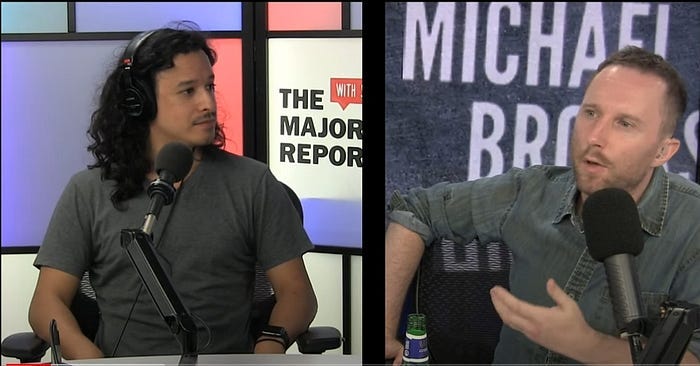
When Michael Brooks died suddenly in July of that same year at the age of thirty-six, the shockwave of his passing acted as a tragic catalyst. The collective grief galvanized this loose, digital network of thinkers into a self-aware, public-facing community. A memorial roundtable organized in his wake gathered key voices of this nascent scene—including Matthew David Segall, Layman Pascal , Brent Cooper, Brad Kershner, and Ryan Nakade—effectively mapping the coordinates of an “integral left” for the first time. Yet even as the scene briefly solidified, a deep irony persisted: while the broader public remembered Brooks for his sharp, quick-witted media critique on The Majority Report or his polemical book Against the Web, the sophisticated developmental architecture that quietly organized his political worldview remained almost entirely unacknowledged by his political allies.
This momentary coalescence, however, proved fragile. Growing Down ceased production within a year, and the scene rapidly dispersed back into its respective niches. Its participants were geographically and institutionally far-flung, operating more as a loose network of independent thinkers than a disciplined political movement. What had briefly bound them together during that season of loss was not a rigid doctrine, but a shared intuition: they saw that the developmental and evolutionary frameworks of the integral tradition carried profound political consequences that the mainstream, action-oriented left was too quick to dismiss as bourgeois navel-gazing. Conversely, they recognized that the mainstream integral community had grown too comfortable in its apolitical quietism, retreating from the harsh material realities of political economy into the sanitized realm of private spiritual development. To bridge this divide, they insisted that a true progressivism required both a psychological depth capable of self-examination and a structural commitment to transforming material conditions. Bringing these two dimensions together meant laying the groundwork for a genuine integral political praxis—a task that remains as unfinished as it is urgent.
It was precisely in the shadow of this unfinished project, and against the rapid quietism of the post-roundtable period, that I launched my own podcast, Integral [+] Facticity, in the spring of 2022. I did so out of a distinct sense of urgency; the transient window of 2020 had slammed shut, and Brooks’s vital synthesis of developmental psychology and cosmopolitan socialism was already slipping back into the digital margins. The inaugural episodes of the show set out to reconstruct this very lineage, debuting with an interview with Matt McManus. In surveying the remaining landscape, I found only a small handful of thinkers who still held the memory of Brooks’s deeper, structural engagement with the integral framework. Among them were Josh Summers and Jeremy Johnson—both of whom I was fortunate enough to host for long-form dialogues. I had not been a participant in the brief, intense season of 2020; rather, I arrived as a chronicler of its aftermath, driven by a quiet determination to prevent its diagnostic breakthroughs from fading into historical obscurity.
Michel also came to this scene late, though through the same hub. Johnson interviewed him on Mutations in November 2020, in a conversation on the commons and cultural evolution, and that is where Michel first registered for me. Here was a European, French-speaking, Catholic-raised thinker who was at the same time deeply conversant with the American integral movement — with Wilber, the Integral Institute, and the whole architecture that grew up around them. That combination is uncommon, and it sat close enough to my own coordinates to command my attention. What eventually brought us into direct contact was the Rosy Cross anthology this past spring, the volume edited by Cadell Last and O.G. Rose out of Last’s Philosophy Portal — the online community that has become, for me, the living continuation of the very milieu this history describes. Where the Growing Down scene scattered, the Portal is where a good deal of that same energy has reconstituted itself, and where several of these figures still turn up. My own contribution to that anthology, A Rosy Cross of a Book, provides a more detailed account of that trajectory from Brooks to Cadell. For present purposes, what matters is that contributing to the anthology alongside Michel gave me the occasion to move from reading his work to writing to him directly, and we have been in semi-regular correspondence since late May.
As part of that exchange he shared a long autobiographical interview tracing his intellectual evolution, and reading it clarified why our paths converge as they do. He begins in a Marxist-revolutionary period, moves through the radical body-mind therapies of the 60s-70s, and passes into an extended engagement with Eastern spiritual traditions and then with the Western esoteric inheritance of Rosicrucianism, and the Hermetic line, before arriving at the work on commons-based peer production and the P2P Foundation for which he is now best known. Threaded through the middle of it is a serious, years-long immersion in Wilber and the Integral Institute. Having discovered Wilber in the early 1980s, he immersed himself in his writings for nearly ten years. He vividly traces the trajectory of falling under the spell of an all-encompassing system of thought and adopting a temporary ideological stance, until the very criticisms he had long brushed aside finally began to hit home. It is this lineage that leads him to frame his own peer-to-peer project as a left-integral offshoot.
While we share a common ground in our Catholic upbringings and the mutual influence of the American integral movement, our professional trajectories diverge in ways that reflect our different approaches to the digital landscape. My own path has been shaped by over fifteen years in information technology, knowledge management, and financial services, which now informs my work as an independent researcher and the development of the Montreal-based Metapattern Institute. Sitting at the intersection of health informatics and integral human development, my research explores how digital tools and information systems shape human meaning-making, culminating in applied work like the Integral Awareness & Commitment Training (IACT) program—a project that synthesizes Canadian speculative philosophy, integral humanism, and contextual behavioral science. Michel’s trajectory, by contrast, was forged through Marxist political economy, leading to his pioneering efforts with the P2P Foundation and the design of decentralized digital commons. Yet, despite this divergence between my focus on health informatics and his work on peer-to-peer institutional architectures, we converged on the same speculative conviction: that the Western tradition harbors vital, neglected resources worth recovering, even if we traveled vastly different routes to find them.
The Varieties of Integral Traditions Today
The word integral acts as a kind of linguistic decoy, luring us into assuming a singular, unified lineage where there is actually a constellation of highly divergent meanings. The differences are not merely semantic; they become critically consequential the moment our attention shifts to human development. Several distinct intellectual movements have independently reached for this same adjective, building remarkably substantial and often incompatible architectures beneath it. They share a label, but in most cases, they share almost nothing else. To prevent our political and theological analysis from collapsing into a muddle of false equivalences, some conceptual disambiguation is unavoidable.
To trace these variations accurately, we can divide the varieties of integral traditions today into three primary geographical and philosophical families: the North-American, the European/Continental, and the Indian-East.
1. The North-American Lineages: Pragmatism, AQAL, and Process-Participatory Pluralism
The contemporary popular landscape of the integral movement is overwhelmingly North-American, shaped by a pragmatic impulse to synthesize disparate developmental models into functional, actionable systems.
This lineage is dominated by Ken Wilber, whose popular “theory of everything” taglines and lifestyle-brand packaging have long obscured a formidable, highly disciplined philosophical project. As I have argued in Can the Real Wilber Please Stand Up? A Short Journey Through Wilberland, the popular caricature of Wilber—dismissed by mainstream academia as an uncredentialed popularizer and by countercultural spaces as an authoritarian dogmatist—hides the actual philosopher. Drawing on Sri Aurobindo’s evolutionary cosmology, Jean Gebser’s historical structures of consciousness, and Clare Graves’s developmental psychology into his AQAL (All Quadrants, All Levels) model, Wilber constructed a framework that, as Zachary Stein has argued in Dancing with Sophia, belongs squarely to the tradition of American Pragmatism alongside Peirce, James, and Dewey.
Tracing this pedigree reveals that the North-American integral movement did not emerge in an intellectual vacuum; its foundational structures were directly fertilized by mid-century humanistic psychology and classical American pragmatism. The mid-century humanistic movement—championed by Abraham Maslow, Carl Rogers, and Rollo May—sought to rescue the human subject from the reductionism of behavioral conditioning and Freudian psychoanalysis, emphasizing self-actualization and the validity of inner experience. Maslow himself envisioned a “Fourth Force” beyond the humanistic tradition that would directly engage transpersonal and mystical horizons. This “Fourth Force” crystallized as transpersonal psychology, serving as the immediate, institutional bridge to Wilber’s early synthesis.
Simultaneously, the epistemic methodology of this movement is deeply indebted to William James’s “radical empiricism.” James famously argued that an adequate empiricism must not exclude any felt or directly lived reality, including religious and spiritual experiences, particularly if those experiences generate practical, transformative effects in a person’s life. This pragmatist validation of pluralistic, enactive experience provided the baseline logic for Wilber’s post-metaphysical turn. By drawing on John Dewey’s functional, enactive developmentalism and Charles Sanders Peirce’s triadic semiotics, Wilber shifted the perennial philosophy away from pre-critical metaphysics into a fallibilist, reconstructive science of consciousness.
This pragmatist lineage becomes visible through Wilber’s specific, systematized absorption of Jürgen Habermas. In his 1983 text A Sociable God, Wilber took Habermas’s tripartite division of knowledge-constitutive interests (empirical-analytic, historical-hermeneutic, and critical-reflective) and translated them into the transpersonal domain. He argued that Habermas’s horizontal-emancipatory interest—the freeing of communication from systemic distortions within a given level of developmental complexity—had to be paired with a vertical-emancipatory interest, a movement toward higher, more integrated structures of consciousness altogether. The result is a post-metaphysical rendering in which developmental levels are not pre-existing Platonic structures, but co-constructed horizons of knowing held in place by empirical, hermeneutic, and contemplative communities of practice. It is precisely this rigorous, epistemologically pluralistic architecture—one designed to prioritize perspective-taking over ontological categorization—that the integral left has sought to repurpose, recognizing in its “vertical-emancipatory” drive a vital conceptual engine for systemic social transformation.
But Wilber is not the only representative of the American integral tradition—a detail frequently overlooked. The California Institute of Integral Studies (CIIS) represents an entirely different history and flavor, serving as a historic seedbed for alternative and pluralistic genealogies. This lineage includes the participatory transpersonal psychology of Jorge Ferrer and the process-relational cosmology of Matthew Segall. In Can the Real Wilber Please Stand Up?, I map the philosophical, psychological, and clinical debates between Wilber’s structural diagnostics and these process-participatory models, arguing that these models risk remaining epistemologically underhoused without developmental coordinates, while outlining how they might interface with the therapeutic schools of contextual behavioral science. For our taxonomic purposes here, what matters is that these traditions represent distinct Western philosophical and psychological currents native to the non-Wilberian ecology of CIIS—a distinction routinely collapsed by observers who assume there is only a singular American integral stream.
This developmental architecture, however, carries a profound structural vulnerability. When stages of consciousness are treated as absolute hierarchies, the AQAL framework is easily co-opted into a form of developmental chauvinism. In this deformation, the vertical gradient of psychological ascent is mapped onto geopolitics or cultures, creating a patronizing civilizational tier system. It pathologizes dissent by labeling non-Western or anti-globalist perspectives as “ethnocentric” or “regressive,” while insulating its own technocratic, Western-centric elite as uniquely “worldcentric.” This is the intellectual bridge through which parts of the North-American integral scene have slid into neo-reactionary elitism and culture-war politics, weaponizing developmental psychologies to validate a soft, evolutionary supremacy that ultimately serves regressive right-wing movements.
Finally, this North-American family carries its own distinct version of integral human development. Grounded in AQAL metatheory, it has recently expanded its boundaries to interface with contemporary evolutionary science—notably through the work of David Sloan Wilson. Here, the drive for individual developmental integration is mapped onto the evolutionary dynamics of multi-level selection, seeking to coordinate human systems from the cellular to the planetary scale.
Yet the hazard here is the slide from biological metaphor to an exclusionary, evolutionary tribalism. If multi-level selection dictates that high-functioning, “multicellular” cooperation is only sustainable when defended by robust boundaries against out-group subversion, the language of complexity is easily retrofitted to justify cultural isolationism. In the hands of ethno-nationalists, Ostrom’s design principles and evolutionary group dynamics are stripped of their universalist cooperative intent and used instead to argue for closed, homogenous communities that suppress internal plurality under the guise of competition and survival.
2. The European and Continental Lineages: Phenomenology, Thomism, and Catholic Social Doctrine
The European and Continental family of integral operates in a fundamentally different key. While the North-American traditions grounded their models in the enactive validation of individual experience and the vertical scaling of humanistic self-actualization, the Continental lineages bypass developmental stage-theories and evolutionary coordinate systems entirely. Instead, their foundations are built on a rigorous triad of German phenomenology, medieval scholastic mereology, and the speculative heritage of Catholic personalism. Rather than seeking to map the psychological growth of an individual on a vertical grid, European thinkers turned outward to the historical mutations of cultural consciousness and inward to a theological anthropology of the person. Here, integral is not a developmental summit to be achieved through evolutionary adaptation, but an intrinsic, structural wholeness—a relational completeness that must be defended against the hollowing-out of modern instrumental reason.
Its first major pillar is Jean Gebser, who reached his own conception of an “integral structure of consciousness” independently, three decades after Aurobindo and in complete ignorance of him. Gebser did not fall from the sky; he came up out of German soil—the Romantic and phenomenological inheritance, and the Protestant cultural formation of a man descended from Melanchthon. His route to integral consciousness ran through poetry and the philosophy of language, above all his study of Rilke, rather than through yoga or developmental psychology. He identified the integral as a mutation of consciousness that overcomes the perspectival, rational fragmentation of the modern mind.
Yet, even Gebser’s elegant phenomenology is not immune to civilizational exceptionalism. Because his diagnosis of the integral mutation is so deeply tethered to the Western historical experience—art, avant-garde poetry, and European scientific breakthroughs—it implicitly positions Europe as the sole, necessary vanguard of human evolution. In its chauvinistic deformation, Gebserian thought can easily pathologize non-European cultures as arrested in “mythic” or “magical” structures of consciousness, turning a descriptive phenomenology of history into an elegant, cultural ethno-nationalism that ignores alternative, non-Western developmental trajectories.
The second and oldest pillar is the scholastic and personalist tradition. Thomas Aquinas gave “integral” its technical, philosophical sense, distinguishing between subjective, potential, and integral parts. For Aquinas, integral parts (partes integrales) are those necessary components that must concur to constitute the completeness of a whole. In his Summa Theologiae (specifically within his treatises on mereology and the architecture of the virtues), he originally illustrates this not through cold, artificial structures, but through the organic unity of a living body composed of its essential limbs—such as the head, hands, and feet—using this concept as working machinery to analyze how virtues like prudence or temperance require a constellation of allied, cooperative capacities to be fully realized.
Seven centuries later, when Jacques Maritain published Humanisme intégral in 1936, he took integral in exactly that Thomistic sense of completeness against existential fragmentation. Maritain outlined a humanism of the whole person, material and spiritual at once, set against both the liberal-individualist dissolution of society into self-seeking parts and the collectivist erasure of the person within the mass. His lay philosophy proved foundational for Catholic social doctrine. Paul VI’s Populorum Progressio (1967) drew on it to formulate integral human development—the good of the whole person and of every person—which Benedict XVI’s Caritas in Veritate (2009) placed at the center of the Church’s critique of global capitalism.
Long before the political resurrection of the term, the word integral was the battleground of a defining twentieth-century theological dispute within French Catholicism. Thinkers like Maurice Blondel, in his pioneering work L’Action (1893), and later the Jesuit theologian Henri de Lubac, in his landmark study Surnaturel (1946), fought for what was called an “integral” Christian philosophy. They opposed the dominant neoscholastic manual theology, which had severed reality into two separate, self-contained tiers: a realm of “pure nature” (natura pura) governed by natural law, and a supernatural realm of grace added on top as an extrinsic supplement. Blondel and de Lubac argued that this dual-order framework truncated human experience, rendering the supernatural irrelevant to concrete life. Instead, they claimed that human nature is integrally and intrinsically oriented toward God, possessing an innate desire for the supernatural that cannot be satisfied by natural ends alone. This nouvelle théologie aimed to restore the organic, integral unity of the cosmos, but it faced fierce resistance from traditionalist neoscholastics who feared that collapsing the boundary between nature and grace would compromise the gratuitousness of God’s gift. This theological debate set the stage for how the concept of the “wholeness” or “integral” would be structurally closed or kept open in the decades to follow.
Today, this neoscholastic desire for a closed, unified order has returned in the form of a muscular, post-liberal political theology known as Catholic integralism. While the Harvard legal scholar Adrian Vermeule is its most prominent theorist with his framework of “Common Good Constitutionalism,” he is part of a much broader intellectual ecosystem. This network includes popular columnists like Sohrab Ahmari, political theorists like Patrick Deneen and Gladden Pappin, theologians like Chad Pecknold, and monastic intellectuals like Pater Edmund Waldstein of The Josias. These contemporary integralists explicitly reject the liberal separation of church and state, holding that civil authority must recognize the spiritual supremacy of the Catholic Church and utilize the vast coercive power of the modern administrative state to promote a substantive, objective moral order. Rejecting the classical liberal myth of procedural neutrality, they argue that political life should be ordered toward humanity’s supernatural end.
This post-liberal resurgence can be productively understood and analyzed through Matt McManus’s critical writing and work on “postmodern conservatism.” As Matt McManus has argued, contemporary right-wing anti-liberalism often functions as a hybrid creature. These thinkers masterfully employ postmodern skepticism to deconstruct the core tenets of Enlightenment liberalism—unmasking its claims to value-neutrality, individual rights, and procedural justice as a covert, highly ideological hegemony. They expose the “view from nowhere” as a secularist myth. Yet, having used postmodern deconstruction to clear the field, they immediately pivot to re-impose a pre-modern, neo-traditionalist hierarchy. In the case of Vermeule, Ahmari, and their cohort, this postmodern conservative playbook is executed with intellectual precision. They expose the liberal state’s proceduralism as an empty, nihilistic arena, only to fill the vacuum with a coercive, top-down Catholic legal order.
Here, the Thomistic concept of “integral parts” undergoes a highly dangerous, coercive closure. When the “whole” is identified exclusively with a singular, confessional-state apparatus, the state ceases to be a pluralistic vessel for the common good and instead becomes an instrument of cultural and religious homogenization. It demands the submission of all private and public life to a centralized, spiritual authority. This political integralism actively seeks the systematic suppression of pluralism, defining the “integral” citizen strictly through ideological conformity and cultural assimilation, providing a sophisticated, academic blueprint for modern clerical-fascist or authoritarian nationalism.
3. The Indian and Eastern Lineages: Integral Yoga and Vedantic Humanism
The Indian root is the oldest and deepest source of the entire integral family, emerging from the reformed spiritual traditions of Bengal and Pondicherry. Rather than presenting a clean tabula rasa, this lineage is marked by a deep-seated tension between evolutionary universalism and a closed, majoritarian major-key nationalism.
Its fountainhead is Sri Aurobindo, who was using integral by 1914 for what he called Purna (Full) Yoga. Developed at his ashram in Pondicherry, Purna Yoga is an evolutionary spiritual vision rooted in a creative, evolutionary reading of Advaita Vedanta. It outlines an Indian metaphysics of consciousness ascending toward the “supramental” transformation of earthly life.
Before he was a spiritual sage, Aurobindo was a revolutionary nationalist—editor of the daily Bande Mataram and jailed in the Alipore Bomb Case of 1908. Yet, the nationalism he arrived at after his prison awakening was spiritual and universal. Crucially, this Eastern root was never an isolated product of the Orient; its very genesis was marked by a profound East-West hybridity. Aurobindo spent his formative childhood and adolescent years (from age seven to twenty) educated in England, thoroughly steeped in Western classical languages, history, and European literature, before returning to India to reconstruct Vedic and Upanishadic thought. For Aurobindo, India’s freedom mattered not as a chauvinistic end in itself, but because its dharma was to offer spiritual wisdom to a materialist world—a necessary civilizational condition for the evolutionary unfolding of humanity as a whole. This is the generous, universalist branch of the Eastern integral that flowed down into Chaudhuri, CIIS, and ultimately into Wilber’s metatheory.
But the same Vedantic soil grew a nationalist deformation. In 1965, Deendayal Upadhyaya, then general secretary of the Bharatiya Jana Sangh (the political wing of the Rashtriya Swayamsevak Sangh, or RSS), delivered the lectures published as Integral Humanism (Ekatma Manav Darshan). This text became the official doctrine of his party and remains foundational for today’s ruling Bharatiya Janata Party (BJP). Upadhyaya’s vocabulary is unmistakably Vedantic—invoking the oneness of all souls and the microcosm answering to the macrocosm—and his target was identical to Maritain’s: capitalism and Marxism alike, each reducing the human being to a mere economic unit.
However, Upadhyaya bent this Vedantic anthropology toward ethnic-nationalism. The whole he prioritized was Chiti, the cultural essence of a people, realized in an organic Hindu Nation (Hindu Rashtra) ordered by dharma; the ideological line he stands in runs not from Aurobindo’s universalism, but from Savarkar’s Hindutva and the organicism of the RSS.
This is the ultimate expression of the Indian integral’s nationalist capture. By framing society as an organic body in which the individual is merely a cell subordinated to the collective “Chiti” of the nation, Upadhyaya’s integralism converts Vedantic universalism into a mechanism of violent majoritarianism. Under this closed framework, India’s religious and ethnic minorities (Islamic, Christian, etc. and indigenous groups) are pathologized as “foreign bodies” disrupting the organic unity of the Hindu state. The metaphysics of the integral whole is thus weaponized to justify systemic state-sponsored exclusion, rewriting a spiritual anthropology of oneness into a coercive ideology of cultural erasure.
Integral Pluralism & the Dialogue of Civilizations
A fifth conception of the integral emerges from political philosophy, specifically the work of Fred Dallmayr. His framework of integral pluralism has guided my own thinking since 2017, serving alongside Richard Bernstein’s engaged fallibilistic pluralism as a cornerstone of Integral Facticity. Dallmayr’s formulation of the integral does something distinct from the other lineages in this survey: it focuses on the relational space between worldviews, offering a vital link between the cosmopolitan socialism of Michael Brooks and the peer-to-peer frameworks of Michel Bauwens.
Dallmayr’s intellectual trajectory was shaped by his wartime childhood in Germany. Born in Ulm in 1928 and raised in Augsburg, he studied law in Munich before emigrating to the United States in 1955. After completing his PhD at Duke, he taught at Notre Dame from 1978 until his retirement. His philosophical formation occupied the space between Heideggerian ontology and Habermas’s critical theory—a position he described as existing Between Freiburg and Frankfurt.
A Fulbright year at the Maharaja Sayajirao University of Baroda in 1991–92 marked a pivotal transition, leading him to engage deeply with Indian philosophy. This encounter prompted him to pioneer the field of comparative political theory, arguing that substantive political philosophy existed outside the Western canon. Over the subsequent decades, Dallmayr translated this theoretical work into practice, serving as executive co-chair of the World Public Forum – Dialogue of Civilizations and writing extensively on intercultural dialogue as a corrective to Samuel Huntington’s “clash of civilizations” thesis before his death in June 2024.
His core thesis is articulated in Integral Pluralism: Beyond Culture Wars (2010). Dallmayr argues that modern history is defined by irreversible pluralization—the differentiation of traditions, spheres, and lifeworlds. The central challenge of our era is to prevent this pluralism from collapsing into either authoritarian balkanization or coercive, top-down unification. His primary foils are Carl Schmitt, the Religious Right, international-relations “realism,” and political Islam—all of which attempt to close the social whole around an exclusive, chosen identity.
To counter these tendencies, Dallmayr synthesizes William James’s pluralism, Gadamer’s fusion of horizons, and Merleau-Ponty’s phenomenology with trans-traditional resources, including the comparative theology of Raimon Panikkar, the political ethics of Gandhi, and the insights of Indian philosophers like Daya Krishna and Ramchandra Gandhi. The resulting position is an integral pluralism: an acknowledgment that while pluralism is original and irreducible, it is not mere balkanization. It is gathered in a “differentiated wholeness” that balances individual freedom with mutual solidarity.
This relational approach provides the taxonomy we need to evaluate the lineages surveyed in this essay. It clarifies the boundary between open and closed systems. Aurobindo’s spiritual universalism and Maritain’s personalism remain open to difference, whereas Upadhyaya’s Hindu nationalism and neoscholastic Catholic integralism close the social whole around a privileged ethno-religious identity. Schmitt, Hindutva, and confessional authoritarianism are the very closures Dallmayr’s relational model is designed to diagnose and resist.
This is also the political philosophy that undergirded Michael Brooks’s cosmopolitan socialism. Brooks sought an internationalist, anti-imperialist left that retained developmental depth and complexity without ceding them to the political right. His work aimed at a left that avoids both the imperial universalism that flattens difference and the localism that abandons solidarity. While Brooks may not have read Dallmayr, his political project was an intuitive application of integral pluralism.
Michel Bauwens’s recent reflections on “scalar and negotiated universalism” represent a similar conceptual movement. Bauwens rejects both the false universalism of a single global epistemology and the radical relativism that fragments the world into isolated, balkanized camps. He redefines universality not as an imposed template, but as a capacity to translate between worldviews. Where Dallmayr saw a dialogue between historically situated civilizational traditions, Bauwens envisions this negotiation occurring across the practical scales of translocal commons and peer-to-peer networks. Whether this dialogical capacity requires deep civilizational traditions or can be reconstructed across post-civilizational guilds remains an open question.
Just as the universalisms of Aurobindo and Maritain cast exclusionary, nationalist shadows, the dialogue among civilizations has its own dark double in Aleksandr Dugin’s “fourth political theory.” Dugin adopts the language of multipolarity and civilizational distinctiveness to reject liberal universalism, but he grounds this plurality in ethnos and traditionalist anti-modernism, closing each civilizational sphere around an exclusive identity. This project has its most prominent Anglophone proponent in Michael Millerman, whose work on Dugin is directly tied to Dallmayr, who served as the external reader on Millerman’s doctoral committee.
This connection reveals a troubling ideological asymmetry. The intellectual carriers of a closed, ethno-nationalist multipolarity have studied Dallmayr’s work closely, while the emergent integral left has largely overlooked the political philosopher whose work provides their natural foundation. Discerning between an open integral pluralism and closed civilizational states is therefore not a matter of semantic classification, but a critical political necessity.
Towards a Second Renaissance & Democracy to Come
To map these divergent lineages is to realize that the history of “integral” is not a chronicle of linear developmental progress, but a series of subterranean water tables occasionally bursting through the dry crust of modern history. In his contribution to the Rosy Cross anthology, Michel Bauwens anchors this underground current in a provocative historical thesis drawn from the Marxist theorist Loren Goldner. He suggests that the genuine integrative tradition—the speculative conviction that matter and spirit, the objective and the subjective, are co-arising and equally sacred—found its Western zenith not in modern developmental psychology, but in the Hermetic Renaissance. This was a moment of cosmological and social wholeness ultimately broken by the Cartesian Enlightenment’s razor-sharp division of the world into dead, mechanical matter and a disembodied, observing ego. From that rupture onward, this integrative impulse was forced underground, flowing as a subterranean heresy through Jakob Boehme, the German Idealists, and the radical, metabolic-restoration project of the young Marx. Goldner’s own name for this lineage is cosmobiology; it is Bauwens, in his integral rendering, who names it—fittingly—integralism, adding yet another deeply historical coordinate to our map.
This historical lineage is not merely a matter of archival curiosity; it provides the essential metaphysical background for what Rufus Pollock, and the ecosystem forming around him, has called a second renaissance. To speak of a second renaissance under contemporary planetary conditions is to recognize that our digital, ecological, and psychological crises are symptoms of a shared exhaustion across multiple civilizations. The Cartesian bifurcation of the world—which reduced nature to resource extraction and the human psyche to an isolated, utility-maximizing spectator—has run its course. The wager of the peer-to-peer movement is that the commons are the modern, structural carriers of this ancient integrative line, just as the early Benedictine and Franciscan monastic commons once carried the seeds of a new social architecture through the collapse of the Roman world.
Yet, as our taxonomy has shown, any attempt to resurrect the “whole” carries a profound, tragic danger. From the closed, coercive jurisdictions of Adrian Vermeule’s Catholic integralism to the majoritarian, exclusionary capture of Deendayal Upadhyaya’s Hindutva, the temptation to cure modern fragmentation by enforcing a top-down, mono-traditional order is the defining right-wing reflex of our epoch. When the spiritual or developmental whole is identified with a singular, closed political authority, the result is inevitably a violent suppression of plurality. Against these formidable reactionary enclosures, the emergent integral left must articulate a different path: one that is structurally, epistemologically, and relationally kept open.
This is precisely where the psychological flexibility of contextual behavioral science meets the macro-political vision of Fred Dallmayr’s Democracy to Come (2017). In Dallmayr’s formulation, democracy is not a fixed, procedural institution to be defensively exported or mechanically managed by a technocratic elite. It is a “promise perpetually arriving”—a demanding, relational askesis that requires continuous self-transformation, ethical cultivation, and a capacity to hold cognitive and cultural dissonance. To construct a “democracy to come” is to recognize that structural integration on a political scale requires a corresponding psychological flexibility on an individual scale. Without the capacity for defusion, acceptance, and perspective-taking, the encounter with deep civilizational difference inevitably triggers a defensive regression into tribalism, balkanization, or the demand for authoritarian order.
Michel Bauwens’s vision of a “scalar and negotiated universalism” offers the practical, infrastructural counterpart to this relational discipline. It suggests that planetary solidarity cannot be achieved by imposing a single, flattened global ideology (the false universalism of neoliberal flatland), nor by retreating into balkanized, culturally pure enclaves. Instead, universalism must be negotiated across scales—from the psychological posture of the individual practitioner to the local cooperative guild, to the translocal digital commons, and ultimately to a multicellular global federation. In this framing, the “metapattern” is not a closed, totalizing map of developmental hierarchies, but an active, open-ended protocol of translation and mutual adaptation.
To hold this vision of the whole open, refusing both the temptation of right-wing authoritarian closure and the flat, moralizing exhaustion of mainstream progressivism, is the urgent task of the integral left. It is a future of active potential—a project that is neither a guaranteed evolution nor an impossible utopia, but a living realization of integral political praxis. This praxis operates as a continuous, metabolic loop where the inner cultivation of psychological flexibility directly feeds the outer struggle for democratic, collaborative institutions. The dialogue between the psychological flexibility of contextual behavioral science, the political ethics of integral pluralism, and the collaborative architecture of the peer-to-peer commons is only beginning. It is within the open-ended space of this running debate, and through the collaborative experiments we build in its wake, that a second renaissance and a democracy to come might finally find its footing.
Further Reading from Integral [+] Facticity
The Return of God & Future of Integral Humanism (November 2024)
A Lament for a Missing Element of Flowers for Marx: Michael Brooks’s Integral Vision (July 2025)
Towards a New Structural Transformation of the Public Sphere (August 2025)
On God, Absolute Freedom, & the Post-Metaphysical Turn (February 2026)
Can the Real Wilber Please Stand Up? A Short Journey Through Wilberland (February 2026)
Through and Beyond the Threshold (February 2026)
On Enchanted Flatland: Iain McGilchrist and the Problem of Romantic Liberalism (May 2026)
The Future of Contextual Behavioral Science & Role of Theology (June 2026)
Suggested Reading
David Sloan Wilson and Steven C. Hayes, eds., Evolution and Contextual Behavioral Science: An Integrated Framework for Understanding, Predicting, and Influencing Human Behavior (Context Press, 2018)
Paul W. B. Atkins, David Sloan Wilson, and Steven C. Hayes, Prosocial: Using Evolutionary Science to Build Productive, Equitable, and Collaborative Groups (Context Press, 2019)
Guy du Plessis, An Integral Guide to Recovery: Twelve Steps and Beyond (Integral Publishers, 2015)
Guy du Plessis, An Integral Foundation for Addiction Treatment: Beyond the Biopsychosocial Model (Integral Publishers, 2017)
William L. White, Slaying the Dragon: The History of Addiction Treatment and Recovery in America, 2nd ed. (Chestnut Health Systems, 2014)
Michael Brooks, Against the Web: A Cosmopolitan Answer to the New Right (Zero Books, 2020)
Ken Wilber, A Sociable God: Toward a New Understanding of Religion, rev. ed. (Shambhala, 2005 [1983])
Michael Schwartz and Sean Esbjörn-Hargens, eds., Dancing with Sophia: Integral Philosophy on the Verge (State University of New York Press, 2019) — see esp. Zachary Stein, “Integral Theory, Pragmatism, and the Future of Philosophy”
Jorge N. Ferrer, Revisioning Transpersonal Theory: A Participatory Vision of Human Spirituality (State University of New York Press, 2002)
William James, Essays in Radical Empiricism (Longmans, Green, 1912)
Jürgen Habermas, Knowledge and Human Interests, trans. Jeremy J. Shapiro (Beacon Press, 1971)
Jean Gebser, The Ever-Present Origin, trans. Noel Barstad with Algis Mickunas (Ohio University Press, 1985)
Thomas Aquinas, Summa Theologiae (c. 1265–1274)
Jacques Maritain, Integral Humanism, trans. Joseph W. Evans (University of Notre Dame Press, 1973)
Maurice Blondel, Action (1893): Essay on a Critique of Life and a Science of Practice, trans. Oliva Blanchette (University of Notre Dame Press, 1984)
Henri de Lubac, Surnaturel: Études historiques (Aubier, 1946)
Pope Paul VI, Populorum Progressio (encyclical letter, 1967)
Pope Benedict XVI, Caritas in Veritate (encyclical letter, 2009)
Adrian Vermeule, Common Good Constitutionalism: Recovering the Classical Legal Tradition (Polity, 2022)
Patrick J. Deneen, Why Liberalism Failed (Yale University Press, 2018)
Matthew McManus, The Rise of Post-Modern Conservatism: Neoliberalism, Post-Modern Culture, and Reactionary Politics (Palgrave Macmillan, 2020)
Sri Aurobindo, The Life Divine (Sri Aurobindo Ashram, 1939–1940)
Sri Aurobindo, The Synthesis of Yoga (Sri Aurobindo Ashram)
Deendayal Upadhyaya, Integral Humanism (Ekatma Manav Darshan) (Bharatiya Janata Sangh, 1965)
Vinayak Damodar Savarkar, Hindutva: Who Is a Hindu? (1923)
Fred Dallmayr, Integral Pluralism: Beyond Culture Wars (University Press of Kentucky, 2010)
Fred Dallmayr, Democracy to Come: Politics as Relational Praxis (Oxford University Press, 2017)
Richard J. Bernstein, Beyond Objectivism and Relativism: Science, Hermeneutics, and Praxis (University of Pennsylvania Press, 1983)
Aleksandr Dugin, The Fourth Political Theory (Arktos Media, 2012)
Michael Millerman, Beginning with Heidegger: Strauss, Rorty, Derrida, Dugin and the Philosophical Constitution of the Political (Arktos Media, 2020)
Michel Bauwens, Vasilis Kostakis, and Alex Pazaitis, Peer to Peer: The Commons Manifesto (University of Westminster Press, 2019)
Cadell Last and O.G. Rose, eds., Rosy Cross: Question of Right and Truth of Christianity (Philosophy Portal Books, 2026)
Rufus Pollock, The Open Revolution: Rewriting the Rules of the Information Age (2018)
Illuminating and informative. Most (all?) Integral-Theory folks I’ve had contact with over the years lean left. So it’s a surprise to learn it originally coded right, largely owing to a theoretical emphasis on hierarchy.
Somewhat similar tendencies have appeared in areas I know more about, lately mostly having to do with the emergence of our planet’s noosphere (sphere of mind) atop it’s geosphere and biosphere. Analyzing the noosphere as a superorganism is popular these days. Yet I’ve learned that organismic theories were/are quite popular among dictators and other autocrats (e.g., Mussolini, etc.). I’m wary of the superorganism model / metaphor.
As you note, multilevel selection (MLS) theory is pretty hierarchal too, including when it is applied to the evolution of organisms into superorganisms. It neglects the importance of lateral developments: e.g., new forms or organization must emerge laterally before new levels of complexity can become possible.
In addition, I’ve wondered about holons and holarchy as forms of organization for future noosphere governance systems. Yet their proponents are keen on “nested hierarchies” as a defining feature. Fortunately I’ve found a literature touting “holonic networks” that are far more horizontal than hierarchical.
In all these areas, this looks like an ingrained theoretical tendency to emphasize (“privilege”?) evolutionary levels over laterals. A shortcoming in my view, since levels don't increase if lateral forms don't increase first. Something like that.
Thanks for writing up your observations. More to think and wonder about….
I was only able to read up until the explanation of the North American tradition because I’m currently falling asleep after a very long work night, but I’ll certainly return back to this piece ASAP!
While I’m still lucid enough, a few quick and somewhat disparate thoughts and impressions: First, that your assumptions about “integralism” as a signifier are indeed correct: I believe I’ve only ever read it used in reference to, I believe, Franco, Mussolini, and perhaps some quasi-fascist leaders of mid-20th century South America. Your deep explanation was fascinating, I now intend to look up Ben Wilber (I’ve been previously unaware of him and his work).
Next is that I, too, dearly miss Michael Brooks, and I think that his replacement at the Majority Report is very strong evidence towards your claim that his philosophical and intellectual contributions and beliefs have been largely forgotten, unfortunately and perhaps even intentionally (though I cannot prove this).
Along with Mark Fisher and sometime’s even Terence McKenna (from when I was a younger man), I find myself deeply missing Brooks and often despairing that he is not still around to offer his critiques and ideas/projects. 😔
I’m also interested in what you referred to as the New Recovery Movement and its place in this tradition/milieu; I am a recovered drug addict of several years (I did not find the 12 Steps useful to my particular recovery, although I attended many meetings and was very involved in the program for a time). And so I have a curiosity about alternative forms of addiction recovery and treatment.
Lastly, I am intensely intrigued by, and dedicated, to both Cadel Last, Daniel (and Michelle), and their O.G. Rose project, as well as some other thinkers you mentioned. If I only had more time, I would dedicate so much more study to both Cadell and especially OG Rose!
All right, I better fall asleep so I can work again this afternoon. Take care!