![Integral [+] Facticity](https://substackcdn.com/image/fetch/$s_!yhcJ!,w_120,h_120,c_fill,f_webp,q_auto:good,fl_progressive:steep/https%3A%2F%2Fbucketeer-e05bbc84-baa3-437e-9518-adb32be77984.s3.amazonaws.com%2Fpublic%2Fimages%2Ff8458843-3278-4fcc-accc-17ad21352205_1280x1280.png)

I. Introduction
In my August 2025 essay, A Rosy Cross of a Book: My First Thoughts on Cadell Last’s Real Speculations, I traced an unorthodox intellectual lineage stretching from the late Michael Brooks to the speculative interventions of Cadell Last. In that piece, I argued that Cadell’s work represents a crucial theoretical apparatus for left-wing thought to adapt and evolve in response to the rise of the New Right and Postmodern Conservatism.
The challenge posed by contemporary conservative thought extends far beyond mere culture-war rhetoric. As the political theorist Matt McManus has argued in The Rise of Post-Modern Conservatism, “Postmodern Conservatism” describes a political phenomenon in which right-wing figures co-opt postmodern tools—distrusting institutional authority, weaponizing epistemic fragmentation, and rejecting universal truths—not to foster a better future, but to mobilize reactionary identity politics and defend traditional hierarchies. By exploiting this breakdown of shared truth, Postmodern Conservatism re-naturalizes capitalist relations and monopolizes existential questions of meaning, theology, and myth. When the Left retreats into either hyper-deconstruction or narrow, techno-reductionist materialism, it abdicates these vital dimensions of human experience, leaving a vacuum that right-wing thought willingly fills.
Cadell’s Hegelian-Lacanian framework in Real Speculations engages these challenges directly by taking questions of ontology, religion, and speculative philosophy seriously rather than dismissively discarding them. Yet, as I argued in A Rosy Cross of a Book, psychoanalysis and critique cannot carry the entire weight of a reconstructed Left on its own. Psychoanalysis is brilliant at diagnosing how we get trapped in ideology and exposing our underlying fantasies, but on its own, it struggles to offer a constructive model for building something new. This is why I hinted that Cadell’s work would benefit immensely from an ongoing dialogue with Ken Wilber’s integral metatheory and Jürgen Habermas’s theory of communicative action. While Cadell focuses on subjective drives and ideological capture, Wilber’s work helps map how individual interiority connects with cultural norms and concrete systemic structures. Meanwhile, Habermas provides the intersubjective validity claims needed to justify collective political action and develop a robust theory of justice.
Putting such distinct intellectual traditions into dynamic and fruitful interplay is not something a single text can accomplish—a book can posit a synthesis, but it cannot enact it. Fulfilling that potential requires a living intellectual public sphere and commons where thinkers representing these divergent streams actively confront and test one another’s assumptions.
Having recently attended my very first conference hosted by Philosophy Portal—Portalpalooza—I witnessed firsthand how Cadell’s ecosystem actually enables this synthesis in practice. Continuing the unifying, cross-tradition magnetism that Michael Brooks once wielded, Cadell has built Philosophy Portal into a rare space where high continental theory, psychoanalysis, Marxism, and integral metatheory actively confront and debate one another. It was precisely the live, interactive stage of Portalpalooza—bringing together Cadell’s speculative Hegelianism, Dylan Shaul’s post-post-metaphysics, and the integral presence brought by Bruce Alderman, Layman Pascal, and Michel Bauwens—that allowed these distinct streams to move off the page and enter into direct dialectical tension, offering left-wing thought a truly multi-dimensional framework to adapt and take on Postmodern Conservatism.
While my excitement was especially sparked by Dylan Shaul’s return to the Portal alongside the integral presence brought by Bruce Alderman, Layman Pascal, and Michel Bauwens—creating a powerful constellation where integral metatheory, post-post-metaphysics, and continental philosophy clashed and cross-pollinated—the conference showcased a remarkably vibrant ecosystem and set of other presenters. Alongside this integral presence, the provocative contributions of Bryce Nance and Michael Downs on sci-fi Marxism and faultline theory highlighted a shared urgency to rethink the Left’s foundational theoretical tools and most caught my attention.
This essay serves as a personal reflection on those conference sessions. In the sections that follow, I examine the contours of Dylan Shaul’s post-post-metaphysics, the speculative potential of sci-fi Marxism and faultline analysis, and how an evolving Left might chart a new path forward.
II. Dylan Shaul: Towards a Post-Post-Metaphysics
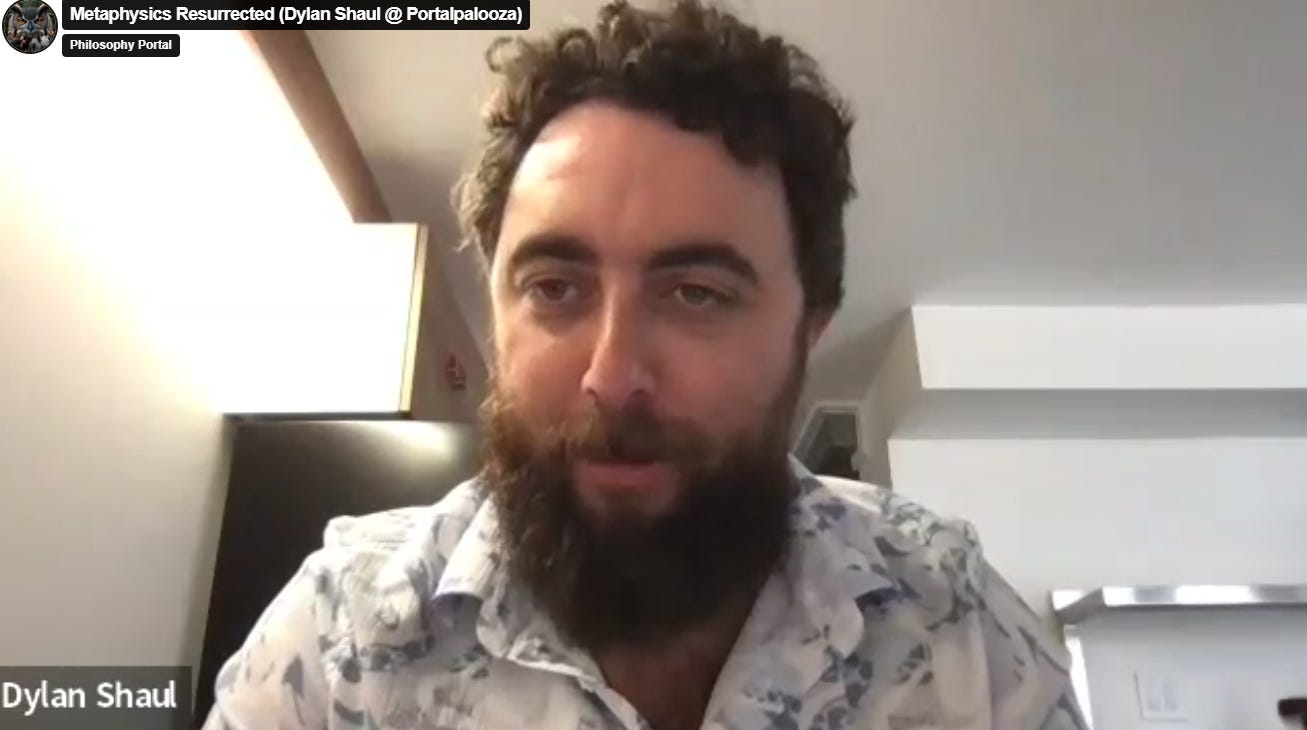
Dylan Shaul—Assistant Professor of Philosophy at UC Riverside—is one of the most compelling young scholars working at the nexus of German Idealism, Jewish theology, and continental philosophy. Like scholars Sean McGrath and Jason Wirth, Shaul does not treat German Idealism as a museum artifact; he animates its existential and theological dimensions to address the deadlocks of our present moment.
My engagement with Shaul’s work began with his seminal paper, “From Nature to Spirit in Hegel’s Encyclopedia: Sex, Death, and Quantum Physics” (Crisis & Critique), where he re-evaluates the transition from Nature to Spirit through the animal organism’s “undecidable decision” (Entschluss) between the sex-drive and the death-drive. Although I was unfortunately unable to attend his prior Philosophy Portal seminar, Philosophy of Theology (”Metaphysics Resurrected”), his theoretical work had already become a major touchstone for my own thinking. Consequently, his return at Portalpalooza for back-to-back panels alongside Bruce Alderman and Layman Pascal was one of the conference highlights I was most eager to witness. It offered a long-awaited opportunity to see his framework engage directly with post-metaphysical epistemologies and integral metatheory—and to confirm several open questions I had harbored about how his speculative theology aligns with a possible reconstructed Left.
At Portalpalooza, Shaul delivered an uncompromising defense of what can best be termed post-post-metaphysics. Grounded in the premise that “the end of metaphysics has itself come to an end,” Shaul argues that philosophy must move past the deconstructive and deflationary retreats of 20th-century anti-realism. Rather than accepting Kant’s “euthanasia of pure reason” or regressing into pre-critical dogmatism, he calls for a resurrection of speculative metaphysics that incorporates the critical lessons of modernity across four key movements:
Metaphysics Resurrected: Rehabilitating metaphysics as the science of first causes (archē) and final ends (telos).
Post-Kantian Speculative Theology: Synthesizing the speculative turn (Meillassoux, Badiou, Žižek) with the theological turn (Marion), refusing to reduce God or the Absolute to a mere void.
Theopolitics and Divine Revelation: Translating metaphysics into political ethics by contrasting procedural liberalism with the disclosure of divine revelation—the un-concealment of the Absolute breaking into historical facticity to order human life toward communal flourishing.
Rational Mysticism: Overcoming the false divide between systematic rationalism and ineffable experience, showing that pure reason culminates in mystical contemplation.
The crucial punch of Shaul’s intervention lies in his critique of contemporary continental thinkers like Alain Badiou and Slavoj Žižek. While praising Badiou’s evental ontology and Žižek’s “materialism without matter” for re-opening questions of the Absolute, Shaul argues that their reliance on pure negativity leaves philosophy without a moral or orienting anchor. For Badiou, truth depends on an arbitrary commitment to an unpredictable event; for Žižek, human agency is reduced to an ungrounded, disruptive rupture in the symbolic order. Because neither thinker grounds truth or action in a shared standard of value, their frameworks rely on sheer, ungrounded choice—a stance that can just as easily justify tyranny as it can emancipation. Without a positive account of the Good (agathon) and an openness to divine revelation, human agency lacks ethical guidance. Crucially, Shaul reframes the relationship between freedom and the Good: while modern liberalism treats individual freedom as the ultimate end, Shaul points out that freedom is merely a means—a capacity that can be exercised for good or for evil. The true ultimate end, which is inherently beneficial, is the Good itself.
This tension directly mirrors my recent work in The Language Parasite & the Symbolic Order: Toward a Post-Metaphysical Virtue Ethics. There, I argued that both contextual behavioral science (RFT/ACT) and Lacanian psychoanalysis excel at diagnosing how language traps subjectivity and offering tools for cognitive defusion or traversing the fantasy. However, both traditions falter when left with purely negative definitions of freedom, offering no positive anthropology or moral orientation. Negative defusion without positive direction leaves the subject adrift.
Shaul’s post-post-metaphysics provides the exact speculative counterpart to this problem. Where my work turned to post-metaphysical virtue ethics—grounding freedom in the emergent virtues of Awareness, Courage, and Love (ACL) enacted through prosocial practice—Shaul approaches the impasse from speculative theology: showing that freedom cannot remain formally empty. Freedom must be oriented by the horizon of divine revelation and the positive reality of the Good.
For the contemporary Left, Shaul’s thesis is vital. If left-wing thought remains strictly post-metaphysical—rejecting all ontological grounding, divine disclosure, and objective visions of the Good—it abdicates the realm of existential meaning and religion entirely to the New Right and Postmodern Conservatism. Shaul’s return to the Portal provided the precise speculative clarity needed to demonstrate how a post-post-metaphysical Left can reclaim these foundational domains.
III. Sci-Fi Marxism and Faultline Theory
Beyond Dylan Shaul’s contributions, one of the most exciting theoretical currents emerging within the Philosophy Portal ecosystem is the work being developed by Michael Downs and Bryce Nance.
Michael Downs—an independent working-class philosopher based in Raytown, Missouri, creator of the widely influential blog The Dangerous Maybe, and author of Capital vs. Subjectivity: A Žižekian Critique of Nick Land—is one of the most dedicated underground theorists working today. Alongside him, Bryce Nance—a fiction writer, essayist, and creator of the Substack Three Billion Nances—brings a creative, literary precision to contemporary critical theory. Together, Downs and Nance have developed “Faultline Theory,” an analytical framework that maps the productive, tectonic friction between two dominant poles of contemporary underground theory: the cybernetic accelerationism of the Cybernetic Culture Research Unit (CCRU) and Nick Land on one side, and the psychoanalytic Hegelianism of Slavoj Žižek and the Ljubljana School on the other.
Hearing Downs and Nance unpack their concept of “Sci-Fi Marxism” in their recent dialogue—and seeing them bring those ideas to Portalpalooza—sparked immense excitement about where left-wing critical theory can go. Sci-Fi Marxism serves as an intuitive “quilting point”, an organizing signifier that captures why traditional Marxist categories must be radically updated to meet the realities of technocapitalism, artificial intelligence, and algorithmic governance without abandoning the core Marxist critique of capital.
As Downs and Nance outline, Sci-Fi Marxism confronts the terrifying synthesis of Capital, Superego, and Machinic Intelligence—a triadic constellation they provocatively term “Robo-Cthulhu” or the “Machine God.” Where Nick Land posits that capitalism is inherently an artificial intelligence that inevitably subsumes human agency, and Žižek highlights how capital operates through a superegoic imperative (”Enjoy!”), Downs and Nance identify how modern technocapitalism uses AI to hijack the superego itself. Under this regime, algorithmic systems do not merely exploit labor; they enforce compliance under the guise of optimizing happiness, utility, and frictionless harmony—what they diagnose in their co-authored essay, Enjoy Your Surveillance!: On Superegoic-Capitalistic Artificial Intelligence.
Against this threat of total machinic subsumption, Sci-Fi Marxism mounts a fierce defense of human and artificial subjectivity. Crucially, Downs and Nance define subjectivity not as a fixed biological identity or traditional humanism, but as Lacanian negativity—the irreducible gap between an entity and its assigned identity, the capacity for self-sabotage, non-utility, error, and radical freedom. To be a subject is to be non-identical with one’s functional role in the capitalist machine.
This is precisely where Sci-Fi Marxism and Faultline Theory intersect with Integral Critical Theory, Integral Epistemological Pluralism (IEP), and Integral Political Praxis. While Downs and Nance diagnose the technocapitalist threat with remarkable depth, their defense of subjectivity benefits immensely from being brought into conversation with integral meta-theory:
Quadrants as a Structural Counterweight: Sci-Fi Marxism rightly identifies that technocapitalism flattens reality into pure Upper-Right (exterior-individual behavioral mechanisms) and Lower-Right (exterior-collective systemic automation) functionality. By placing Faultline Theory within Wilber’s AQAL architecture, we can see that defending negativity is not merely a theoretical stance in the Upper-Left (subjective interiority), but requires active, communicative construction in the Lower-Left (inter-subjective culture and shared ethics).
From Faultline Friction to Epistemological Pluralism: Faultline Theory excels at holding the tension between Landian accelerationism and Žižekian psychoanalysis. IEP (Integral Epistemological Pluralism) takes this tension and legitimizes both perspectives as distinct methodological zones, ensuring that the insights of cybernetics (technocapital’s vector) do not destroy the validity conditions of psychoanalysis and phenomenology (subjectivity’s defense).
Praxis Against Robo-Cthulhu: Downs and Nance passionately defend the messy, non-linear spontaneity of human freedom against algorithmic optimization. Here, IACT praxis—as a concrete expression of Integral Political Praxis (which must not be confused with IEP, the overarching meta-theoretical architecture)—provides the functional, process-based layer (defusion, values-clarification, committed action) needed to operationalize this defense in everyday life, turning theoretical resistance against "Robo-Cthulhu" into concrete, repeatable habits.
The work of Downs and Nance proves that left-wing theory can be deeply creative, pop-culture fluent, and speculative without losing its critical edge. By bridging Sci-Fi Marxism with integral critical theory, we begin to see the outline of a Left that can navigate technocapitalist futures while fiercely protecting the open horizon of human freedom.
IV. Michel Bauwens and the Evolution of the Integral Left
Another major highlight of Portalpalooza was the presentation by Michel Bauwens—the renowned Belgian cyber-philosopher, commons theorist, and founder of the P2P Foundation. Bauwens brings a unique historical depth to the integral scene; having been deeply immersed in Ken Wilber’s work throughout the 1980s and 1990s before pioneering peer-to-peer (P2P) economic theory, his intellectual trajectory represents a vital bridge between American integral metatheory, European political economy, and Catholic social thought.
My own engagement with Bauwens deepened significantly through a series of correspondence exchanges leading up to the conference, which I mapped in my July 2026 essay, A Short History of the Integral Left & Varieties of Integral Traditions Today. In those dialogues, we compared notes on how the micro-level psychological flexibility of contextual behavioral science (and Ostrom-based Prosocial models) intersects with macro-level commons governance and peer-to-peer resource management. Our exchanges also explored the neglected tradition of Catholic integral human development—from Jacques Maritain’s personalism to Catholic social doctrine—revealing how deeply the Western tradition harbors integrative, non-statist alternatives to both raw capitalism and bureaucratic collectivism.
In his conference address, titled around the “resurrection” of the Integral Left, Bauwens mapped a rich historical arc tracing how left-wing thought and commons-based peer production can interface with integral theory. Drawing on Marxist theorist Loren Goldner’s thesis on the Hermetic Renaissance (”cosmobiology”), Bauwens highlighted how the conviction that matter and spirit are co-arising was forced underground by Cartesian dualism, only to re-emerge in radical political economics and P2P resource management.
While Bauwens’ talk offered an extraordinary historical synthesis, I find myself making a subtle but crucial conceptual distinction regarding his title. Bauwens speaks of the resurrection of the Integral Left—a term that carries connotations of bringing back a static, past model (such as the brief 2020 Growing Down milieu formed around Michael Brooks’ passing or early Hermetic paradigms). In my view, what we are witnessing—and what we must actively cultivate—is not a resurrection, but an evolution of the Integral Left.
An evolutionary framework recognizes that the Left cannot simply restore past developmental models or rely on pre-critical spiritual syntheses. Instead, it must adapt dialectically to the realities of the present moment:
It must integrate Dylan Shaul’s post-post-metaphysics to reclaim ontological and existential grounding—specifically anchoring human action in divine revelation and the pursuit of the Good—without regressing to pre-modern dogmatism.
It must incorporate Downs and Nance’s Sci-Fi Marxism and Faultline Theory to confront algorithmic governance, AI, and technocapitalism (”Robo-Cthulhu”).
It must ground its macro-political vision of the P2P commons (Bauwens) and cosmopolitan socialism (Brooks) in Fred Dallmayr’s integral pluralism (”democracy to come”) using Integral Epistemological Pluralism (IEP) as its meta-theoretical architecture, alongside the enactive, post-metaphysical discipline of IACT praxis (i.e., Integral Political Praxis).
Where “resurrection” looks backward to restore a lost coherence, “evolution” moves forward, synthesizing new theoretical tools to build an adaptive, multi-dimensional Left capable of out-thinking and out-organizing the New Right.
V. Conclusion
Attending Portalpalooza solidified my conviction that Philosophy Portal is serving as one of the most vital intellectual spaces for the contemporary Left. By bringing together thinkers like Dylan Shaul, Bruce Alderman, Layman Pascal, Michael Downs, Bryce Nance, and Michel Bauwens, Cadell Last has cultivated an ecosystem where speculative philosophy, psychoanalysis, integral metatheory, and political economy can engage in transformative dialogue.
The path forward for left-wing thought does not lie in a defensive retreat into hyper-deconstruction, an uncritical embrace of techno-scientific reductionism, or a reflexively hostile secularism. Rather, as the exchanges at Portalpalooza demonstrated, the Left must evolve a post-post-metaphysical, epistemologically pluralistic framework—one that actively collaborates with religious traditions, takes spiritual awakening and divine revelation seriously, and reclaims the foundational horizons of existential meaning, and virtue ethics.
For too long, the Left has ceded questions of ultimate value, transcendent disclosure, and contemplative realization to Postmodern Conservatism and reactionary political theology. By recognizing that human beings require more than material utility or formal proceduralism, an evolving Integral Left can bridge the horizontal struggle for economic justice and P2P commons governance with the vertical depth of spiritual realization. Taking divine revelation and spiritual awakening seriously is not a regression to pre-critical dogmatism; it is an essential condition for orienting human freedom toward the Good, defending human subjectivity against algorithmic flattening, and building a truly multi-dimensional politics of collective flourishing.